India Condemns Violation of Qatar Sovereignty at UNHRC
Source:The Hindu ↗
Why It Matters
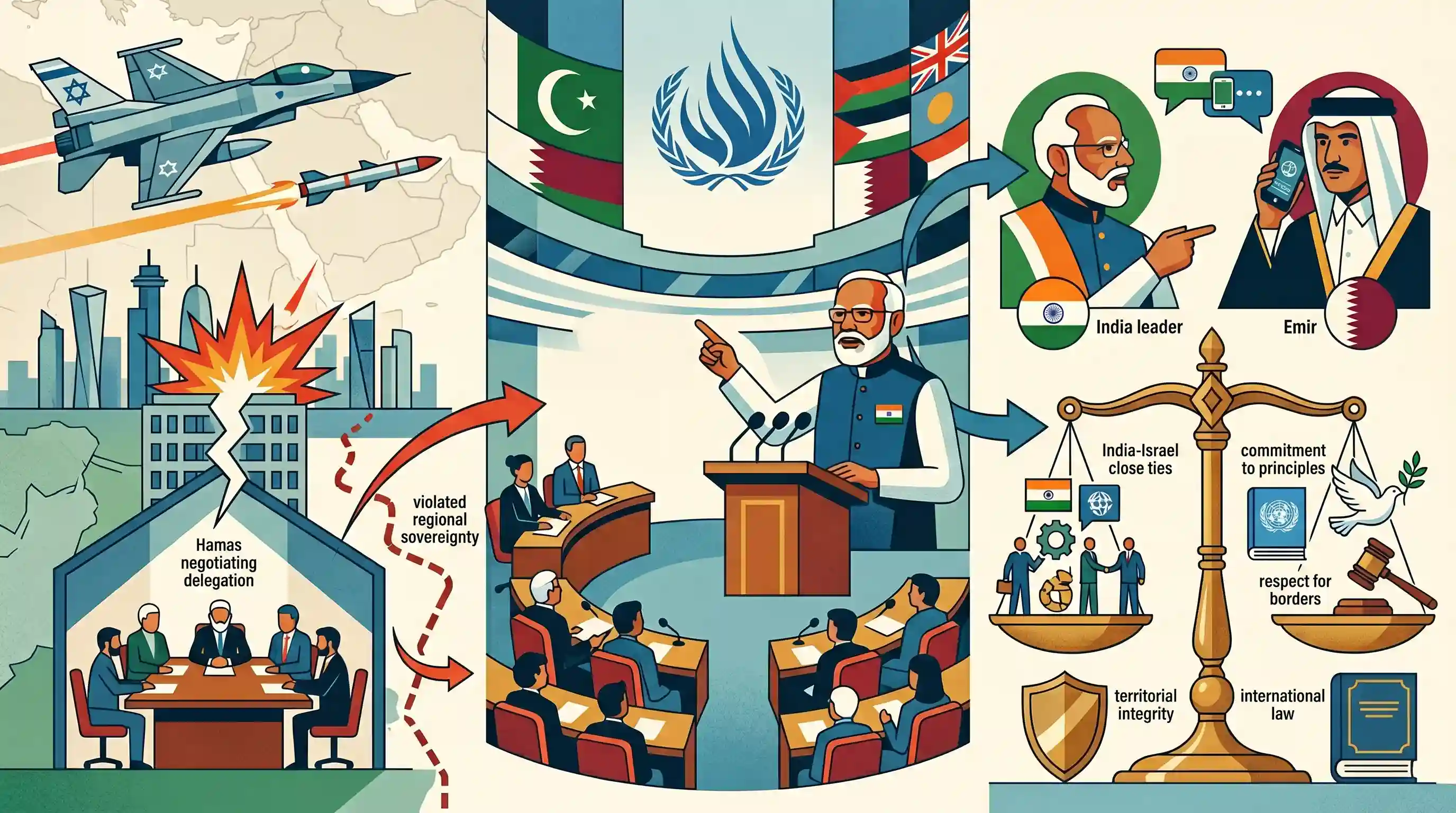
This event illustrates the nuances of India's foreign policy in West Asia, demonstrating how New Delhi balances its robust strategic partnership with Israel alongside its principled stance on state sovereignty, international law, and its relationships with pivotal Arab states like Qatar.
Summary
At the UN Human Rights Council (UNHRC), India officially condemned the recent violation of Qatar's sovereignty, referring to an Israeli bombing in Doha that targeted a Hamas negotiating delegation. India's Permanent Representative, Arindam Bagchi, emphasized that such actions undermine regional mediation efforts regarding the Gaza conflict and constitute a serious escalation. Prime Minister Narendra Modi also conveyed this position directly to Qatar's Emir, balancing India's close ties with Israel against its commitment to international law, territorial integrity, and peaceful dispute resolution.
Key Points
- India strongly condemned the violation of Qatar's sovereignty following an Israeli bombing in Doha on September 9.
- The condemnation was delivered by India's Permanent Representative to the UN, Arindam Bagchi, at the UN Human Rights Council (UNHRC).
- The attack targeted the Hamas negotiating team hosted in Doha, undermining Qatar's critical role in mediating the Gaza war.
- Prime Minister Narendra Modi personally communicated India's stance to Qatar's ruler, Sheikh Tamim Bin Hamad Al-Thani, reaffirming India's commitment to territorial integrity.
- The incident prompted the Organisation of Islamic Cooperation (OIC) to host an emergency Arab-Islamic summit in response to the escalation.
Important Terms
UNHRC (United Nations Human Rights Council)

A 47-member UN intergovernmental body based in Geneva that promotes global human rights and monitors violations through the Universal Periodic Review (UPR).
UPSC context
GS Paper II: International Relations/Multilateralism. Tests knowledge of global governance, human rights diplomacy, and India's re-election for the 2026-28 term.
Organisation of Islamic Cooperation (OIC)
The second-largest intergovernmental organization (57 members) after the UN, headquartered in Jeddah, serving as the "collective voice of the Muslim world" to safeguard Islamic interests.
UPSC context
GS Paper II: Regional Groupings. Tests India’s complex relations with the Islamic world, its status as a non-member, and managing the OIC's stance on Kashmir.
Hamas
A Palestinian Sunni-Islamic militant and political organization that has governed the Gaza Strip since 2007; it is designated as a terrorist group by several nations but remains a key negotiator.
UPSC context
GS Paper II: West Asia Relations. Crucial for understanding the Israel-Palestine conflict, India’s de-hyphenated foreign policy, and regional security dynamics.
Sovereignty
The supreme authority of a state to govern its own territory and affairs without external interference, a core principle of the UN Charter and international law.
UPSC context
GS Paper II: Foreign Policy/Polity. Central to the Preamble and Panchsheel principles; tests India’s stance on non-interference and global territorial disputes.
Territorial Integrity
A principle of international law stating that a nation's borders are inviolable and should not be altered by force or external aggression.
UPSC context
GS Paper II: IR/Security. Vital for India’s position on border disputes (LAC/LoC) and its commitment to upholding international law in global conflicts.
Mediation (International Relations)
A diplomatic process where a neutral third party facilitates negotiations between conflicting sides to reach a peaceful settlement, often practiced by Qatar in West Asian disputes.
UPSC context
GS Paper II: IR. Tests understanding of peaceful dispute resolution mechanisms and India’s preference for dialogue-based solutions in volatile regions like the Middle East.
Prelims Trap
"The UN Human Rights Council is one of the six principal organs of the United Nations."
It is a subsidiary organ created by the UN General Assembly in 2006, replacing the UN Commission on Human Rights. It is not a principal UN organ.
Static Concepts Connected
How is the UN Human Rights Council (UNHRC) structured?
- Membership: 47 member states elected directly and individually by secret ballot by the majority of the UN General Assembly.
- Term limits: Members serve three-year terms and are not eligible for immediate re-election after serving two consecutive terms.
- Key mechanism: Conducts the Universal Periodic Review (UPR) to assess human rights situations in all UN Member States.
What is India's 'De-hyphenation' policy in West Asia?
- Independent evaluation: Maintaining independent, mutually exclusive relationships with rival nations (e.g., Israel and Palestine/Arab states) based purely on national interest rather than zero-sum bloc politics.
- Strategic autonomy: Allows India to buy critical defense tech from Israel while simultaneously securing LNG from Qatar and defending its territorial sovereignty on global platforms.
Cross-Topic Patterns
West Asia Geopolitics & LNG Security
India's defense of Qatar’s sovereignty directly correlates with its energy security, as Qatar supplies over 40% of India's LNG. Foreign policy stances here are heavily shaped by critical energy dependencies.
Sovereignty vs. Extra-territorial Strikes
Israel's strike in Doha mirrors global debates on extra-territorial actions and targeted killings, testing the limits of Article 2(4) of the UN Charter regarding territorial integrity and state sovereignty.

Expect a multi-statement question on UNHRC composition/UPR alongside India’s 'de-hyphenation' policy in West Asia for Prelims 2026.
Linked PYQs · 4
Linked PYQs · 4
- 2018MainsGS2
“India’s relations with Israel have, of late, acquired a depth and diversity, which cannot be rolled back.” Discuss.
- 2023PrelimsGS1
Consider the following statements: Statement-I: Israel has established diplomatic relations with some Arab States. Statement-II: The 'Arab Peace Initiative' mediated by Saudi Arabia was signed by Israel and Arab League. Which one of the following is correct in respect of the above statements?
- 2018PrelimsGS1
The term "two-state solution" is sometimes mentioned in the news in the context of the affairs of
- 2007PrelimsGS1
Where are the headquarters of the Organization of the Islamic Conference (OIC) located?
