India positions itself as principal voice of Global South at UN
Source:The Hindu ↗
Why It Matters
India's focus on the Global South is a critical component of its contemporary foreign policy. It directly applies to GS Paper 2 (Bilateral, regional and global groupings and agreements involving India and/or affecting India's interests) and is essential for understanding India's arguments for UN reforms and its leadership role among developing nations.
Summary
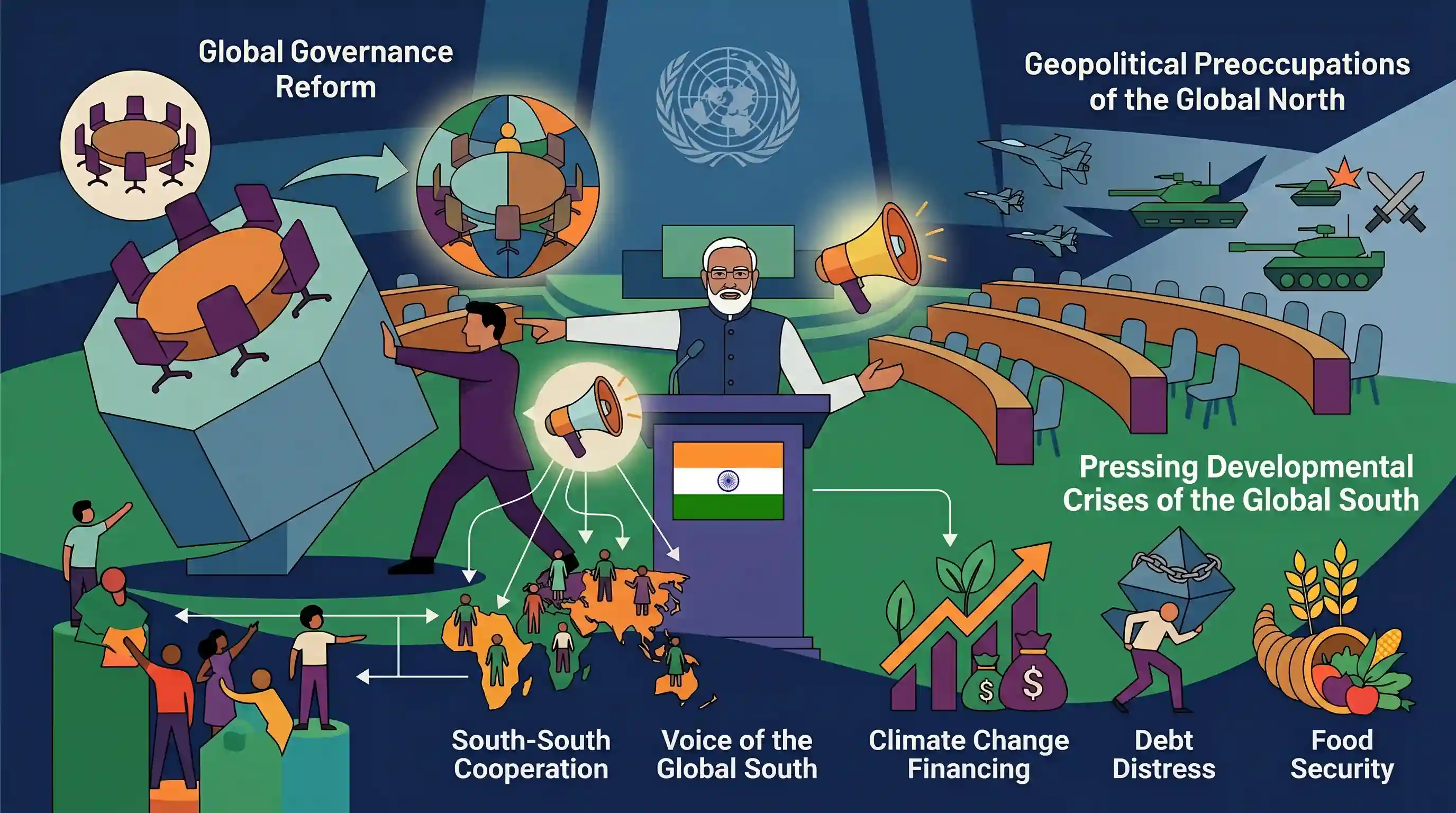
During the United Nations General Assembly (UNGA) week, India actively positioned itself as the definitive voice of the Global South, signaling a strategic diplomatic realignment. India emphasized that global governance structures, particularly the UN Security Council, are outdated and must be reformed to give adequate representation to developing nations. The diplomatic push focused on drawing global attention away from the geopolitical preoccupations of the Global North towards the pressing developmental crises facing the Global South, including climate change financing, debt distress, and food security. By championing South-South cooperation, India reinforced its leadership ambitions and its demand for a more equitable, multipolar world order.
Key Points
- India leveraged the UNGA session to solidify its role as the primary advocate for the Global South, bridging the gap between developing nations and the global order.
- New Delhi emphasized the urgent need for reforming multilateral institutions like the UN Security Council to ensure equitable representation for developing countries.
- The diplomatic signaling prioritized existential issues of the developing world, such as climate finance, sustainable development, and debt relief, over the geopolitical conflicts driven by the Global North.
- India's engagement reflects a strategic realignment to champion South-South cooperation and promote a multipolar world order.
Important Terms
Global South

A geopolitical term for developing nations in Asia, Africa, and Latin America characterized by shared histories of colonization and socio-economic challenges.
UPSC context
GS Paper 2: International Relations; tests India’s leadership role and agreements affecting its interests.
South-South Cooperation
The mutual exchange of resources, technology, and knowledge among developing nations to achieve collective self-reliance and sustainable development.
UPSC context
GS Paper 2: Multilateral groupings; tests understanding of developmental diplomacy and non-Western cooperation frameworks.
United Nations General Assembly (UNGA)
The UN’s primary deliberative and policy-making organ where all 193 member states have equal representation and voting power.
UPSC context
GS Paper 2: Important International institutions; tests knowledge of global representative forums.
United Nations Security Council (UNSC)
The UN organ responsible for international peace and security, featuring five permanent members with veto power and ten rotating members.
UPSC context
GS Paper 2: Global governance reform; focuses on India’s bid for permanent membership.
Multilateralism
Cooperation between three or more nations to address global issues through shared rules and institutional frameworks like the UN.
UPSC context
GS Paper 2: International Relations; tests ability to analyze shifts in global decision-making structures.
Multipolar World Order
A global order where power and influence are distributed among multiple major states rather than dominated by a single superpower.
UPSC context
GS Paper 2: Global power dynamics; relevant for India’s strategic autonomy and foreign policy goals.
Prelims Trap
The 'Global South' comprises all developing and under-developed nations located geographically in the Southern Hemisphere.
Global South is a socio-economic and geopolitical grouping, not geographical. India and China are in the Northern Hemisphere; Australia and New Zealand are in the Southern Hemisphere but belong to the Global North.
Static Concepts Connected
What are the core principles of South-South Cooperation?
- Equality: Based on solidarity and shared historical experiences, devoid of traditional donor-recipient hierarchies.
- Non-interference: Strict respect for national sovereignty with zero policy conditionalities attached to aid or resource sharing.
- Mutual Benefit: Focuses on mutual capacity building through the exchange of technology, knowledge, and resources.
What is the Ezulwini Consensus?
- African Union pact: A unified position adopted by the African Union in 2005 regarding the reform of the United Nations.
- UNSC Representation: Demands at least two permanent seats (with veto power) and five non-permanent seats for Africa in the UN Security Council.
- Correcting imbalance: Highlights the structural imbalance of the P5 and serves as a major talking point for Global South nations demanding equitable global governance.
Cross-Topic Patterns
Global South & Climate Justice linkages
India's diplomatic shift ties UN reform to climate finance (CBDR principle) and debt restructuring, moving away from pure geopolitics to address the existential economic crises of developing nations.
Evolution from NAM to VOGSS
India's traditional non-alignment has morphed into proactive agenda-setting. Platforms like the Voice of Global South Summit (VOGSS) and DAKSHIN show India leading the bloc rather than just abstaining from Western alliances.

Expect a 2026 Prelims question mapping UN reform proposals (Ezulwini Consensus) to India-led platforms like DAKSHIN and VOGSS.
Linked PYQs · 3
Linked PYQs · 3
- 2025MainsGS2
"The reform process in the United Nations remains unresolved, because of the delicate imbalance of East and West and entanglement of the USA vs. Russo-Chinese alliance.” Examine and critically evaluate the East-West policy confrontations in this regard.
- 2025MainsGS2
India-Africa digital partnership is achieving mutual respect, co-development and long-term institutional partnerships. Elaborate.
- 2022PrelimsGS1
With reference to the United Nations General Assembly, consider the following statements: 1. The UN General Assembly can grant observer status to the non-member States. 2. Inter-governmental organisations can seek observer status in the UN General Assembly. 3. Permanent Observers in the UN General Assembly can maintain missions at the UN headquarters. Which of the statements given above are correct?
