United Nations General Assembly Climate Justice and CBDR
Source:Indian Express ↗
Why It Matters
The editorial provides critical insights into India\'s stance at international climate negotiations (UNFCCC, UNGA). It underscores the tension between developmental imperatives of the Global South and the push for legally binding global mitigation efforts without adequate climate finance, which is highly relevant for GS-2 (International Relations) and GS-3 (Environment and Ecology) mains questions.
Summary
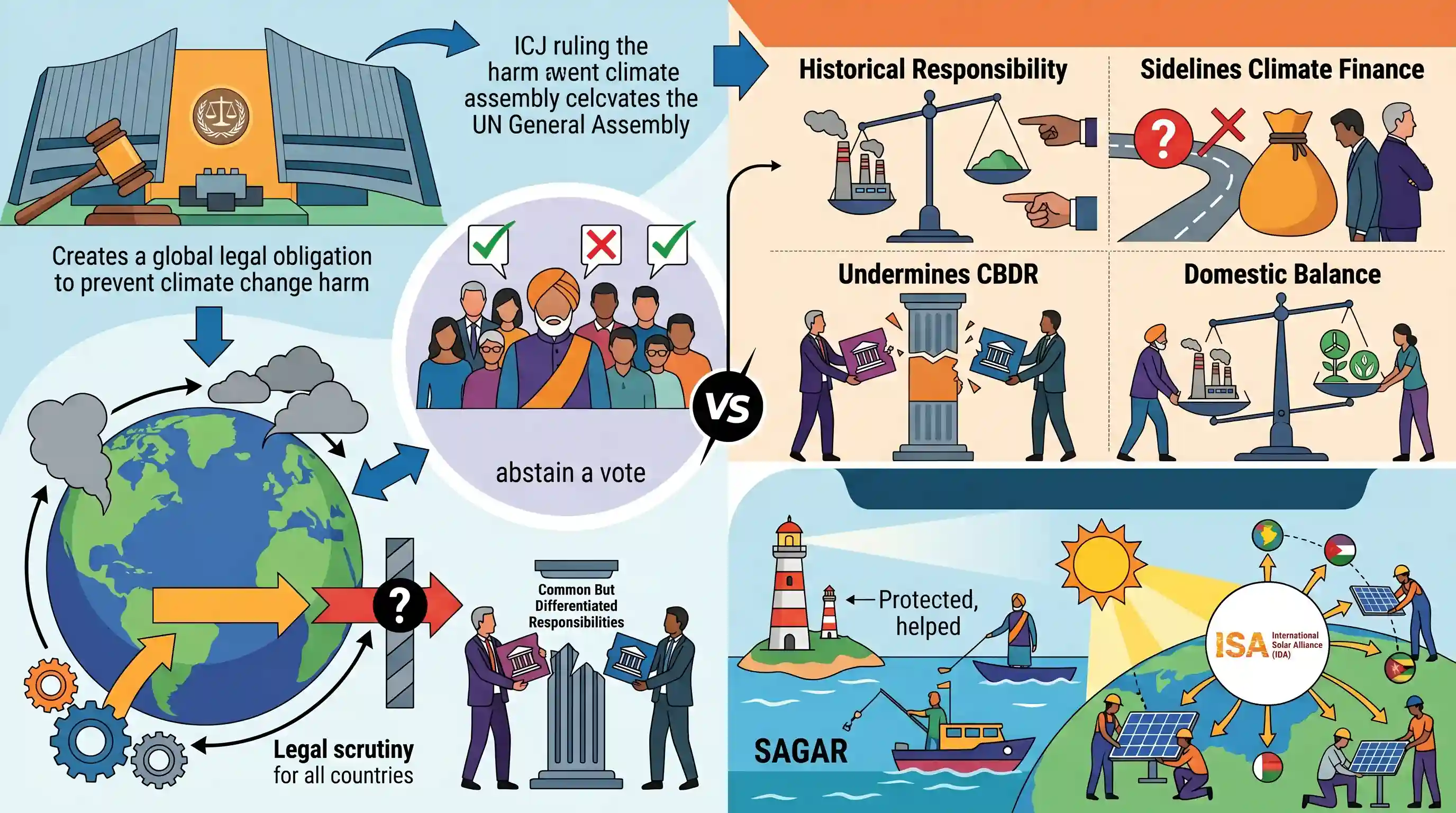
The UN General Assembly (UNGA) passed a resolution based on an ICJ ruling that obligates countries to prevent climate change harm, shifting the global climate debate by legally underpinning mitigation efforts. However, India and 27 other countries abstained from voting. India argued that the resolution ignores the historical responsibilities of industrialized nations and completely sidelines climate finance. By allowing legal scrutiny of mitigation plans without holding developed nations financially accountable, the resolution undermines the principle of Common But Differentiated Responsibilities (CBDR). Despite its abstention, India maintains its commitment to small island states through initiatives like SAGAR and the International Solar Alliance, while balancing its green transition targets with its domestic economic and developmental needs.
Key Points
- The UN General Assembly passed a resolution obligating countries to prevent harm from climate change, effectively shifting mitigation from a voluntary basis to a more legally scrutinized framework.
- India and 27 other nations abstained from the vote, citing the resolution\'s failure to account for historical emissions and the developmental needs of emerging economies.
- The resolution is notably silent on climate finance, opening up developing nations\' climate plans to legal scrutiny without auditing the financial commitments of industrialized countries.
- This undermines the foundational climate negotiation principle of Common But Differentiated Responsibilities (CBDR).
- Despite abstaining, India remains committed to vulnerable small island states through initiatives like SAGAR and the International Solar Alliance, and continues to meet its Paris Agreement targets.
Important Terms
Common But Differentiated Responsibilities (CBDR)

A principle in international law acknowledging that all states share responsibility for environmental protection, but obligations differ based on historical contributions and economic/technological capacities.
UPSC context
GS3 (Environment). Essential for understanding climate equity and India's stance in global negotiations.
Climate Finance
Local, national, or transnational funding from public and private sources intended to support mitigation and adaptation actions that address climate change in developing nations.
UPSC context
GS3 (Economy/Environment). Tests knowledge of funding gaps and the $100 billion annual commitment.
International Solar Alliance (ISA)
A treaty-based intergovernmental organization launched by India and France in 2015 to promote solar energy deployment and reduce fossil fuel dependence globally.
UPSC context
GS2/GS3 (IR/Energy). Tests India's leadership in renewable energy and South-South cooperation.
SAGAR (Security and Growth for All in the Region)
India’s strategic maritime vision for the Indian Ocean Region, emphasizing cooperative security, sustainable development, and humanitarian assistance to ensure regional stability.
UPSC context
GS2 (International Relations). Tests India's maritime diplomacy and regional security role.
International Court of Justice (ICJ)
The UN's principal judicial organ that resolves legal disputes between states and provides advisory opinions on international law, including state climate obligations.
UPSC context
GS2 (International Institutions). Tests the role of international law in defining state environmental liabilities.
UNFCCC
The primary 1992 multilateral treaty established to stabilize greenhouse gas concentrations; it serves as the foundational framework for global climate negotiations.
UPSC context
GS3 (Environment). Foundational for understanding global environmental governance and annual COP processes.
Prelims Trap
"The UNGA resolution makes climate mitigation legally binding on all members, overriding the CBDR principle."
UNGA resolutions are recommendatory, not legally binding. Furthermore, the resolution does not legally replace UNFCCC or CBDR; India abstained precisely to prevent customary international law from overriding CBDR.
Static Concepts Connected
What is the CBDR-RC principle in climate negotiations?
- Origin: Formalized at the 1992 Rio Earth Summit and enshrined as a guiding principle in the UNFCCC framework.
- Core Philosophy: Acknowledges that while all nations must address climate change, developed nations bear a greater burden due to their historical greenhouse gas emissions.
- Application: Anchors the Paris Agreement, ensuring developing countries retain policy space to set voluntary targets (NDCs) aligned with their developmental needs.
How does the ICJ's Advisory Jurisdiction function?
- Authorization: The UN General Assembly, UN Security Council, and authorized specialized UN agencies can request advisory opinions on legal questions.
- Legal Status: Unlike judgments in contentious cases between states, advisory opinions are not legally binding, though they carry immense moral and customary legal weight.
Cross-Topic Patterns
Climate Diplomacy vs Maritime Geopolitics
India balances opposing a Vanuatu-led UNGA resolution to protect its economic interests, while separately aiding Small Island Developing States (SIDS) through the SAGAR doctrine and International Solar Alliance (ISA).
Legal mandates vs Climate Finance (NCQG)
Developed nations increasingly leverage international legal frameworks (like ICJ/UNGA) to enforce mitigation, while systematically deflecting legally binding targets for climate finance and technology transfer.

India’s UNGA abstention to protect CBDR, linked with ICJ advisory powers and SIDS diplomacy, is a high-probability 2026 prelims target.
Linked PYQs · 5
Linked PYQs · 5
- 2025MainsGS3
Write a review on India's climate commitments under the Paris Agreement (2015) and mention how these have been further strengthened in COP26 (2021). In this direction, how has the first Nationally Determined Contribution intended by India been updated in 2022?
- 2022MainsGS2
‘Clean energy is the order of the day.’ Describe briefly India's changing policy towards climate change in various international fora in the context of geopolitics.
- 2020MainsGS3
Explain intra-generational and inter-generational issues of equity from the perspective of inclusive growth and sustainable development.
- 2025PrelimsGS1
Consider the following statements : Statement I: Article 6 of the Paris Agreement on climate change is frequently discussed in global discussions on sustainable development and climate change. Statement II: Article 6 of the Paris Agreement on climate change sets out the principles of carbon markets. Statement III : Article 6 of the Paris Agreement on climate change intends to promote inter-country non-market strategies to reach their climate targets. Which one of the following is correct in respect of the above statements?
- 2022PrelimsGS1
"Climate Action Tracker" which monitors the emission reduction pledges of different countries is a :
