US Tariffs on Russian Oil Purchases Strain Bilateral Relations
Source:The Hindu ↗
Why It Matters
The escalating tariff war and U.S. pressure over Russian oil purchases highlight the delicate balance India must maintain in its strategic autonomy and foreign policy. It touches directly upon GS-2 (International Relations) regarding bilateral ties and GS-3 (Economy) concerning protectionism, trade wars, and the geopolitical dimensions of energy security and reserve currencies.
Summary
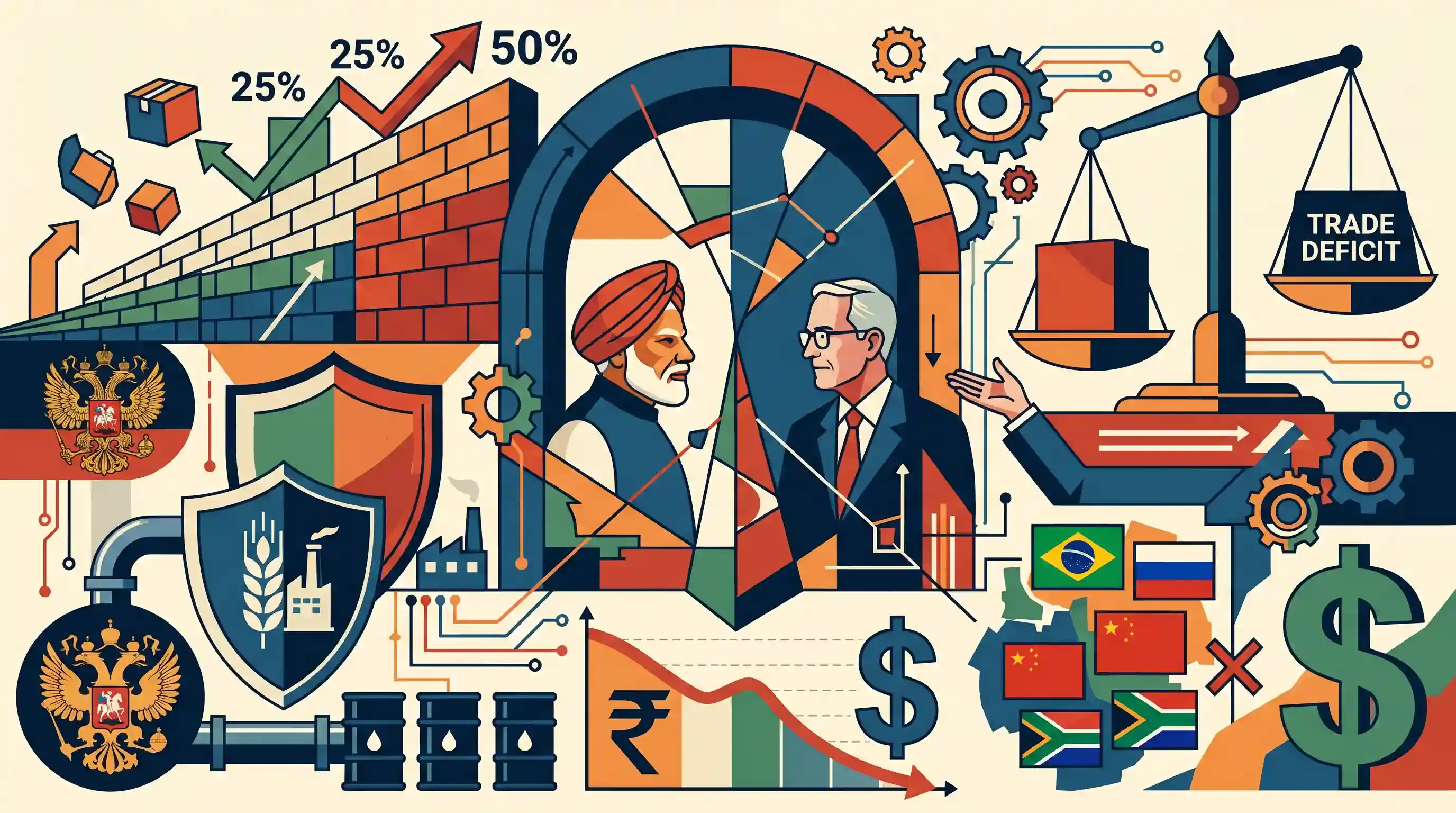
U.S. Treasury Secretary Scott Bessent acknowledged the "very complicated" nature of India-U.S. relations amid escalating trade tensions but expressed optimism for a resolution. The dispute centers around a new 25% U.S. tariff—bringing the total to 50%—on India for its continued purchase of Russian crude oil. In response, PM Narendra Modi has maintained a firm stance, refusing to compromise India's domestic agricultural and industrial interests. The U.S. considers its trade deficit with India as a strategic advantage in negotiations. Additionally, Bessent downplayed the threat of rupee internationalization within BRICS due to the Indian currency's current weakness against the dollar.
Key Points
- U.S. Treasury Secretary Scott Bessent stated that the India-U.S. relationship is 'complicated', but expressed hope for a resolution to the ongoing tariff dispute.
- The U.S. recently imposed an additional 25% tariff (bringing total levies to 50%) targeting India's purchase of Russian crude oil.
- Indian PM Narendra Modi asserted that India will not compromise on the interests of its farmers, cattle-rearers, and small-scale industries despite external pressure.
- The U.S. believes its position as a deficit country in the bilateral trade relationship gives it leverage in the ongoing trade dispute.
- Bessent dismissed concerns over India’s push for rupee-based trading within BRICS, citing the rupee's near all-time low against the US dollar.
Important Terms
Reciprocal Tariffs

Import duties imposed by a country in direct response to tariffs levied on its exports by a trading partner to ensure trade "fairness."
UPSC context
GS Paper 2 & 3; tests understanding of economic nationalism and the shift from multilateral to bilateral trade norms.
Rupee Internationalization
The process of increasing the Indian Rupee's acceptance for cross-border transactions, trade invoicing, and as a global reserve currency to reduce dollar dependence.
UPSC context
GS Paper 3 (Economy); relevant for topics on external sector, exchange rate stability, and financial sovereignty.
Trade Deficit
An economic condition where the value of a country's imports exceeds its exports; often used as a strategic bargaining chip in trade negotiations.
UPSC context
GS Paper 3; crucial for analyzing the Current Account Deficit (CAD) and India's bilateral trade balance with major partners.
BRICS
A grouping of major emerging economies (Brazil, Russia, India, China, South Africa) aimed at enhancing South-South cooperation and reforming global governance.
UPSC context
GS Paper 2; focuses on regional and global groupings and their impact on India’s foreign policy interests.
Protectionism
Economic policy of shielding domestic industries from foreign competition through methods like high tariffs, quotas, or restrictive regulations.
UPSC context
GS Paper 3; tests the impact of global trade wars on India's industrial growth and export competitiveness.
Strategic Autonomy
A nation's ability to pursue independent foreign and economic policies based on national interest without being coerced by other global powers.
UPSC context
GS Paper 2; core concept in Indian diplomacy, particularly regarding balancing relations between the U.S. and Russia.
Prelims Trap
"India runs a structural merchandise trade deficit with the United States."
India actually maintains a persistent merchandise trade surplus with the US. The US leverages this deficit position to demand greater market access from India.
Static Concepts Connected
What are the primary macroeconomic prerequisites for internationalising the Indian Rupee?
- Capital Convertibility: Full or substantial capital account convertibility to allow seamless cross-border financial flows without stringent regulatory bottlenecks.
- Exchange Rate Stability: Minimal volatility against major global currencies to ensure trading partners trust the Rupee as a reliable store of value over time.
- Deep Bond Markets: Highly liquid and deep domestic financial markets to provide foreign entities safe and profitable avenues to invest their accumulated Rupee surpluses.
How do unilateral tariffs differ from standard WTO trade remedy measures?
- WTO Remedies: Anti-dumping, countervailing, and safeguard duties are legal, rule-based measures explicitly permitted by the WTO to counter unfair trade practices or import surges.
- Unilateral Tariffs: Punitive levies applied by a single nation (often for geopolitical leverage or political disputes) operating entirely outside the WTO dispute settlement authorization.
Cross-Topic Patterns
Strategic autonomy in energy procurement
India's refusal to halt Russian crude purchases despite punitive U.S. tariffs showcases how energy security imperatives actively dictate India's non-alignment and strategic autonomy doctrine.
Macro constraints on BRICS de-dollarisation
Structural currency weakness in emerging markets heavily restricts the viability of local currency settlement (LCS) frameworks, stalling broader BRICS de-dollarisation ambitions.

Expect a multi-statement Prelims question linking bilateral trade balances, rupee depreciation, and mechanisms of currency internationalisation.
Linked PYQs · 4
Linked PYQs · 4
- 2018MainsGS3
How would the recent phenomena of protectionism and currency manipulations in world trade affect macroeconomic stability of India?
- 2025MainsGS3
What are the challenges before the Indian economy when the world is moving away from free trade and multilateralism to protectionism and bilateralism? How can these challenges be met?
- 2019MainsGS2
‘What introduces friction into the ties between India and the United States is that Washington is still unable to find for India a position in its global strategy, which would satisfy India's national self-esteem and ambitions.’ Explain with suitable examples.
- 2021PrelimsGS1
Consider the following statements : The effect of devaluation of a currency is that it necessarily 1. improves the competitiveness of the domestic exports in the foreign markets 2. increases the foreign value of domestic currency 3. improves the trade balance Which of the above statements is/are correct?
