Indian Navy Project 17A and Defence Indigenisation Challenges
Source:The Hindu ↗
Why It Matters
The article critically evaluates India's defence manufacturing capabilities and strategic preparedness. It provides vital insights for GS-3 answers on defence indigenisation, showing that high 'indigenous content by value' masks dangerous dependencies on imported critical technologies, directly impacting national security and maritime dominance.
Summary
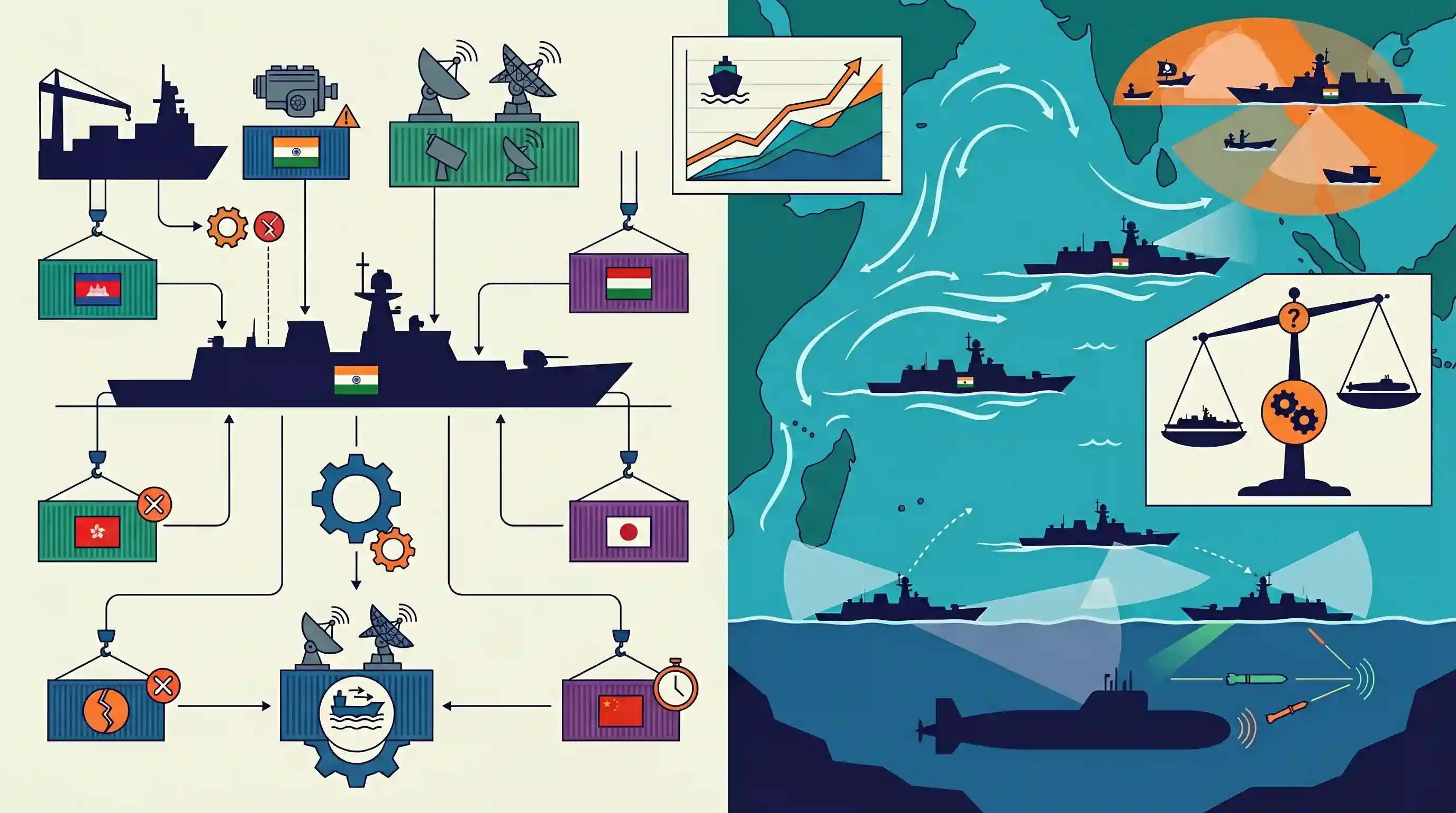
The Indian Navy's Project 17A highlights structural flaws in India's defence indigenisation and naval modernisation strategies. While the delivery of ships like INS Mahendragiri progresses, critical components such as engines and sensors remain heavily import-dependent, causing severe delays and resulting in platforms being inducted without full combat readiness. Furthermore, there is a strategic mismatch between the expanded surface frigate fleet and the actual threat matrix in the Indian Ocean. These platforms are considered overkill for countering piracy and smuggling, yet they lack the advanced sensor capabilities required to effectively monitor the growing presence of Chinese submarines, pointing to investments that do not align with evolving maritime security needs.
Key Points
- Project 17A is a ₹45,000-crore initiative to build seven 'Nilgiri'-class frigates for the Indian Navy, with the recent delivery of INS Mahendragiri highlighting a history of delays.
- A 2025 CAG report flagged systemic inefficiencies, noting that platforms are often inducted on paper to meet deadlines while lacking critical combat components and supporting infrastructure.
- While ships report 75% indigenous content by value, critical technologies like engines, radars, and sonars remain heavily dependent on imports, leading to integration bottlenecks.
- The current procurement strategy is criticized as being out of step with the threat environment; high-end frigates are overkill for non-traditional threats like piracy and smuggling, yet lack the necessary advanced sensors to track Chinese submarines.
- The regional sensor grid (Chain of Static Sensors), spanning Mauritius, Sri Lanka, and Seychelles, remains compromised by incomplete coverage, overdue upgrades, and reliance on imported hardware.
Important Terms
Project 17A

An Indian Navy program to build seven 'Nilgiri-class' stealth guided-missile frigates. It uses modular construction and aims for 75% indigenisation, following the Shivalik-class design.
UPSC context
GS Paper III: Indigenisation of technology and defence manufacturing; tests understanding of naval modernisation and strategic self-reliance.
Project 17B
A planned follow-on to Project 17A, recently cleared by the Defence Acquisition Council to build 7-8 Next Generation Frigates (NGF) with advanced indigenous firepower.
UPSC context
GS Paper III: Defence procurement and infrastructure; relevant for tracking the evolution of India's maritime combat fleet.
Chain of Static Sensors
A coastal surveillance network of radar stations established post-26/11 to provide real-time maritime domain awareness and electronic monitoring along India’s coastline and island territories.
UPSC context
GS Paper III: Internal Security (Coastal Security); tests knowledge of Maritime Domain Awareness (MDA) and technology in security.
Comptroller and Auditor General (CAG) of India
The constitutional authority (Article 148) responsible for auditing all government expenditures. It flags inefficiencies, cost overruns, and readiness issues in major defence projects.
UPSC context
GS Paper II: Statutory/Regulatory bodies; GS Paper III: Accountability in defence management and resource allocation.
People's Liberation Army Navy (PLAN)
The naval branch of the Chinese military. Its expanding presence and submarine deployments in the Indian Ocean Region (IOR) are key strategic challenges for India.
UPSC context
GS Paper II: International Relations (India-China); GS Paper III: External security challenges and the Indian Ocean power balance.
Indian Coast Guard (ICG)
A multi-mission armed force under the Ministry of Defence, tasked with maritime law enforcement, coastal security, and search and rescue in India's EEZ.
UPSC context
GS Paper III: Various Security forces and agencies and their mandate; crucial for coastal security and disaster management.
Prelims Trap
Project 17A frigates feature entirely indigenous critical combat technologies, marking full self-reliance in naval manufacturing.
While Project 17A boasts 75% indigenous content by value (largely hull and steel), critical technologies like gas turbine engines and sonars remain heavily import-dependent.
Static Concepts Connected
What are the key Indian Navy modernization projects?
- Project 17A: Nilgiri-class stealth guided-missile frigates (follow-on to Project 17 Shivalik-class) being built at MDL and GRSE.
- Project 15B: Visakhapatnam-class stealth guided-missile destroyers featuring advanced indigenous weapons like BrahMos.
- Project 75/75I: Kalvari-class conventional diesel-electric submarines (75) and next-gen Air-Independent Propulsion (AIP) submarines (75I).
What is India's Coastal Surveillance Radar System (CSRS)?
- Core Objective: Establishes a regional sensor grid to enhance Maritime Domain Awareness (MDA) across the Indian Ocean Region.
- Littoral Coverage: Spans India's coastline and strategic island partners including Mauritius, Seychelles, Sri Lanka, and the Maldives.
- Data Integration: Feeds real-time coastal radar data to the Information Management and Analysis Centre (IMAC) in Gurugram.
Cross-Topic Patterns
Defence Procurement vs. String of Pearls
Deploying heavy frigates instead of specialized anti-submarine warfare (ASW) assets highlights a strategic lag in countering China's undersea expansion in the IOR.
CAG Audits & Defence Deficits
CAG's exposure of 'paper commissioning' mirrors past audits that repeatedly highlighted critical shortages in ammunition and delays in offset contract executions.

Expect a Prelims match-the-following on naval projects (17A/15B/75I), or a Mains Q on the 'indigenisation by value vs capability' gap.
Linked PYQs · 3
Linked PYQs · 3
- 2022MainsGS3
What are the maritime security challenges in India ? Discuss the organisational, technical and procedural initiatives taken to improve the maritime security.
- 2025MainsGS3
Why is maritime security vital to protect India's sea trade? Discuss maritime and coastal security challenges and the way forward.
- 2024MainsGS3
Industrial pollution of river water is a significant environmental issue in India. Discuss the various mitigation measures to deal with this problem and also the government's initiatives in this regard.
