Uniform Civil Code exemption for Scheduled Tribes
Source:The Hindu ↗
Why It Matters
The applicability of the UCC to tribal communities with distinct customary laws is a major constitutional debate, touching upon Article 44 versus the autonomy granted under the 5th and 6th Schedules. Furthermore, the push for a religious criterion for ST status and demands to amend the PESA Act highlight critical socio-political dynamics regarding tribal identity, conversion, and local governance.
Summary
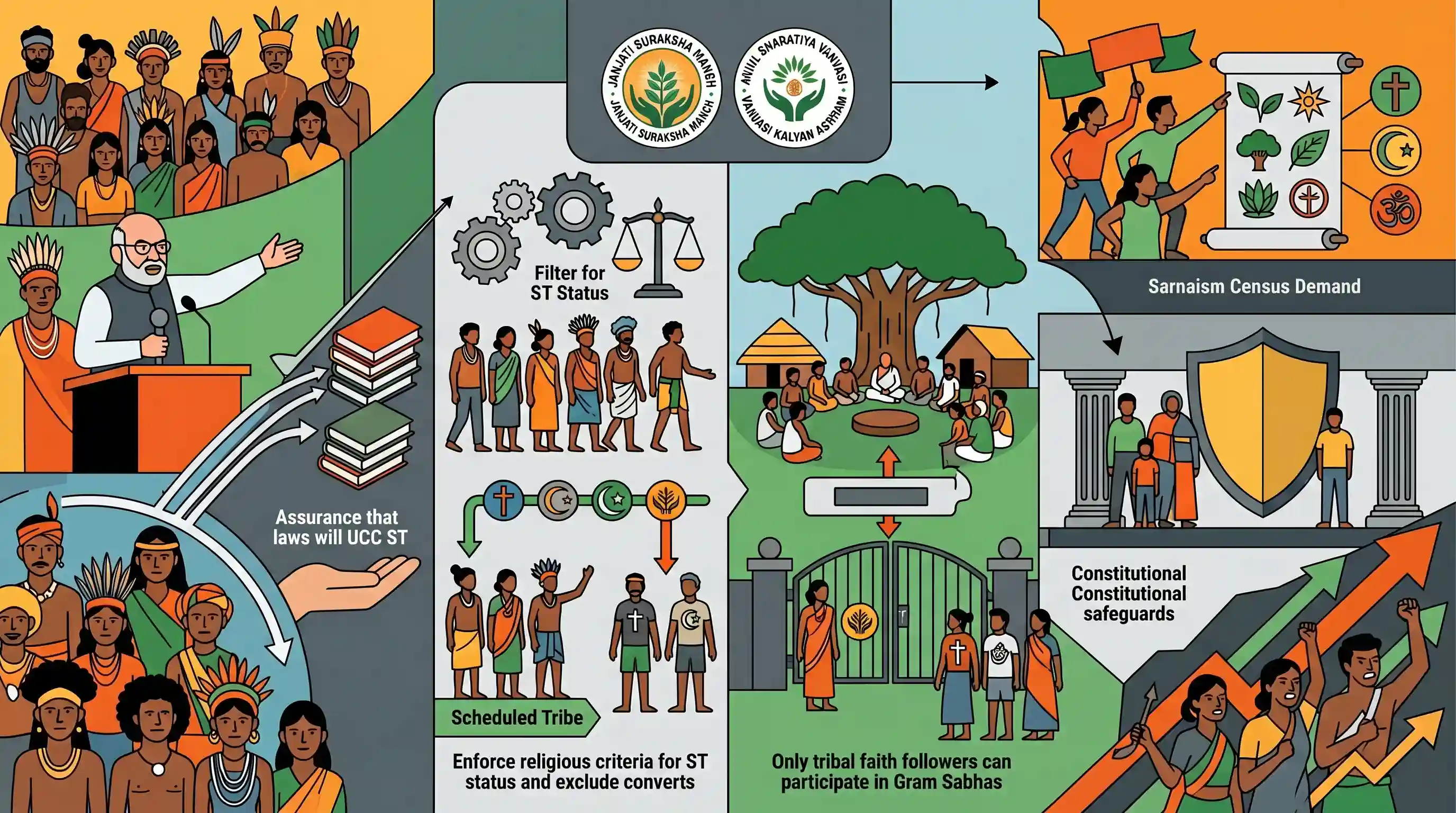
At the 'Janjati Mahakumbh' organized by Sangh Parivar affiliates, Union Home Minister Amit Shah assured tribal communities that the proposed Uniform Civil Code (UCC) will not apply to Scheduled Tribes (STs). The organizers, Janjati Suraksha Manch and Akhil Bharatiya Vanvasi Kalyan Ashram, pushed for constitutional amendments to enforce a religious criterion for ST status, similar to the provision for Scheduled Castes, which would exclude converts. They also sought amendments to the PESA Act to ensure only followers of tribal faith can participate in traditional Gram Sabhas. This comes amid growing demands from tribal communities for a separate religious code for Sarnaism in the Census.
Key Points
- Home Minister Amit Shah assured that the Uniform Civil Code (UCC) will not apply to Scheduled Tribes, addressing concerns about the erosion of tribal customs.
- Sangh Parivar affiliates JSM and ABVKA demanded constitutional amendments to introduce a religious criterion for ST classification, seeking to exclude converts from ST benefits.
- Demands were made to amend the PESA Act to restrict Gram Sabha membership in Scheduled Areas only to followers of the indigenous tribal faith and culture.
- Tribal groups are increasingly advocating for a separate religious code for their indigenous religion, Sarnaism, in the upcoming Census.
- The event invoked the legacy of Birsa Munda and his 'Ulgulan' (rebellion) to emphasize tribal pride and identity.
Important Terms
Uniform Civil Code (UCC)

A proposed common set of personal laws governing marriage, divorce, and inheritance for all citizens, irrespective of religion, as envisioned under Article 44 (DPSP).
UPSC context
GS Paper 2: Indian Constitution and Governance. Tests understanding of secularism, gender justice, and federalism.
PESA Act, 1996
Legislation extending Panchayati Raj to Fifth Schedule areas, empowering Gram Sabhas to manage natural resources and safeguard traditional tribal customs.
UPSC context
GS Paper 2: Governance/Local Self-Government. Tests knowledge of tribal self-rule and decentralization.
Sangh Parivar
The collective name for the network of organizations inspired by the Rashtriya Swayamsevak Sangh (RSS), influencing Indian social, cultural, and political spheres.
UPSC context
GS Paper 2: Pressure Groups and Formal/Informal Associations. Relevant for understanding socio-political influences on policy.
Janjati Suraksha Manch (JSM)
An RSS-affiliated organization advocating for 'delisting' tribal converts to Christianity or Islam from the Scheduled Tribes (ST) list to stop their reservation benefits.
UPSC context
GS Paper 2: Welfare schemes for vulnerable sections. Tests issues regarding tribal identity and constitutional criteria for ST status.
Akhil Bharatiya Vanvasi Kalyan Ashram (ABVKA)
The tribal welfare wing of the Sangh Parivar, established in 1952 to promote education and health while preserving traditional tribal culture against religious conversions.
UPSC context
GS Paper 1: Social Empowerment. Tests understanding of tribal welfare organizations and social assimilation efforts.
Delisting Demand
The controversial demand to exclude tribal individuals who convert to Christianity or Islam from the Scheduled Tribes list, citing Article 341-like restrictions for SCs.
UPSC context
GS Paper 2: Indian Constitution (Article 342). Tests legal and ethical complexities of tribal reservation and religious conversion.
Sarnaism (Sarna Code)
A distinct nature-worshipping faith practiced by several tribal communities (e.g., Santhals, Oraons), for which a separate census religion code is being demanded.
UPSC context
GS Paper 1: Indian Culture/Sociology. Tests knowledge of indigenous religious identities and census classification issues.
Prelims Trap
Like Scheduled Castes, Scheduled Tribe status is constitutionally restricted to individuals professing Hinduism, Sikhism, or Buddhism.
SC classification is restricted to Hinduism, Sikhism, and Buddhism. However, ST classification is entirely religion-neutral. Converts do not lose ST status under the Constitution.
Static Concepts Connected
What are the criteria for specifying a community as a Scheduled Tribe (ST)?
- Lokur Committee: The Lokur Committee (1965) established the foundational criteria still used by the government today to define Scheduled Tribes.
- Five Traits: Indications of primitive traits, distinctive culture, geographical isolation, shyness of contact with the community at large, and overall backwardness.
- Religion Neutrality: Unlike Scheduled Castes (SCs), ST status is purely ethnological and religion-neutral. An individual can follow any faith and remain an ST.
How does the Constitution protect tribal customary laws from uniform parliamentary legislation?
- Article 371 Exceptions: Articles 371A (Nagaland) and 371G (Mizoram) prohibit Parliament from legislating on customary law and social practices without State Assembly approval.
- Sixth Schedule: Grants Autonomous District Councils (ADCs) in Assam, Meghalaya, Tripura, and Mizoram legislative powers over marriage, inheritance, and social customs.
- PESA Act 1996: Empowers Gram Sabhas in Fifth Schedule areas to safeguard and preserve the traditions, customs, and cultural identity of the people.
Cross-Topic Patterns
UCC vs. Asymmetric Federalism
The push for a UCC clashes directly with special protections under Articles 371A/371G and Sixth Schedule areas, highlighting the constitutional tension between uniform civil laws and asymmetric federalism.
Ulgulan to modern identity movements
Agrarian tribal revolts like Birsa Munda's Ulgulan (1899) are increasingly invoked in modern socio-political movements demanding distinct census codes (Sarna) and exclusive Gram Sabha rights.

Expect a 2026 multi-statement Prelims question comparing religion-neutral ST criteria with religion-specific SC criteria and PESA powers.
Linked PYQs · 3
Linked PYQs · 3
- 2020PrelimsGS1
With reference to the history of India, "Ulgulan" or the Great Tumult is the description of which of the following events?
- 2013PrelimsGS1
The Government enacted the Panchayat Extension to Scheduled Areas (PESA) Act in 1996. Which one of the following is not identified as its objective?
- 2015MainsGS2
Discuss the possible factors that inhibit India from enacting for its citizens a uniform civil code as provided for in the Directive Principles of State Policy.
