Ethanol Blending and Infrastructure Growth in India Energy Strategy
Source:Indian Express ↗
Why It Matters
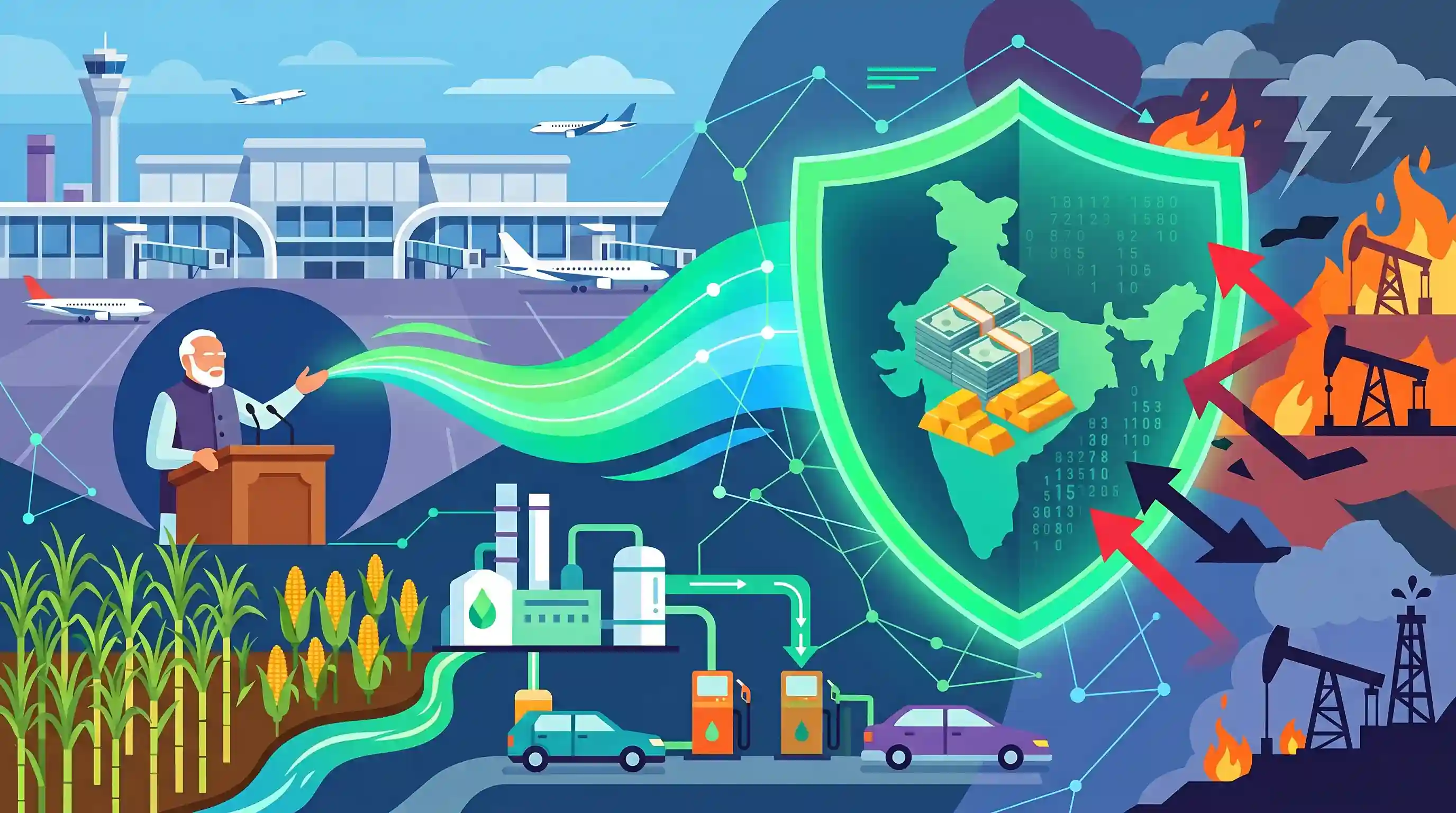
This article connects domestic renewable energy initiatives (ethanol blending) with macroeconomic stability (forex savings) and geopolitical resilience (insulation from West Asia energy shocks). It provides excellent fodder for Mains answers on energy security and the benefits of biofuels, while the Noida Airport launch ties into GS3 infrastructure and PPP themes.
Summary
At the inauguration of the Noida International Airport, Prime Minister Narendra Modi emphasized how India's strategic push for ethanol blending served as a critical buffer against global energy volatility amid the West Asia crisis. Highlighting that the blending initiative saved the exchequer Rs 1.5 lakh crore in foreign exchange, the PM framed biofuel adoption not just as a green energy measure, but as a core component of India's macroeconomic resilience and energy security. The new airport simultaneously reflects the government's continued focus on building mega-infrastructure to drive regional economic growth and connectivity.
Key Points
- Prime Minister Narendra Modi inaugurated the Noida International Airport, marking a significant milestone in India's aviation and regional infrastructure development.
- The PM highlighted that India's robust ethanol blending push successfully shielded the economy from severe global energy shocks induced by the West Asia crisis.
- The ethanol blending initiative has resulted in monumental foreign exchange savings, estimated at Rs 1.5 lakh crore, by reducing reliance on imported crude oil.
- The speech underscored the intersection of agricultural policy (biofuels), economic resilience (forex savings), and geopolitical strategy (insulation from supply chain disruptions).
Important Terms
Ethanol Blended Petrol (EBP) Programme

A government initiative to mix ethanol (bio-alcohol from biomass) with petrol, aimed at reducing crude oil import dependency, carbon emissions, and boosting farmer income.
UPSC context
GS Paper 3 (Economy & Environment); vital for energy security and Atmanirbhar Bharat (self-reliance) in the energy sector.
Noida International Airport (Jewar Airport)
A major greenfield airport in Jewar, Uttar Pradesh, designed to be India's largest. It follows a PPP model to boost regional logistics and decongest Delhi’s IGI Airport.
UPSC context
GS Paper 3 (Infrastructure); tests understanding of mega-infrastructure projects, public-private partnerships, and regional economic development.
Energy Security
The uninterrupted availability of energy sources at an affordable price, mitigating risks from global geopolitical volatility, such as supply disruptions in West Asia.
UPSC context
GS Paper 2 & 3; critical for national sovereignty and economic stability amid global supply chain shocks.
National Policy on Biofuels, 2018
A regulatory framework (amended in 2022) that advanced the 20% ethanol blending target (E20) to 2025-26 and expanded permitted feedstocks to include damaged food grains and maize.
UPSC context
GS Paper 3 (Environment/Energy); relevant for climate goals and diversifying the agricultural value chain.
Net Zero Emissions
A commitment to achieving a balance between greenhouse gases emitted and those removed from the atmosphere. India aims to reach this goal by 2070.
UPSC context
GS Paper 3 (Environment); central to India's 'Panchamrit' goals and international climate change negotiations.
Prelims Trap
"Ethanol production in India is strictly restricted to sugarcane molasses and non-food biomass to avoid food security risks."
False. The amended National Policy on Biofuels explicitly allows the use of surplus food grains (like maize and excess FCI rice) for ethanol production to ensure E20 targets are met.
Static Concepts Connected
What are the four generations of biofuels?
- First Generation (1G): Derived from traditional food crops (sugarcane, corn, starch).
- Second Generation (2G): Derived from non-food biomass and agricultural residue (lignocellulosic waste, stalks, wood chips).
- Third Generation (3G): Extracted from algae, yielding high energy per acre without requiring arable land.
- Fourth Generation (4G): Genetically engineered crops or microbes designed to consume extra carbon dioxide while producing fuel.
What defines a Greenfield airport and what is its FDI limit?
- Greenfield Definition: An aviation facility built from scratch on previously undeveloped land, unconstrained by existing infrastructure.
- FDI Limits: 100% Foreign Direct Investment is permitted under the automatic route for both Greenfield and Brownfield airport projects.
Cross-Topic Patterns
Biofuels & WTO Subsidy Limits
Diverting surplus grains for ethanol prevents FCI stock accumulation, indirectly supporting MSP procurement without breaching WTO's 10% de minimis limit on food subsidies.
Aerotropolis & PM Gati Shakti
Greenfield airports act as anchor nodes for regional economic integration, combining aviation logistics with surface transport corridors under the Gati Shakti Master Plan.

Expect a multi-statement 2026 Prelims question mixing E20 feedstock types (maize/FCI rice), amended target dates, and 100% aviation FDI.
Linked PYQs · 3
Linked PYQs · 3
- 2009PrelimsGS1
In the context of alternative sources of energy, ethanol as a viable bio-fuel can be obtained from
- 2017MainsGS3
Examine the development of Airports in India through joint ventures under Public-Private Partnership (PPP) model. What are the challenges faced by the authorities in this regard?
- 2023PrelimsGS1
With reference to green hydrogen, consider the following statements: 1. It can be used directly as a fuel for internal combustion. 2. It can be blended with natural gas and used as fuel for heat or power generation. 3. It can be used in the hydrogen fuel cell to run vehicles. How many of the above statements are correct?
