NITI Aayog Meeting and Delhi Infrastructure and River Projects
Source:The Hindu ↗
Why It Matters
The article showcases actionable policy measures for urban sustainability, tackling river pollution, and green mobility. It provides practical case studies (Yamuna cleaning, EV transitions, rooftop solar) relevant to GS3 Environment and Infrastructure, while illustrating the importance of cooperative federalism (NITI Aayog, inter-state river management) in executing regional environmental projects.
Summary
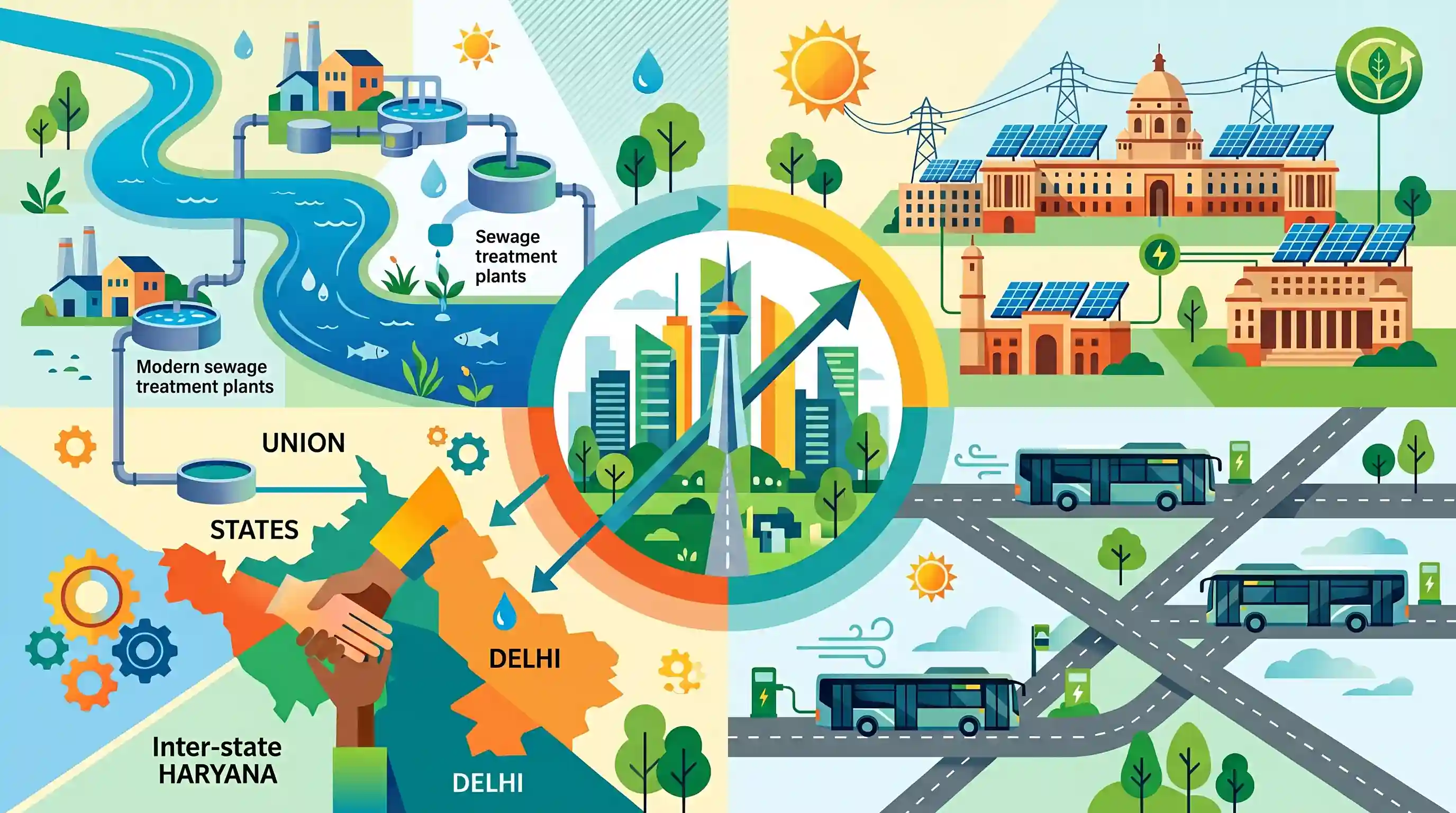
At the 10th NITI Aayog Governing Council meeting, Delhi Chief Minister Rekha Gupta laid out a vision to transform Delhi into a highly sustainable and liveable city by 2047. She sought collaborative support from the Centre and neighboring states like Haryana and Uttar Pradesh to clean the Yamuna river, announcing plans to establish 40 new sewage treatment plants. Further environmental targets include transitioning to a 100% electric public transport network—highlighted by the introduction of DEVi buses—and installing rooftop solar panels on government buildings to foster a green economy.
Key Points
- Delhi CM Rekha Gupta presented a roadmap at the 10th NITI Aayog Governing Council meeting to make Delhi the world's most sustainable and liveable city by 2047.
- Highlighted the critical need to clean the Yamuna River by setting up 40 new sewage treatment plants (STPs) to stop the flow of untreated water.
- Stressed the necessity of inter-state cooperation, specifically seeking support from the Centre, Haryana, and Uttar Pradesh for the river's rejuvenation.
- Announced targets to make Delhi pollution-free by transitioning public transport to 100% electric, including rolling out 2,000 new DEVi (Delhi Electric Vehicle Interconnector) buses.
- Promoted a transition to a 'green economy' with initiatives such as installing rooftop solar panels on government buildings.
Important Terms
NITI Aayog

The National Institution for Transforming India; the premier policy think-tank of the Government of India that replaced the Planning Commission to foster cooperative federalism and strategic planning.
UPSC context
GS II: Governance and Constitution; tests knowledge of India's planning machinery and its shift from centralized to cooperative federalism.
Governing Council (NITI Aayog)
The apex decision-making body of NITI Aayog, chaired by the Prime Minister and comprising all state Chief Ministers and UT Lieutenant Governors to coordinate national development priorities.
UPSC context
GS II: Statutory, regulatory and various quasi-judicial bodies; tests understanding of inter-governmental coordination mechanisms.
Delhi Electric Vehicle Interconnector (DEVi)
A Delhi government initiative featuring a fleet of compact electric buses designed to enhance last-mile connectivity between metro stations and residential neighborhoods.
UPSC context
GS III: Infrastructure (Transport) and Environment; relevant for discussing urban mobility and pollution mitigation strategies.
Viksit Bharat@2047
The national roadmap to transform India into a fully developed nation by the centenary of its independence (2047), focusing on economic growth, social progress, and environmental sustainability.
UPSC context
GS III: Indian Economy and development; tests familiarity with long-term national development goals and strategic visions.
Cooperative Federalism
A constitutional philosophy where the Union and States work together to solve national problems, moving away from a top-down administrative relationship.
UPSC context
GS II: Issues and challenges pertaining to the federal structure; a core theme in Indian polity and governance.
Sewage Treatment Plant (STP)
Infrastructure designed to remove contaminants from wastewater before discharge into water bodies; 40 new plants are planned to clean the Yamuna river.
UPSC context
GS III: Environmental Pollution and Degradation; technical solutions for river rejuvenation and urban waste management.
Prelims Trap
"The NITI Aayog Governing Council possesses statutory authority to mediate inter-state river water disputes."
NITI Aayog is strictly an advisory executive body (think tank). Inter-state water dispute resolution falls under Article 262 (Water Disputes Act) or Article 263 (Inter-State Council).
Static Concepts Connected
What differentiates the NITI Aayog Governing Council from the Inter-State Council?
- Body Nature: NITI Aayog was created by an executive resolution, whereas the Inter-State Council is a constitutional body established under Article 263.
- Core Mandate: NITI focuses on fostering cooperative federalism and economic planning. The ISC is specifically mandated to investigate and advise on disputes between states.
How does untreated sewage affect the Biochemical Oxygen Demand (BOD) of river ecosystems?
- BOD Definition: BOD measures the amount of dissolved oxygen consumed by aerobic microorganisms to decompose organic matter in water.
- Sewage Impact: Raw domestic sewage introduces a massive organic load, causing microorganisms to multiply and rapidly deplete dissolved oxygen while breaking down the waste.
- Ecological Consequence: When dissolved oxygen levels drop drastically, the aquatic environment becomes hypoxic, leading to the death of fish and other aquatic life.
Cross-Topic Patterns
Cooperative federalism in environmental governance
City-level environmental targets (like Delhi's 2047 vision) cannot be met in isolation; they depend heavily on upstream/downstream state cooperation (Haryana/UP for Yamuna) and central financial platforms.
EV public transport and grid decarbonization
Rolling out 100% electric public transport significantly curbs local particulate matter, but true carbon emission reduction requires pairing this EV transition with renewable energy generation like rooftop solar.

Expect a multi-statement Prelims question merging Yamuna's multi-state catchment geography with the non-statutory limits of NITI Aayog.
Linked PYQs · 3
Linked PYQs · 3
- 2024MainsGS3
Industrial pollution of river water is a significant environmental issue in India. Discuss the various mitigation measures to deal with this problem and also the government's initiatives in this regard.
- 2023MainsGS3
The adoption of electric vehicles is rapidly growing worldwide. How do electric vehicles contribute to reducing carbon emissions and what are the key benefits they offer compared to traditional combustion engine vehicles?
- 2020MainsGS3
Describe the benefits of deriving electric energy from sunlight in contrast to the conventional energy generation. What are the initiatives offered by our Government for this purpose?
