Paschim Bardhaman sponge iron factory blast injures workers
Source:The Hindu ↗
কেন এটি গুরুত্বপূর্ণ
Paschim Bardhaman is a heavily industrialized district and a key topic in West Bengal Geography for WBCS. Incidents like this underscore the vulnerabilities regarding occupational hazards, disaster response, and industrial safety in major manufacturing belts.
সারসংক্ষেপ
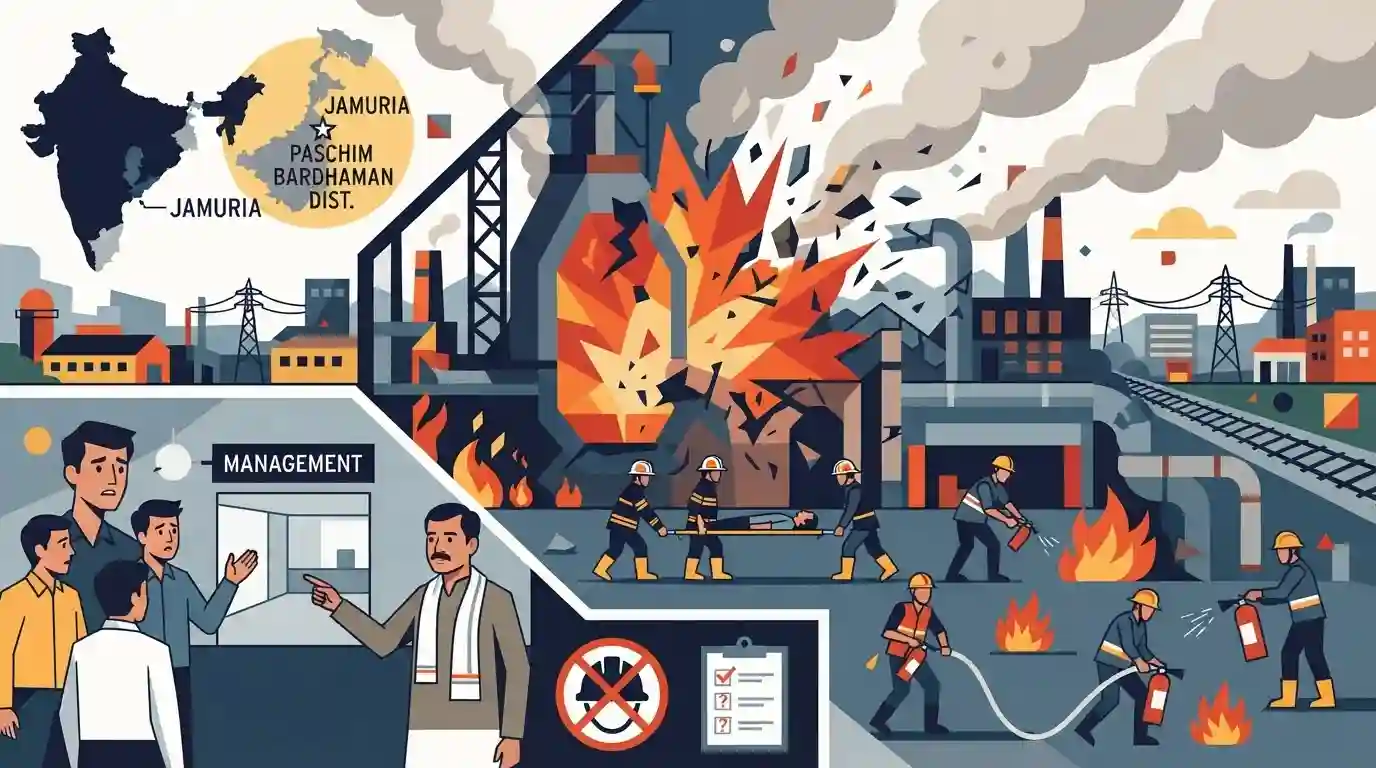
An explosion at a sponge iron factory in Jamuria, located in West Bengal's Paschim Bardhaman district, has left at least five workers severely injured. The blast caused a massive fire, significantly raising temperatures inside the unit and complicating rescue efforts led by local police and fire services. Amid fears that more workers might be trapped, local political figures criticized the factory management for their absence from the site, drawing attention to industrial safety and hazard management practices in the region.
মূল বিষয়
- A blast at a sponge iron factory in Jamuria, Paschim Bardhaman district, injured at least five workers and triggered a massive fire.
- Rescue operations by local police and fire services were hindered by extreme heat, with fears that more workers could be trapped inside.
- Local leaders pointed out the absence of the factory management at the site following the incident, raising concerns over industrial safety and accountability.
- The event highlights the critical need for strict enforcement of occupational safety regulations in West Bengal's industrial hubs.
গুরুত্বপূর্ণ শব্দ
Occupational Safety, Health and Working Conditions Code, 2020

A key Indian labour code consolidating 13 central laws to establish uniform standards for workplace safety, health, and welfare, streamlining regulatory compliance across diverse industrial sectors.
UPSC context
GS Paper II/III: Government Policies & Labour Reforms. Tests regulatory knowledge of worker welfare and industrial ease.
Disaster Management Act, 2005
India's primary legislative framework that provides the institutional and legal setup, including NDMA, SDMAs, and DDMAs, for proactive disaster prevention, mitigation, and emergency response.
UPSC context
GS Paper III: Disaster Management. Tests legislative provisions, institutional frameworks, and reactive versus proactive disaster responses.
Sponge Iron
A highly porous iron product created by the direct reduction of iron ore using reducing gases or carbon, serving as a primary raw material in electric steelmaking furnaces.
UPSC context
GS Paper I/III: Economic Geography & Industrial Sectors. Tests resource distribution, manufacturing processes, and steel industry dynamics.
Paschim Bardhaman District
A highly urbanized, resource-rich industrial and coal-mining district in West Bengal, containing major industrial hubs like Asansol and Durgapur and often called the Ruhr of India.
UPSC context
GS Paper I: Geography of India. Tests regional industrial clusters, mineral distribution, and geographic locations.
Industrial Disasters
Severe mishaps or explosions within industrial facilities causing significant casualties, property damage, or toxic releases, requiring comprehensive risk-mitigation plans and emergency response.
UPSC context
GS Paper III: Disaster Management. Tests hazardous process management, safety regulations, and corporate environmental liability.
প্রিলিমস ফাঁদ
"India relies heavily on coking coal imports to sustain its position as the second-largest producer of sponge iron."
India is actually the world's LARGEST producer of sponge iron (since 2003). Additionally, unlike blast furnaces, sponge iron production utilizes non-coking coal.
সংযুক্ত স্থির ধারণা
What is Sponge Iron (Direct Reduced Iron) and why is it crucial?
- Solid-state reduction: It is produced by directly reducing iron ore (removing oxygen) in its solid state using non-coking coal or natural gas, without melting it.
- Scrap alternative: It acts as a vital substitute for steel scrap in secondary steelmaking (Electric Arc Furnaces).
- India's dominance: India is the world's largest producer, leveraging its abundant non-coking coal reserves instead of importing expensive metallurgical coking coal.
What is the regulatory framework for chemical and industrial disasters in India?
- Legislative backbone: Post-Bhopal gas tragedy, industrial safety is governed by the EPA 1986, Public Liability Insurance Act 1991, and the Factories Act (now OSHWC Code 2020).
- NDMA Guidelines: The NDMA mandates strict safety audits and requires units to prepare both On-Site and Off-Site Emergency Plans to contain human-induced catastrophes.
- Major Accident Hazards (MAH): Installations storing or processing hazardous chemicals beyond specific threshold quantities are classified as MAH units, requiring specialized regulatory compliance.
আন্তঃবিষয় প্যাটার্ন
OSHWC Code & Industrial Safety
Frequent factory blasts highlight the stalled implementation of the Occupational Safety, Health and Working Conditions (OSHWC) Code, 2020, which subsumes the legacy Factories Act to unify safety standards.
Sponge iron & coal geography
The clustering of sponge iron plants in the Asansol-Durgapur belt is heavily dictated by proximity to the Raniganj coalfield, which supplies the non-coking coal required for the DRI process.

Expect a Prelims statement comparing sponge iron (non-coking coal) with blast furnace iron (coking coal) regarding fuel dependency.
সংযুক্ত PYQ · 3
সংযুক্ত PYQ · 3
- 2021WBCS_PRELIMSGS1
Mica producing district of West Bengal is
- 2018WBCS_PRELIMSGS1
The largest Arsenic de-contamination/purification plant in West Bengal is located at
- 2018WBCS_PRELIMSGS1
In West Bengal rail wagons are manufactured at
