Lightning and hailstorms cause casualties across multiple districts
Source:The Hindu ↗
Why It Matters
The recurrent loss of life and agricultural damage due to extreme weather phenomena like lightning strikes and hailstorms underscores the urgent need for enhanced disaster preparedness and resilience. It highlights the critical role of early warning systems provided by agencies like the IMD, as well as the necessity for effective urban infrastructure to prevent flooding, both key components of India's disaster management framework.
Summary
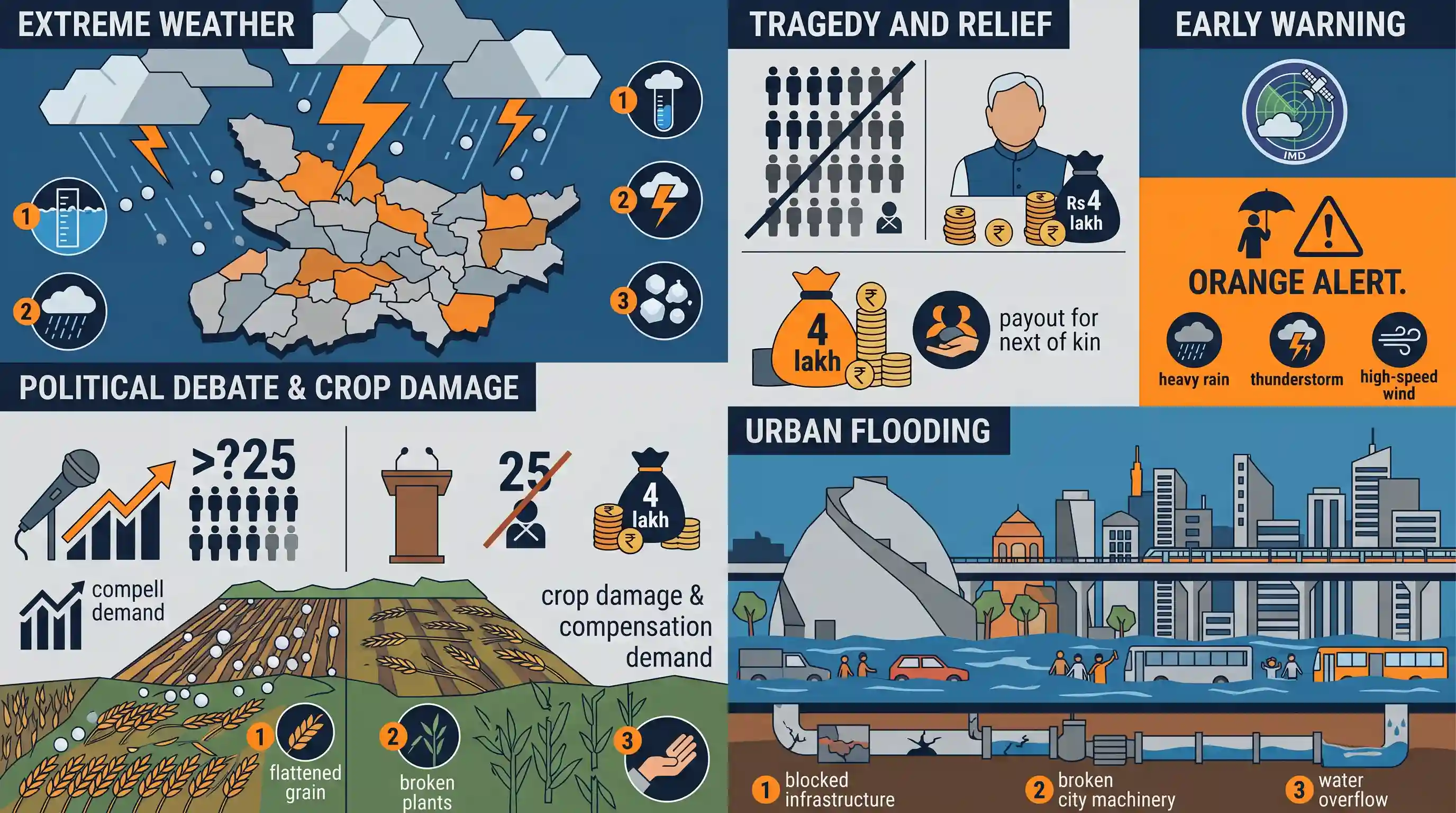
Severe extreme weather events, including lightning strikes and hailstorms, have claimed at least 25 lives across several districts in Bihar. In response to the tragedy, the state government has announced an ex gratia of Rs 4 lakh for the next of kin of each deceased person. The India Meteorological Department (IMD) has issued an 'orange alert' forecasting further heavy rainfall, thunderstorms, and high-speed winds. The incident has also sparked political debate, with opposition leaders claiming a higher death toll and demanding adequate compensation for extensive crop damage suffered by farmers. Heavy rains simultaneously caused severe water-logging in Patna, highlighting urban infrastructure challenges.
Key Points
- At least 25 people died in Bihar due to severe lightning strikes and hailstorms, with Nalanda district recording the highest number of casualties.
- Chief Minister Nitish Kumar announced an ex gratia payment of Rs 4 lakh for the families of the deceased.
- The India Meteorological Department (IMD) issued an 'orange alert' predicting heavy rainfall, thunderstorms, and gusty winds for multiple districts.
- Opposition leader Tejashwi Yadav claimed a higher death toll and demanded compensation for farmers who suffered crop losses.
- Heavy rainfall led to significant water-logging in the state capital, Patna.
Important Terms
India Meteorological Department (IMD)

The nodal government agency under the Ministry of Earth Sciences responsible for meteorological observations, weather forecasting, and providing early warnings for severe weather events like cyclones and heavy rain.
UPSC context
GS Paper 1 (Geography) and Paper 3 (Disaster Management); essential for understanding India's early warning infrastructure and climate monitoring.
Orange Alert
A weather warning level signifying 'Be Prepared.' It indicates that extremely bad weather is likely, with potential for significant disruptions to life, property, and transport.
UPSC context
GS Paper 3 (Disaster Management); tests knowledge of early warning protocols and standard operating procedures during extreme weather events.
Ex-gratia Payment
A voluntary payment made by a government as a goodwill gesture after a disaster or tragedy, provided without any legal obligation or admission of liability.
UPSC context
GS Paper 2 (Governance) and Paper 3 (Economy/Disaster Relief); relevant for mechanisms of immediate financial relief vs. statutory compensation.
Urban Flooding
Inundation in a built environment caused by intense rainfall exceeding the capacity of drainage systems, often exacerbated by unplanned urbanization and encroachment of natural water bodies.
UPSC context
GS Paper 3 (Disaster Management/Environment); focuses on man-made causes of flooding, infrastructure challenges, and city-specific resilience strategies.
Early Warning Systems (EWS)
Systems of technology and institutional protocols designed to detect impending disasters and disseminate warnings to at-risk communities to reduce loss of life and property.
UPSC context
GS Paper 3 (Disaster Management); a key pillar of the Sendai Framework and India's National Disaster Management Plan.
Prelims Trap
Lightning is classified as a notified national disaster eligible for NDRF compensation.
Despite high annual fatalities, lightning is NOT a notified disaster under the National Disaster Response Fund (NDRF). States use their State Disaster Response Fund (SDRF) for ex-gratia relief.
Static Concepts Connected
What drives pre-monsoon thunderstorms (Nor'westers) in Eastern India?
- Kalbaisakhi: Violent, squally pre-monsoon thunderstorms affecting Bihar, West Bengal, Odisha, and Assam during April and May.
- Mechanism: Triggered by the intense local heating and collision of warm, moist air from the Bay of Bengal with dry, cooler continental winds from the northwest.
What do the IMD's colour-coded weather alerts signify?
- Yellow (Be aware): Indicates severely bad weather spanning several days; advises the public and authorities to stay updated.
- Orange (Be prepared): Forecasts extreme weather with potential disruptions to transport, power, and normal life; authorities must prepare.
- Red (Take action): Poses a severe risk to life and property; requires immediate preventive action by authorities.
Cross-Topic Patterns
Climate Change & Lightning Frequency
Rising surface temperatures increase atmospheric instability and moisture holding capacity, directly escalating the frequency of severe convective clouds and lethal lightning strikes across the Indian subcontinent.
Federalism in Disaster Relief
The gap between state-specific disaster declarations (using SDRF) and the Centre's NDRF notified list highlights fiscal federalism challenges in climate-induced disaster compensation.

Expect a 2026 prelims statement testing the non-notified status of lightning under NDRF alongside the criteria for IMD's Orange Alert.
Linked PYQs · 3
Linked PYQs · 3
- 2024MainsGS3
Flooding in urban areas is an emerging climate-induced disaster. Discuss the causes of this disaster. Mention the features of two such major floods in the last two decades in India. Describe the policies and frameworks in India that aim at tackling such floods.
- 2024MainsGS3
What is disaster resilience? How is it determined? Describe various elements of a resilience framework. Also mention the global targets of Sendai Framework for Disaster Risk Reduction (2015–2030).
- 2019MainsGS3
Disaster preparedness is the first step in any disaster management process. Explain how hazard zonation mapping will help disaster mitigation in the case of landslides.
