Gold mine collapse in northwest Nigeria causes massive fatalities
Source:Indian Express ↗
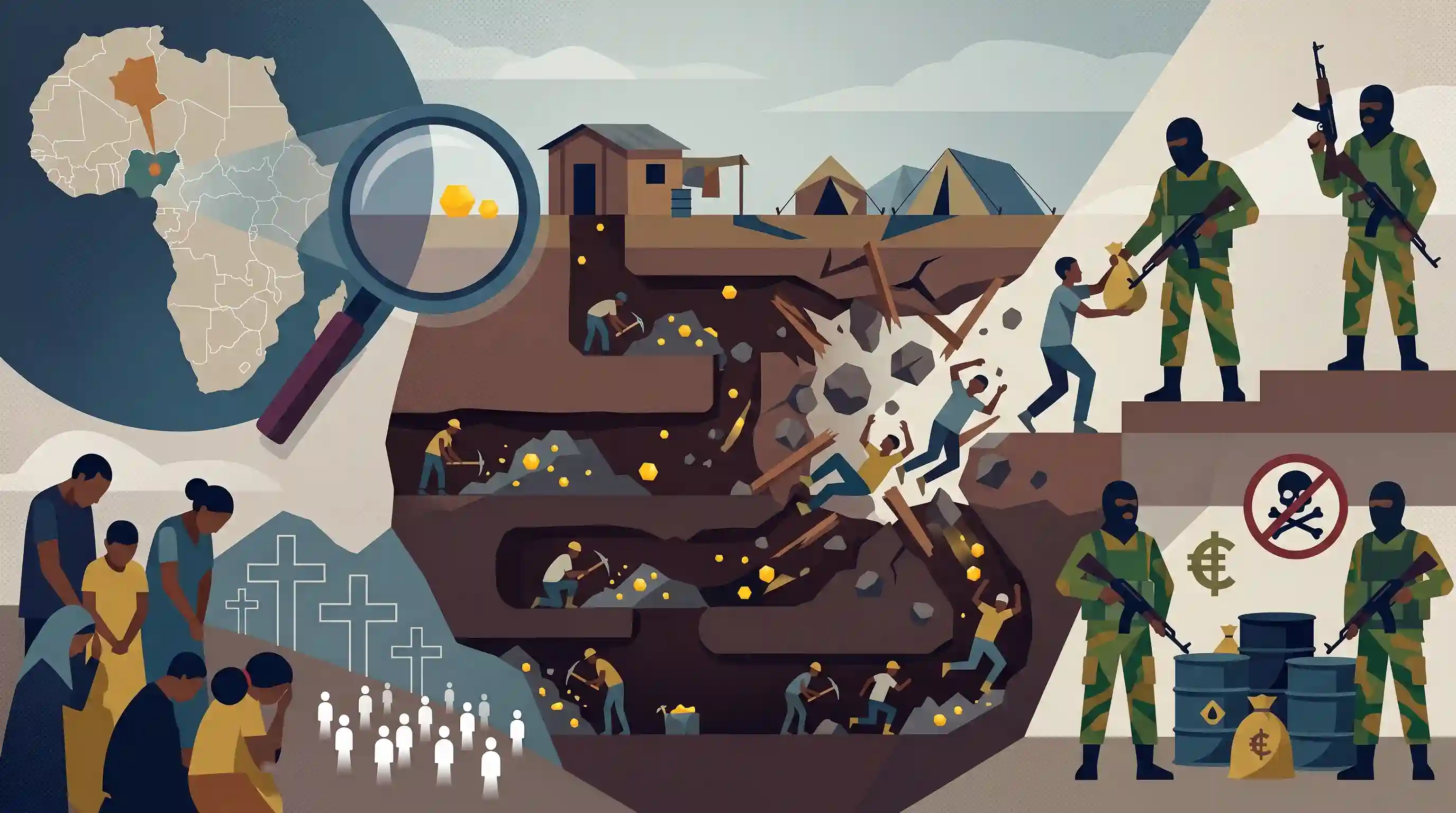
Why It Matters
For UPSC aspirants, this event is highly relevant for 'Places in News' (mapping Zamfara/Nigeria) and serves as a vital case study for GS3 topics on the socioeconomic and environmental consequences of illegal, unregulated artisanal mining and the 'resource curse' in conflict zones.
Summary
A devastating gold mine collapse in northwest Nigeria's Zamfara State has left at least 100 artisanal miners feared dead. The incident occurred at the Kadauri mining site in the Maru local government area. Illegal mining operations are prevalent in Zamfara, where the sector is largely unregulated and frequently controlled by armed gangs, contributing to severe regional violence and recurrent deadly industrial accidents.
Key Points
- A major gold mining pit collapse at the Kadauri site in Zamfara State, northwest Nigeria, left over 100 artisanal miners feared dead.
- Rescue efforts were slow, with only a few survivors pulled from the rubble and some rescuers reportedly suffocating.
- Illegal and artisanal gold mining is widespread in Zamfara State due to economic desperation and poor regulation.
- The region's gold fields are often controlled by armed gangs, exacerbating violence, instability, and deadly safety compromises in the sector.
Important Terms
Zamfara State

A state in northwestern Nigeria known for significant gold deposits. It is currently a focal point for security challenges, including banditry and unregulated artisanal mining operations.
UPSC context
Relevant for GS Paper I (World Geography) and GS Paper II (International Relations/Regional Security). Tests knowledge of global resource-rich conflict zones.
Artisanal Mining
Small-scale subsistence mining characterized by manual labor and minimal technology. Often part of the informal economy, it provides livelihoods but frequently lacks safety and environmental regulations.
UPSC context
GS Paper I (Resources) and GS Paper III (Environment/Economy). Tests understanding of informal sectors and sustainable resource management.
Resource Curse
A socio-economic paradox where regions with abundant natural resources experience lower economic growth, poor governance, and increased conflict due to exploitation by armed groups or corrupt officials.
UPSC context
GS Paper II (Governance) and GS Paper III (Economic Development). Critical for analyzing why mineral-rich nations struggle with stability.
Illegal Mining
Extraction of minerals without legal permits. In Nigeria, it is linked to revenue loss ($9 billion annually) and funding for armed syndicates, posing a major national security threat.
UPSC context
GS Paper III (Internal Security). Tests the nexus between illicit economic activities and organized crime/terrorism.
Banditry
Organized criminal activity involving armed gangs engaged in cattle rustling, kidnapping, and murder. In Nigeria, it is increasingly intertwined with the control of gold mining sites.
UPSC context
GS Paper III (Internal Security). Relevant for understanding non-state actor threats in developing nations.
Maru Local Government Area
A local government area in Zamfara State, Nigeria, and the site of the Kadauri gold mine. It serves as a significant hub for both mining and regional insecurity.
UPSC context
GS Paper I (Places in News). Important for mapping global conflict and industrial disaster locations.
Prelims Trap
Nigeria's mineral wealth is exclusively restricted to petroleum and natural gas reserves in the Niger Delta.
Nigeria possesses significant, untapped solid mineral reserves (gold, lithium, coltan) in its north. Absolute terms like 'exclusively' are classic UPSC traps ignoring these deposits.
Static Concepts Connected
How does Artisanal and Small-Scale Gold Mining (ASGM) cause severe heavy metal pollution?
- Mercury amalgamation: Mercury is used to extract gold from ore, forming an amalgam which is then burned, releasing toxic mercury vapors. ASGM is the largest anthropogenic source of mercury pollution.
- Lead co-occurrence: Processing lead-rich gold ores in rudimentary residential settings causes severe lead dust contamination, leading to catastrophic local health crises.
- Minamata Convention: A global environmental treaty specifically targeting the reduction and elimination of mercury use in ASGM operations.
What is the 'Resource Curse' in mineral-rich developing nations?
- Economic stagnation: Resource-rich countries often experience slower economic growth due to over-reliance on a single export, ignoring other sectors like manufacturing (Dutch Disease).
- Conflict financing: Illicit extraction directly funds armed insurgencies and terrorist networks, destabilizing regions and preventing effective state governance.
Cross-Topic Patterns
Sahel insurgency and conflict minerals
Unregulated mining in regions like Nigeria, Mali, and Burkina Faso provides a steady revenue stream for armed gangs and extremist groups, complicating counter-terrorism efforts and regional stability.
Informal processing and heavy metal toxicity
Zamfara's lead poisoning mirrors India's informal e-waste recycling (e.g., Moradabad), where unregulated processing causes acute heavy metal toxicity in marginalized communities.

Expect a match-the-following question pairing African regions (Zamfara, Kivu, Sahel) with their specific conflict minerals or insurgencies.
Linked PYQs · 3
Linked PYQs · 3
- 2023PrelimsGS1
In the recent years Chad, Guinea, Mali and Sudan caught the international attention for which one of the following reasons common to all of them?
- 2025MainsGS3
Mineral resources are fundamental to the country's economy and these are exploited by mining. Why is mining considered an environmental hazard? Explain the remedial measures required to reduce the environmental hazard due to mining.
- 2013MainsGS3
What are the consequences of Illegal mining ? Discuss the Ministry of Environment and Forests' concept of GO AND NO GO zones for coal mining sector.
