Delhi air pollution crisis and fundamental right to clean environment
Source:Indian Express ↗
Why It Matters
The article connects a pressing environmental and public health crisis (Delhi air pollution) to constitutional rights and civic activism. This is crucial for GS-2 (judicial activism regarding Article 21 and the right to health) and GS-3 (environmental pollution and policies like NCAP and GRAP), both of which are recurrent themes in UPSC Prelims and Mains.
Summary
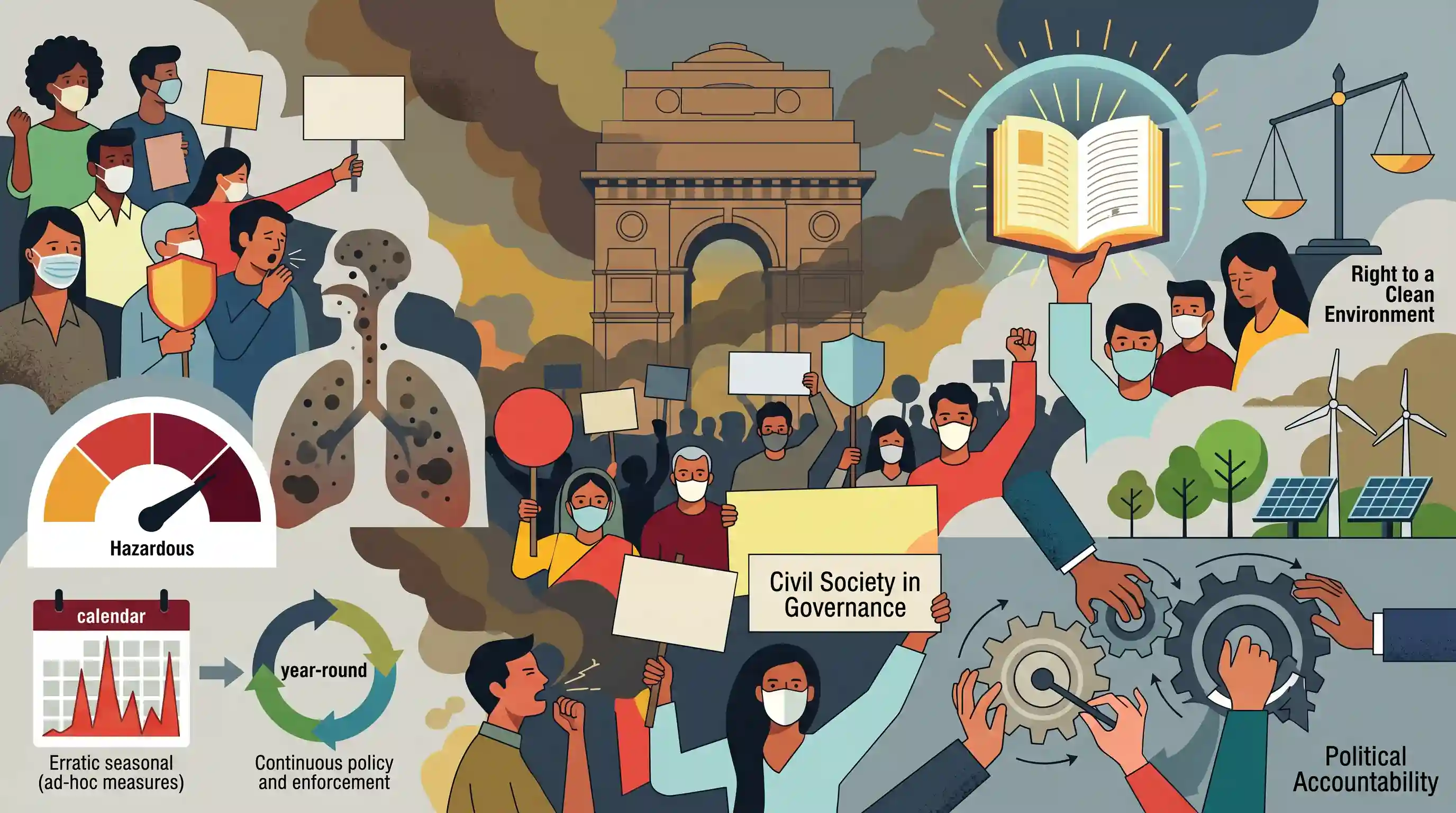
The article discusses the recent citizen protests at India Gate over the severe air pollution and hazardous Air Quality Index (AQI) in Delhi and the National Capital Region (NCR). It highlights growing public frustration with governmental inaction and ad-hoc measures that fail to address the annual winter pollution crisis. By framing the demand for clean air as a fundamental struggle for survival and a public health emergency, the piece emphasizes the need for political accountability, year-round policy enforcement, and the realization of the constitutional right to a clean environment.
Key Points
- Citizens recently protested at India Gate against the hazardous Air Quality Index (AQI) levels in Delhi-NCR, signaling a shift towards active civic mobilization over environmental issues.
- The recurring air pollution crisis highlights systemic governance failures and the inefficacy of seasonal measures like the Graded Response Action Plan (GRAP).
- The issue transcends environmental degradation, manifesting as a severe public health emergency that threatens citizens' Right to Life (Article 21).
- The protest underscores a growing demand for political accountability, inter-state coordination, and year-round structural interventions rather than reactive policies.
Important Terms
Graded Response Action Plan (GRAP)

A set of emergency measures implemented in Delhi-NCR to combat air pollution. It activates progressively stricter restrictions (Stages I-IV) based on the severity of the Air Quality Index (AQI).
UPSC context
GS Paper III (Environment); vital for questions on urban pollution management and the role of emergency environmental frameworks.
National Clean Air Programme (NCAP)
A national-level strategy launched in 2019 to reduce particulate matter (PM2.5 and PM10) concentrations by 40% by 2026 in 131 non-attainment cities across India.
UPSC context
GS Paper III (Environment/Pollution); tests knowledge of long-term government targets and non-attainment city frameworks.
Central Pollution Control Board (CPCB)
A statutory body under the Ministry of Environment, Forest and Climate Change (MoEFCC) responsible for setting air/water quality standards and coordinating pollution control efforts nationwide.
UPSC context
GS Paper II (Statutory Bodies) and GS III (Environment); central to the institutional architecture of environmental governance.
Article 21 (Right to Clean Environment)
Guarantees the Right to Life and Personal Liberty. The Supreme Court has judicially expanded this to include the right to a clean and healthy environment for all citizens.
UPSC context
GS Paper II (Polity/Fundamental Rights); essential for discussing environmental jurisprudence and judicial activism in India.
Air Quality Index (AQI)
A tool for communicating daily air quality status using 'One Number-One Colour-One Description'. It tracks eight major pollutants, including PM2.5, PM10, and Nitrogen Dioxide.
UPSC context
GS Paper III (Environment); frequently tested in Prelims regarding the specific pollutants monitored and its categorization.
Commission for Air Quality Management (CAQM)
A statutory body formed in 2021 to coordinate and oversee air quality management in the National Capital Region (NCR) and surrounding areas, including implementing GRAP.
UPSC context
GS Paper II (Governance) and GS III (Environment); relevant for institutional shifts in managing interstate environmental issues.
Prelims Trap
"The Graded Response Action Plan (GRAP) in Delhi-NCR is enforced by the CPCB or the EPCA."
Aspirants often assume CPCB or the EPCA manages Delhi's emergency pollution response. The EPCA was dissolved; the Commission for Air Quality Management (CAQM), a statutory body, now enforces GRAP.
Static Concepts Connected
Which pollutants are measured to calculate India's National Air Quality Index (AQI)?
- Eight Specific Pollutants: The index tracks PM10, PM2.5, Nitrogen Dioxide (NO2), Sulphur Dioxide (SO2), Carbon Monoxide (CO), Ozone (O3), Ammonia (NH3), and Lead (Pb).
- Notable Exclusions: Carbon Dioxide (CO2) and Methane (CH4) are major greenhouse gases but are explicitly NOT included in the National AQI calculation.
How does the Constitution guarantee the Right to a Clean Environment?
- Article 21 Evolution: The Supreme Court expanded Article 21 in Subhash Kumar v. State of Bihar (1991) to declare that the right to life includes the right to a pollution-free environment.
- DPSP and Fundamental Duties: Article 48A directs the State to protect the environment, while Article 51A(g) makes it a fundamental duty for citizens to protect forests, lakes, and wildlife.
Cross-Topic Patterns
Air pollution as a Federalism test
Tackling NCR pollution requires strict inter-state coordination (Delhi, Punjab, Haryana) via the CAQM, highlighting the limits of state-level policies and acting as a recurrent test for India's cooperative federalism frameworks.
Civic mobilization and Article 21
The shift of environmental demands from judicial activism (PILs) to direct civic mobilization marks a new phase in enforcing Article 21 rights, moving beyond courtrooms to grassroots accountability.

Expect a 2026 multi-statement Prelims question combining the statutory powers of CAQM, National AQI parameters, and NCAP's revised targets.
Linked PYQs · 4
Linked PYQs · 4
- 2015MainsGS2
Does the right to clean environment entail legal regulations on burning crackers during Diwali? Discuss in the light of Article 21 of the Indian Constitution and Judgement(s) of the Apex Court in this regard.
- 2022MainsGS2
“The most significant achievement of modern law in India is the constitutionalization of environmental problems by the Supreme Court.” Discuss this statement with the help of relevant case laws.
- 2022PrelimsGS1
In the context of WHO Air Quality Guidelines, consider the following statements: 1. The 24-hour mean of PM2.5 should not exceed 15 µg/m³ and annual mean of PM2.5 should not exceed 5 µg/m³. 2. In a year, the highest levels of ozone pollution occur during the periods of inclement weather. 3. PM10 can penetrate the lung barrier and enter the bloodstream. 4. Excessive ozone in the air can trigger asthma. Which of the statements given above are correct?
- 2016PrelimsGS1
In the cities of our country, which among the following atmospheric gases are normally considered in calculating the value of Air Quality Index? 1. Carbon dioxide 2. Carbon monoxide 3. Nitrogen dioxide 4. Sulfur dioxide 5. Methane Select the correct answer using the code given below.
