Role of technical institutions in value based professional ethics
Source:The Hindu ↗
Why It Matters
The President's address provides excellent fodder for GS-4 (Ethics) answers regarding empathy, compassion, and value-based professional competence. It also touches upon key GS-2 (Social Justice/Education) and GS-3 (Employment/Innovation) themes such as the societal role of premier educational institutions, tribal welfare (EMRS), and the push toward entrepreneurship.
Summary
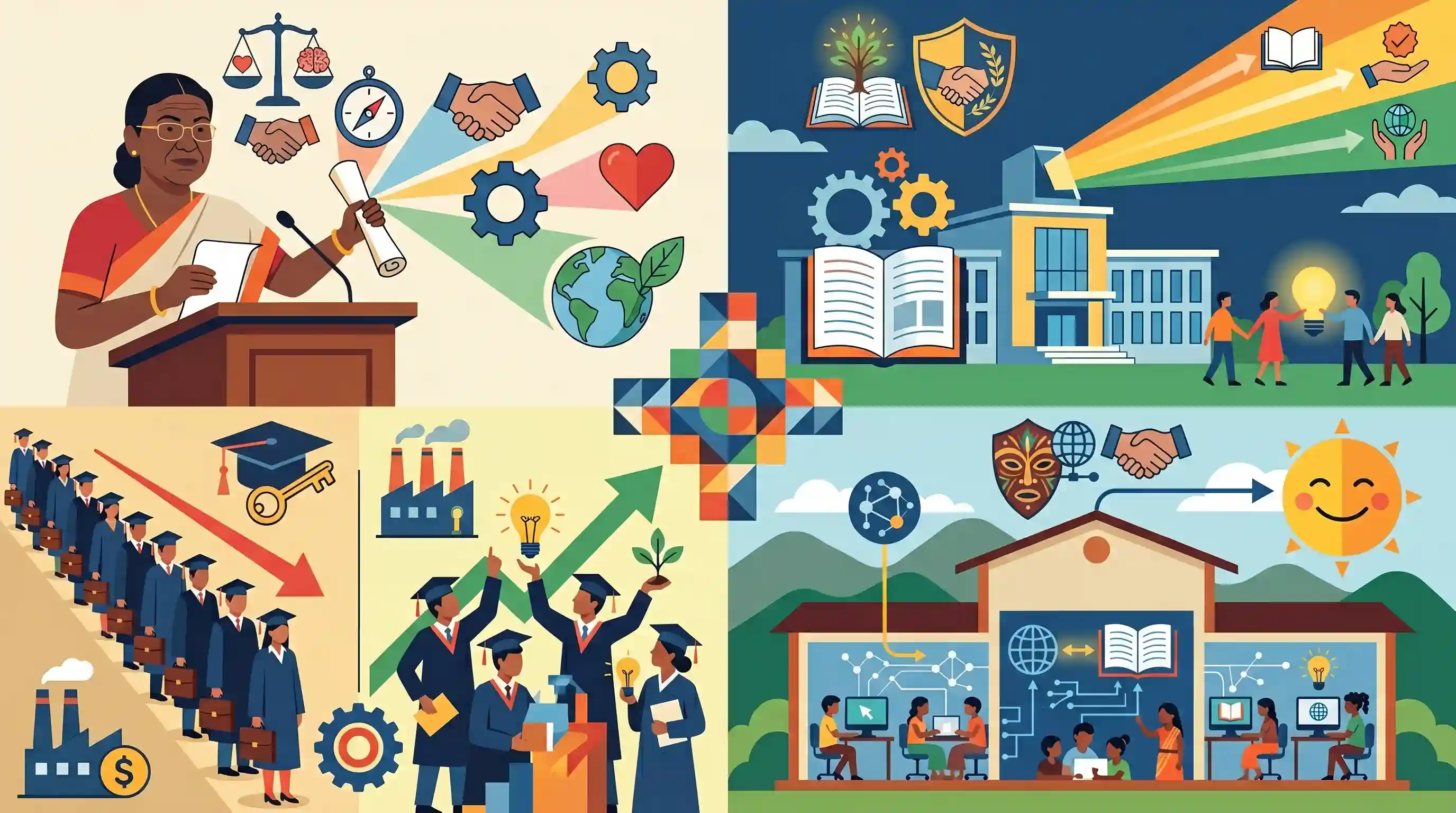
During the 45th convocation of IIT (ISM) Dhanbad, President Droupadi Murmu highlighted the integral role of IITs in India's development story. She urged graduates to combine technical excellence with empathy and ethics, calling for innovations that address global challenges such as climate change and inequality while remaining inclusive. Emphasizing self-reliance, the Union Education Minister encouraged students to transition from job seekers to job creators. The event also highlighted the institution's social outreach, noting its Centre of Excellence for Tribal Welfare, which works with the Ministry of Tribal Affairs to impart digital literacy to students of Eklavya Model Residential Schools.
Key Points
- President Droupadi Murmu, addressing the 45th convocation of IIT (ISM) Dhanbad, urged graduating students to lead with empathy, ethics, and innovation rooted in compassion.
- She emphasized the responsibility of premier technical institutions to develop sustainable and inclusive solutions for contemporary challenges like climate change, resource depletion, and inequality.
- Union Education Minister Dharmendra Pradhan echoed the sentiment, urging students to become 'job creators, not just job seekers' to harness India's demographic dividend.
- IIT (ISM) Dhanbad has established a Centre of Excellence for Tribal Welfare, collaborating with the Ministry of Tribal Affairs to provide digital literacy to students in Eklavya Model Residential Schools.
Important Terms
Eklavya Model Residential Schools (EMRS)

A central sector scheme providing free residential middle and high school education to Scheduled Tribe students in remote areas, aiming to bring them at par with the general population.
UPSC context
GS Paper 2 (Social Justice/Schemes); important for tribal education, welfare, and bridging the rural-urban literacy gap.
Ministry of Tribal Affairs (MoTA)
The nodal ministry of the Government of India responsible for the overall socio-economic development, policy-making, and coordination of welfare programs for Scheduled Tribe (ST) communities.
UPSC context
GS Paper 2 (Governance/Institutions); tests knowledge of the administrative structure for protecting the rights and interests of vulnerable sections.
IIT (ISM) Dhanbad
An Institute of National Importance in Dhanbad, established in 1926 as the Indian School of Mines (ISM) and upgraded to an IIT in 2016, specializing in earth sciences and engineering.
UPSC context
GS Paper 2 (Education); showcases the growth of higher education and specialized technical training in India's mineral-rich regions.
Centre of Excellence (CoE) for Tribal Welfare
A specialized facility at IIT (ISM) Dhanbad, supported by the Ministry of Tribal Affairs, focused on digital literacy, skill development, and scientific interventions for tribal empowerment.
UPSC context
GS Paper 2 (Social Justice); signifies the role of higher education institutions in grass-roots level social engineering and inclusive development.
Digital Literacy
The ability to use digital technology and communication tools to find, evaluate, and create information, essential for modern employment and accessing government services in marginalized areas.
UPSC context
GS Paper 2 (Governance/E-Governance); highlights strategies to overcome the 'digital divide' among marginalized groups for inclusive growth.
Prelims Trap
"Eklavya Model Residential Schools (EMRS) are exclusively for Scheduled Tribe students, with 100% of seats strictly reserved for them."
Up to 10% of EMRS seats can be allocated to non-ST students (e.g., children of staff/locals), defying the common 'ST-only' absolutist assumption.
Static Concepts Connected
What are the core criteria and features of Eklavya Model Residential Schools (EMRS)?
- Funding Nature: It is a 100% centrally funded scheme (Central Sector) under the Ministry of Tribal Affairs.
- Block Criteria: Mandated in every block with over 50% ST population and at least 20,000 tribal persons.
- Inclusivity & Quotas: It ensures gender parity, allows up to 10% non-ST students, and reserves 20% for outstanding ST sportspersons.
How does the UPSC Ethics syllabus frame the concept of compassionate innovation?
- Technological Determinism: Technology without moral grounding exacerbates inequalities (e.g., AI bias, unequal access to climate tech).
- Compassionate Capitalism: Aligning market-driven technical excellence with empathy to address bottom-of-the-pyramid challenges sustainably.
- Constitutional Morality: Fulfilling Article 51A(h) (developing a scientific temper) while simultaneously preserving the spirit of humanism.
Cross-Topic Patterns
Tech institutes driving tribal welfare
IITs establishing Centres of Excellence for tribal digital literacy bridges the digital divide, practically linking GS3 (technology/digital India) with GS2 (vulnerable sections and inclusive growth).
Demographic dividend vs. demographic disaster
The policy shift from job-seeking to job-creating is crucial to prevent the demographic dividend from turning into a demographic disaster, linking NEP 2020 skill-focus with macro-employment.

EMRS criteria (>50% ST, >20k ST population) and the 10% non-ST seat allowance are prime targets for a multi-statement 2026 Prelims Q.
Linked PYQs · 4
Linked PYQs · 4
- 2022MainsGS4
Apart from intellectual competency and moral qualities, empathy and compassion are some of the other vital attributes that facilitate the civil servants to be more competent in tackling the crucial issues or taking critical decisions. Explain with suitable illustrations.
- 2024MainsGS4
“Ethics encompasses several key dimensions that are crucial in guiding individuals and organizations towards morally responsible behaviour.” Explain the key dimensions of ethics that influence human actions. Discuss how these dimensions shape ethical decision-making in the professional context.
- 2015MainsGS2
The quality of higher education in India requires major improvements to make it internationally competitive. Do you think that the entry of foreign educational institutions would help improve the quality of higher and technical education in the country? Discuss.
- 2014MainsGS3
While we flaunt India's demographic dividend, we ignore the dropping rates of employability. What are we missing while doing so? Where will the jobs that India desperately needs come from? Explain.
