Gemini 35 Flash and Proactive AI Agents Redefining Search Engines
Source:The Hindu ↗
Why It Matters
The evolution of search engines into proactive, autonomous AI agents signifies a major milestone in human-computer interaction. For UPSC, this highlights the rapid advancement of large language models, multimodal AI capabilities, and their extensive integration into everyday applications. It also raises profound ethical and regulatory questions concerning continuous data surveillance, individual privacy, and market monopolisation in the emerging generative AI landscape.
Summary
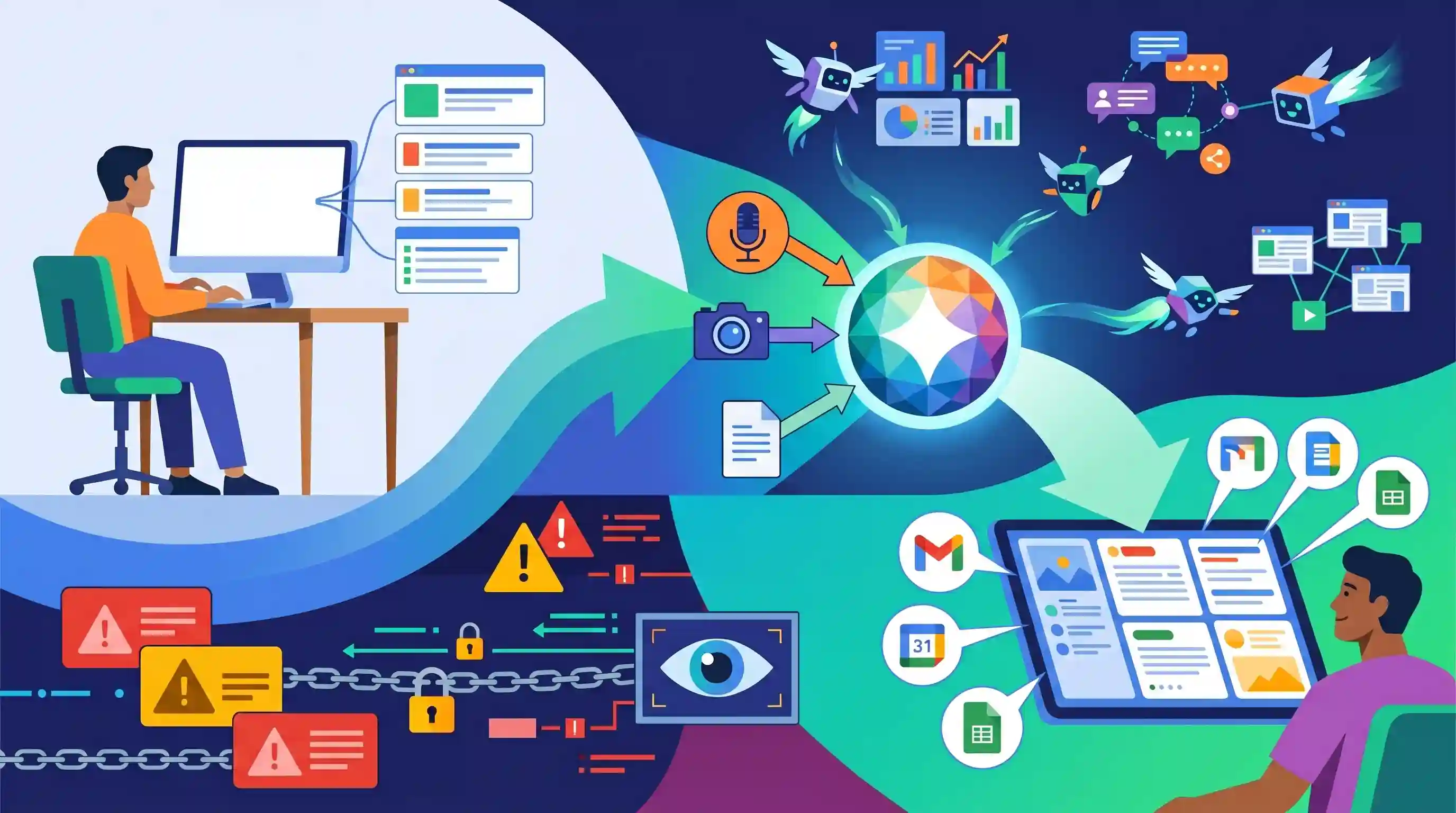
At its I/O 2026 conference, Alphabet unveiled a radical redesign of Google Search, fundamentally shifting how users interact with the internet. By integrating the Gemini 3.5 Flash AI model, Google replaces the classic search box with a multimodal AI interface capable of understanding voice, video, images, and text. A major innovation is the introduction of proactive 'information agents'—background AI processes that continuously monitor the web, social media, and financial data to synthesize custom updates for users. This transition from reactive querying to proactive AI-driven data synthesis, integrated across Google Workspace, highlights significant advancements in generative AI while potentially raising new data privacy and AI governance challenges.
Key Points
- Google introduced Gemini 3.5 Flash as the default model globally in its new AI Mode.
- The traditional search box is being replaced by a dynamically expanding multimodal input field that accepts images, files, videos, and complex queries.
- The launch of 'information agents' marks a shift from reactive to proactive search, as these background processes continuously scan the internet to provide synthesised updates to users.
- The new AI ecosystem integrates deeply across Google Workspace, boasting the ability to process up to 3.2 quadrillion tokens per month for deep personal intelligence.
Important Terms
Gemini 3.5 Flash

A high-efficiency multimodal AI model by Google, optimized for high speed and 'agentic' tasks like coding and multi-step background workflows.
UPSC context
GS-3 (Science & Tech): Tests awareness of frontier AI developments and their practical applications in digital infrastructure.
Agentic AI
AI systems designed to autonomously perform multi-step tasks and make decisions to achieve goals, rather than just generating text in response to prompts.
UPSC context
GS-3 (Science & Tech): Important for understanding the shift from passive tools to autonomous systems and associated safety risks.
Information Agents
Proactive AI processes that continuously monitor web, social, and financial data to synthesize custom updates and perform tasks on a user's behalf.
UPSC context
GS-3 (IT & Computers): Relates to the evolution of search engines and personalized data synthesis.
Multimodal AI
AI capable of processing and generating information across multiple 'modes' including text, images, video, audio, and code simultaneously.
UPSC context
GS-3 (Science & Tech): Tests knowledge of core AI capabilities and their role in human-computer interaction.
AI Governance
The framework of rules, ethical principles, and laws designed to ensure AI is developed and used safely, fairly, and transparently.
UPSC context
GS-2 (Governance/Ethics): Critical for issues regarding algorithmic accountability, privacy, and India's 'IndiaAI' mission.
Alphabet Inc.
The parent company of Google, serving as a holding company for diverse technology ventures including AI research, cloud computing, and hardware.
UPSC context
GS-3 (Economy): Relevant to Big Tech's global economic influence and the regulation of digital monopolies.
Google DeepMind
Alphabet's specialized AI research laboratory, responsible for developing the Gemini family of models and advancing fundamental machine learning.
UPSC context
GS-3 (Science & Tech): Important as a primary driver of global AI innovation and research breakthroughs.
Gemini Spark
A specific personal AI agent introduced by Google that runs 24/7 to manage a user's digital tasks and background research.
UPSC context
GS-3 (IT): Example of consumer-facing AI assistants and the growing trend of digital personalization.
Prelims Trap
"Tokens in generative AI ecosystems refer to cryptographic digital assets used to secure data."
In LLMs, a 'token' is a fundamental unit of text/data (like a word or syllable) processed by the model, completely unrelated to blockchain cryptocurrency.
Static Concepts Connected
What distinguishes Generative, Multimodal, and Agentic AI?
- Generative AI: Algorithms designed to create new, original content (text, code, images, audio) based on patterns learned from vast training datasets.
- Multimodal AI: Systems capable of seamlessly understanding, processing, and synthesizing multiple data types (video, voice, image, text) simultaneously rather than relying on single-input formats.
- Agentic AI: Autonomous systems that pursue complex, multi-step goals over time, executing background tasks and fetching information without requiring continuous, prompt-by-prompt human intervention.
What is a 'Token' in the context of Large Language Models (LLMs)?
- Definition: The smallest semantic unit of data processed by an AI model. Depending on the system, a token can represent a whole word, a character, or a subword.
- Tokenization Mechanism: The computational process of breaking human-readable text into tokens, which the model then converts into numerical vectors to compute context, relationships, and generate outputs.
Cross-Topic Patterns
DPDP Act vs Agentic AI
Proactive AI agents continuously scanning personal workspaces challenge the 'purpose limitation' and 'data minimization' principles strictly mandated under India's Digital Personal Data Protection (DPDP) Act.
IndiaAI Mission and Compute Capacity
The massive token-processing scale required by advanced AI ecosystems highlights the critical need for India's ₹10,300 crore IndiaAI Mission to build sovereign compute infrastructure.

Expect a match-the-pair Prelims question differentiating Multimodal AI, Agentic AI, and Generative AI definitions in 2026.
Linked PYQs · 2
Linked PYQs · 2
- 2023MainsGS3
Introduce the concept of Artificial Intelligence (AI). How does Al help clinical diagnosis? Do you perceive any threat to privacy of the individual in the use of Al in healthcare?
- 2025PrelimsGS1
Consider the following statements: I. It is expected that Majorana 1 chip will enable quantum computing. II. Majorana 1 chip has been introduced by Amazon Web Services (AWS). III. Deep learning is a subset of machine learning. Which of the statements given above are correct?
