Invasive alien species proliferation in Delhi wildlife sanctuary
Source:Indian Express ↗
हे का महत्त्वाचे आहे
The proliferation of invasive alien species in protected areas like Delhi's Asola Bhatti Wildlife Sanctuary highlights critical challenges in urban biodiversity conservation, ecosystem restoration, and wildlife management under GS3 Environment.
सारांश
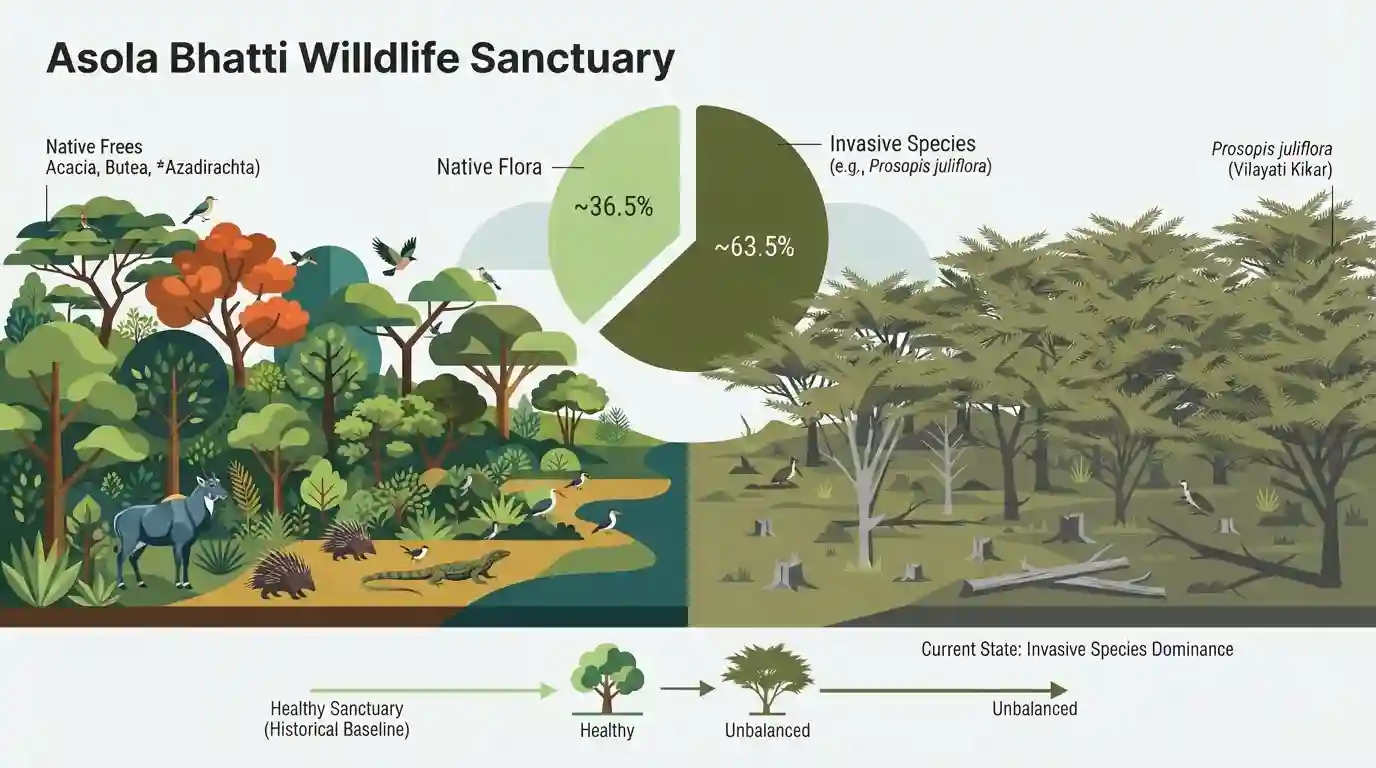
A study or assessment reveals that Delhi's sole wildlife sanctuary, the Asola Bhatti Wildlife Sanctuary, faces a major ecological challenge with invasive trees covering nearly 63.48% of its landscape, threatening native flora, fauna, and overall ecosystem health.
मुख्य मुद्दे
- An invasive tree species (such as Prosopis juliflora or similar dominant invasive weed/trees) covers over 63% of the landscape in Delhi's lone wildlife sanctuary, the Asola Bhatti Wildlife Sanctuary.
- Invasive alien species pose a severe threat to native biodiversity, altering soil nutrient composition, displacing native flora, and disrupting the local ecosystem balance.
- Managing and eradicating invasive species in urban and semi-urban protected areas requires systematic ecological restoration, removal strategies, and long-term monitoring.
- Protected areas near urban centers face immense anthropogenic pressures alongside ecological degradation from biological invasions.
महत्त्वाच्या संज्ञा
Asola Bhatti Wildlife Sanctuary

Delhi's sole protected wildlife sanctuary located on the southern ridge of the Aravalli hills, currently facing ecological stress due to invasive species like Prosopis juliflora and high densities of rhesus macaques.
UPSC context
Important for Prelims (Protected Areas) and Mains GS Paper III (Environment and Biodiversity Conservation, Invasive Alien Species).
Wildlife (Protection) Act, 1972
Comprehensive Indian legislation enacted in 1972 providing the legal framework for the protection of wild animals, birds, and plants, and establishing national parks and wildlife sanctuaries.
UPSC context
Crucial for Prelims and Mains GS Paper III under environment, wildlife legislation, and protected area governance.
संबंधित स्थिर संकल्पना
What are the key ecological impacts of invasive alien species like Prosopis juliflora on protected areas?
- Water Depletion: Aggressive consumption of groundwater depletes local water tables, starving native vegetation of moisture.
- Allelopathy: Secretes allelopathic chemicals that inhibit the germination and growth of indigenous plant species.
- Soil Alteration: Alters soil nitrogen cycles and microbial communities, making it difficult for native flora to recover post-removal.
- Habitat Degradation: Monoculture stands reduce food and shelter availability for native fauna, disrupting local trophic webs.
आंतर-विषय नमुने
Urban Ecology and Protected Area Fragmentation
The ecological degradation of Delhi's ridge by Prosopis juliflora connects urban land-use planning with biodiversity loss under the National Action Plan on Climate Change (NAPCC).
Invasive Species vs. Forest Rights Act
Invasive alien species eradication intersects with Scheduled Tribes and Other Traditional Forest Dwellers (FRA) context when community-led ecological restoration is mandated in eco-sensitive zones.

Expect a statement-based question pairing Asola Bhatti's invasive coverage with general ecological impacts of alien species on soil and native flora.
संबंधित PYQ · 3
संबंधित PYQ · 3
- 2023PrelimsGS1
'Invasive Species Specialist Group' (that develops Global Invasive Species Database) belongs to which one of the following organizations?
- 2017PrelimsGS1
In India, if a species of tortoise is declared protected under Schedule I of the Wildlife (Protection) Act, 1972, what does it imply?
- 2023MainsGS3
Comment on the National Wetland Conservation Programme initiated by the Government of India and name a few India's wetlands of international importance included in the Ramsar Sites.
