Godavari river records lowest daily inflow at Polavaram in decades
Source:The Hindu ↗
Why It Matters
The article underscores the hydrogeography of Andhra Pradesh, highlighting critical river interlinkages (Sileru, Sabari, Godavari) and the impact of global meteorological phenomena (El Niño) on local irrigation projects (Polavaram National Project) and agricultural adaptation patterns.
Summary
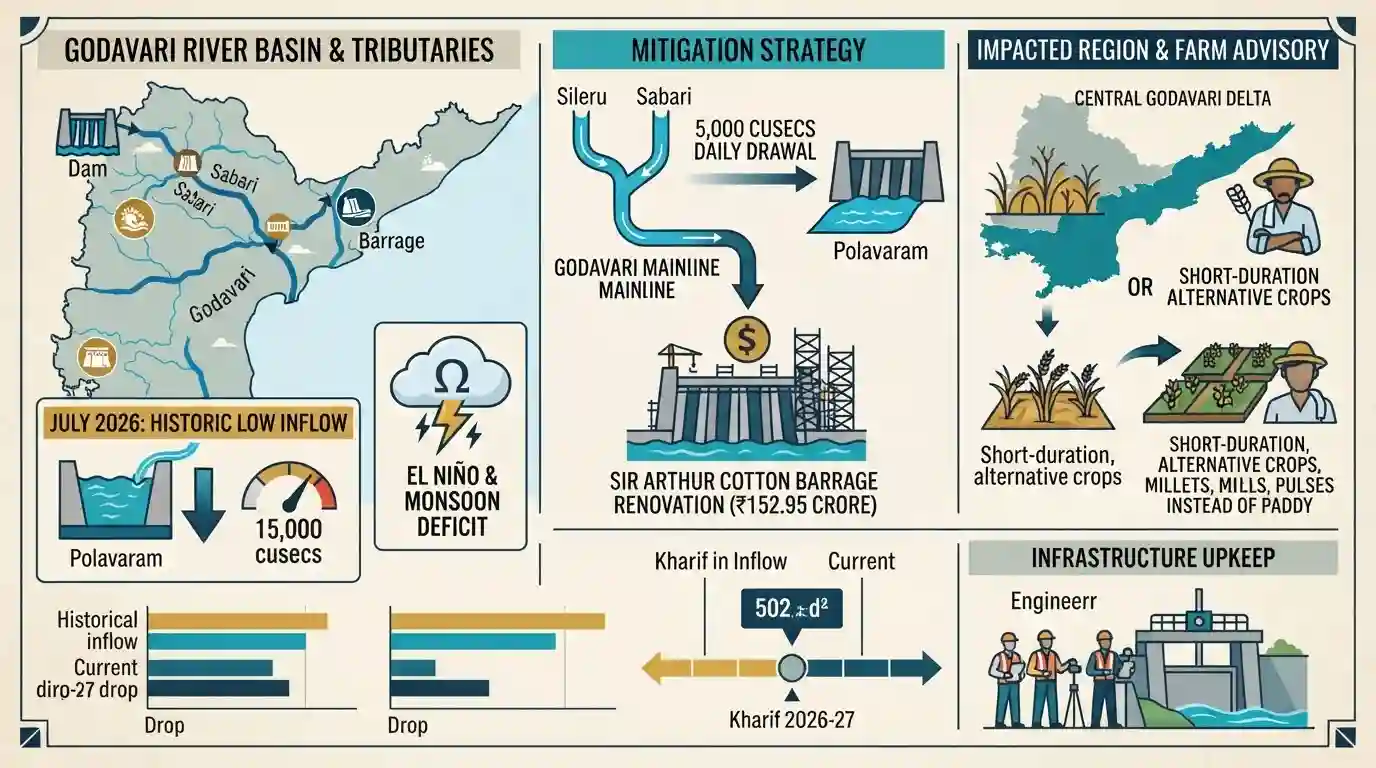
In July 2026, Andhra Pradesh's Water Resources Minister Nimmala Ramanaidu announced that the Godavari River's daily inflow at the Polavaram project had dropped to a historic seven-decade low of 15,000 cusecs. This deficit, caused by El Niño and delayed infrastructure upkeep, has heavily impacted the Central Godavari Delta. To mitigate the crisis, the state is drawing 5,000 cusecs daily from the Sileru-Sabari river systems, undertaking a ₹152.95 crore renovation of the Sir Arthur Cotton Barrage, and advising regional farmers to shift to short-duration and alternative crops for the Kharif 2026-27 season.
Key Points
- Daily water inflow of the Godavari River at the Polavaram irrigation project recorded a historic low of 15,000 cusecs, the lowest daily inflow witnessed in seven decades.
- The acute shortage is primarily attributed to the global El Niño phenomenon and delayed repairs or negligence of the Godavari irrigation systems during the 2019-2024 administration.
- To sustain the Godavari delta, about 5,000 cusecs of water is being drawn daily from the Sileru River, which originates in Odisha, joins the Sabari River at Chintoor, and flows into the Godavari River upstream of the Polavaram project.
- The Andhra Pradesh government launched a ₹152.95 crore renovation project for the Sir Arthur Cotton Barrage to upgrade the decades-old infrastructure.
- Due to scarce water, the government has advised farmers in the heavily impacted Central Godavari Delta (including Lolla, Amalapuram, P. Gannavaram, and Mummudivaram) to opt for short-duration crops and alternatives to paddy during the Kharif 2026-27 season.
- An rotational or shift-basis canal water-sharing system is being implemented to ensure that irrigation water reaches tail-end agricultural fields.
Important Terms
Polavaram Irrigation Project

A major multipurpose national irrigation project on the Godavari River in Andhra Pradesh, designed to provide irrigation, drinking water, hydroelectric power, and facilitate river interlinking.
UPSC context
GS Paper 1 (Geography) & GS Paper 3 (Agriculture/Infrastructure); tests knowledge of interstate water disputes and river interlinking.
Sir Arthur Cotton Barrage Renovation Project
A project aimed at repairing and replacing gates of the historic Sir Arthur Cotton Barrage (Dowleswaram) on the Godavari River to safeguard this world-heritage-recognized delta irrigation structure.
UPSC context
GS Paper 3 (Agriculture & Infrastructure); tests understanding of heritage irrigation systems, water management, and delta ecosystem conservation.
Water Users' Associations
Community-based cooperative organizations of farmers established under Participatory Irrigation Management (PIM) to operate, maintain, and equitably distribute water from local canal networks.
UPSC context
GS Paper 2 (Local Governance) & GS Paper 3 (Agriculture); tests participatory resource management and agricultural water-use efficiency.
Dowleswaram Irrigation Circle
An administrative division of the Andhra Pradesh Water Resources Department responsible for managing water distribution, canal maintenance, and flood safety in the Godavari Delta.
UPSC context
GS Paper 2 (State Administration) & GS Paper 3 (Water Management); relates to regional resource governance and state-level irrigation machinery.
YSRCP
A prominent regional political party in Andhra Pradesh, officially known as the Yuvajana Sramika Rythu Congress Party, focused on welfare economics and peasant rights.
UPSC context
GS Paper 2 (Polity); tests dynamics of regional political parties, welfare-driven electoral politics, and federalism in India.
Prelims Trap
Under the AP Reorganisation Act, the Centre funds 100% of all project components (irrigation, power, drinking water) of Polavaram.
National Project status ensures 100% central funding only for the irrigation component of the multi-purpose project, not for power or drinking water components.
Static Concepts Connected
What are the key hydrological features and tributaries of the Godavari River?
- Left-bank Tributaries: Includes major rivers like Pranhita (Penganga, Wardha, Wainganga combined), Indravati, and Sabari (which receives the Sileru River).
- Geographical Landforms: The river carves the steep, narrow Bison Gorge through the Papi Hills in the Eastern Ghats before reaching its deltaic coastal plains.
What does "National Project" status entail for irrigation schemes in India?
- Central Funding: Typically eligible for 90% central funding for the irrigation component, though Polavaram receives 100% under the AP Reorganisation Act 2014.
- Project Criteria: Given to projects with irrigation potential of over 2 lakh hectares, or those of national, strategic, or trans-boundary international importance.
Cross-Topic Patterns
El Niño + Kharif Crop Diversification
Links global macro-climatic anomalies (El Niño) with micro-level agricultural advisories, forcing state intervention to pivot farmers from water-guzzling paddy to short-duration alternative crops.
Interstate Rivers + Cooperative Federalism
Demonstrates how drawing water from the Sileru system (bordering Odisha) to tackle the AP delta deficit relies heavily on cooperative federalism and joint basin management.

Godavari left-bank tributaries (Sabari, Sileru), Papi Hills geography, and Polavaram's National Project funding rules will merge in 2026.
Linked PYQs · 2
Linked PYQs · 2
- 2023APPSC_PRELIMSGS1
Polavaram Project is a
- 2019APPSC_PRELIMSGS1
El-Nino is a complex weather system that appears once every three to seven years. Consider the following statements in this regard : A. The appearance of warm currents off the Coast of Peru in the Eastern Pacific. B. The word El-Nino means 'Christ Child' because the current appears around Christmas in December. C. El-Nino was one of the reasons for the deficit rainfall in India (2014). Which of the statements given above is/are correct ?
