Kolkata NGOs build low-cost handmade telescope from ship scrap
Source:The Hindu ↗
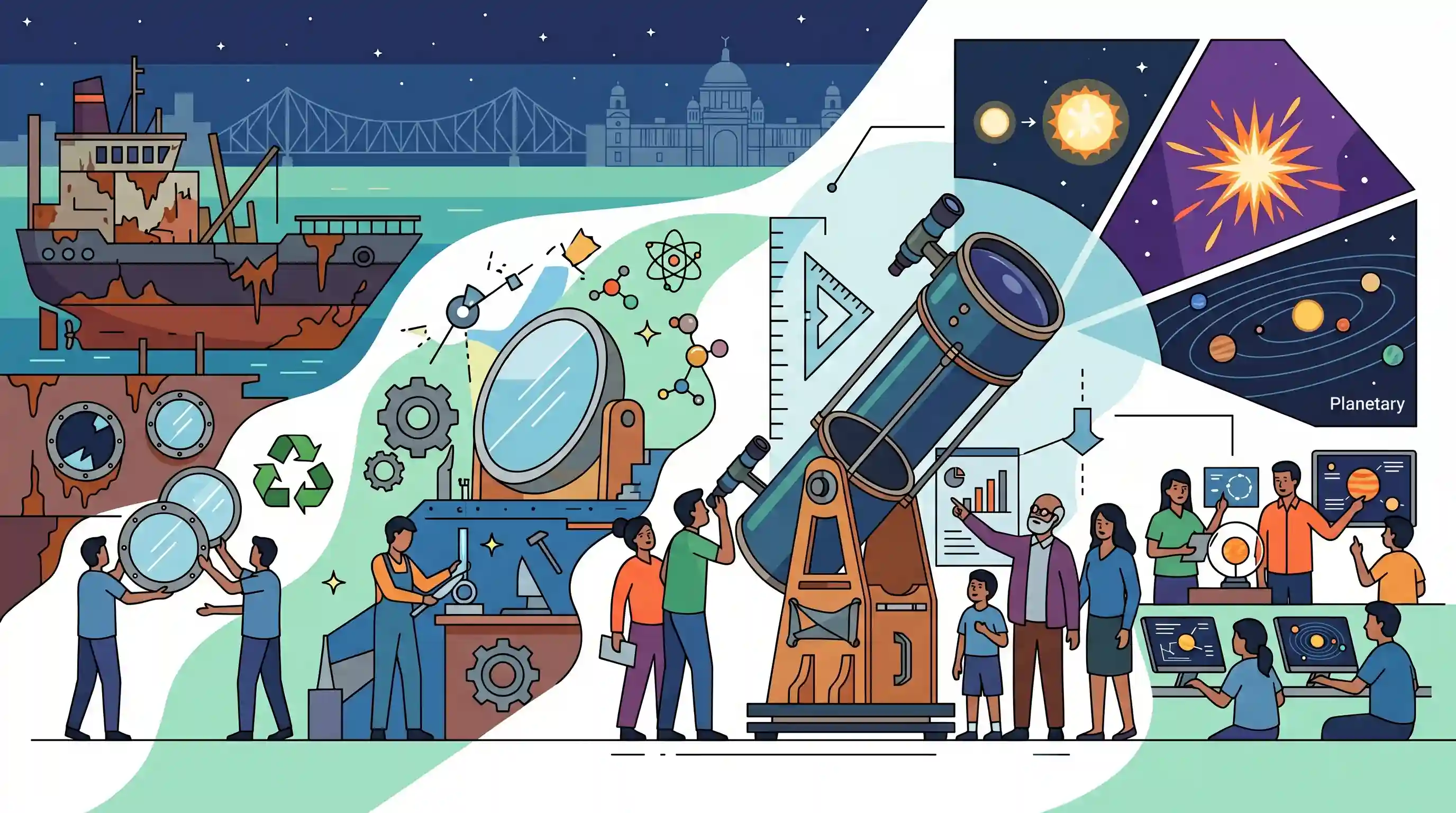
Why It Matters
Demonstrates low-cost indigenous innovation and upcycling (converting ship scrap into a scientific instrument). It also highlights civil society's role in promoting STEM education, astronomy outreach, and citizen science, relevant for GS3 Science and Technology.
Summary
In a major boost for citizen science and observational astronomy, two Kolkata-based NGOs have jointly built the city's largest handmade, low-cost telescope. The 14.5-inch f/5 Dobsonian telescope was innovatively constructed using upcycled porthole glass sourced from a scrapped ship at the Kandala shipyard in Gujarat. Designed for serious celestial observation, the telescope will allow enthusiasts and researchers to study phenomena such as variable stars, novae, supernovae, and planetary systems, promoting accessible science education.
Key Points
- Two astronomy NGOs, OAC and IASES, have created Kolkata's largest handmade, low-cost telescope.
- The 14.5-inch f/5 Dobsonian telescope was uniquely built using upcycled porthole glass from a scrapped ship in Kandala, Gujarat.
- The structure was crafted using fiberglass, wood, and steel, ensuring cost-effectiveness without compromising functionality.
- The telescope is intended for advanced observational astronomy, specifically to study variable stars, novae, supernovae, and planetary systems.
Important Terms
Institute of Astronomy Space and Earth Science (IASES)

A Kolkata-based research institute registered in 2021-22 focusing on fundamental and applied research in astronomy, astrophysics, and cosmology. It promotes science popularization through innovative, low-cost instrumentation and outreach.
UPSC context
GS Paper III (Science & Technology); tests awareness of indigenous research bodies and local contributions to space sciences.
Observational Astronomy Centre (OAC)
A Kolkata-based NGO of astronomy enthusiasts and professionals dedicated to observational research and education. It partnered with IASES to build large-scale, low-cost telescopes using upcycled materials.
UPSC context
GS Paper II (NGOs/Education) and GS Paper III (S&T); highlights the role of civil society in scientific advancement.
Dobsonian Telescope
A simplified, altazimuth-mounted Newtonian reflector telescope designed for low-cost, portable deep-sky observation. It emphasizes large apertures for maximum light collection without expensive motorized tracking systems.
UPSC context
GS Paper III (Science & Technology); relevant to indigenization of technology and basics of astronomical instrumentation.
Citizen Science
Scientific research conducted with the participation of non-professional or amateur scientists. It democratizes science by involving the public in data collection, observation, and building accessible research tools.
UPSC context
GS Paper III (S&T/Education); tests understanding of participatory research models and democratizing science education in India.
Upcycling
The creative reuse of discarded materials to create products of higher quality or value. Here, it refers to repurposing salvaged ship porthole glass for high-precision astronomical mirrors.
UPSC context
GS Paper III (Environment/Economy); covers waste management, circular economy, and sustainable innovation in scientific manufacturing.
Prelims Trap
"A Nova is the catastrophic terminal explosion and death of a massive star."
This describes a Supernova. A Nova is a recurring, non-terminal thermonuclear explosion on the surface of a white dwarf. The star survives the event.
Static Concepts Connected
What is the difference between Reflecting and Refracting telescopes?
- Refracting (Lenses): Uses glass lenses to bend and focus light. They are heavier, more expensive for large sizes, and prone to chromatic aberration (color distortion).
- Reflecting (Mirrors): Uses a curved primary mirror (like the Dobsonian mentioned) to gather light. They are highly cost-effective for large apertures and eliminate chromatic aberration.
How do Novae differ from Supernovae in stellar evolution?
- Nova: A surface explosion on a white dwarf in a binary system. It temporarily increases in brightness but the star survives and can erupt again.
- Supernova: The catastrophic terminal explosion of a massive star, or a white dwarf exceeding the Chandrasekhar limit (1.4 solar masses), completely destroying the star.
Cross-Topic Patterns
Frugal Space Tech & Circular Economy
Using Kandala ship-glass connects astronomy to India's ship-recycling industry (Alang) and the Recycling of Ships Act 2019, bridging S&T with sustainable waste management.
Citizen Science & Standard Candles
Democratized astronomy allows amateurs to track Cepheid variables, crucial "standard candles" for measuring cosmic distances, a domain traditionally reserved for institutional space agencies.

Expect multi-statement Prelims questions mixing basic optics (reflecting vs refracting) with stellar evolution (Nova/Supernova limits).
Linked PYQs · 4
Linked PYQs · 4
- 2023PrelimsGS1
Consider the following pairs: Objects in space Description 1. Cepheids: Giant clouds of dust and gas in space 2. Nebulae: Stars which brighten and dim periodically 3. Pulsars: Neutron stars that are formed when massive stars run out of fuel and collapse How many of the above pairs are correctly matched?
- 2024PrelimsGS1
Consider the following statements: Statement-I: Giant stars live much longer than dwarf stars. Statement-II : Compared to dwarf stars, giant stars have a greater rate of nuclear reactions. Which one of the following is correct in respect of the above statements?
- 2017PrelimsGS1
The terms 'Event Horizon', 'Singularity', 'String Theory' and 'Standard Model' are sometimes seen in the news in the context of
- 2020PrelimsGS1
"The experiment will employ a trio of spacecraft flying in formation in the shape of an equilateral triangle that has sides one million kilometres long, with lasers shining between the craft." The experiment in question refers to
