Astronomers Discover Inside Out Planetary System Around Red Dwarf
Source:The Hindu ↗
Why It Matters
The discovery directly challenges existing models of planetary formation, illustrating the evolving nature of space science. Telescopes like JWST, the concept of the 'Goldilocks Zone' (habitability), and the classification of exoplanets (super-Earths, mini-Neptunes) are highly relevant for both UPSC Prelims and GS-III Mains space technology questions.
Summary
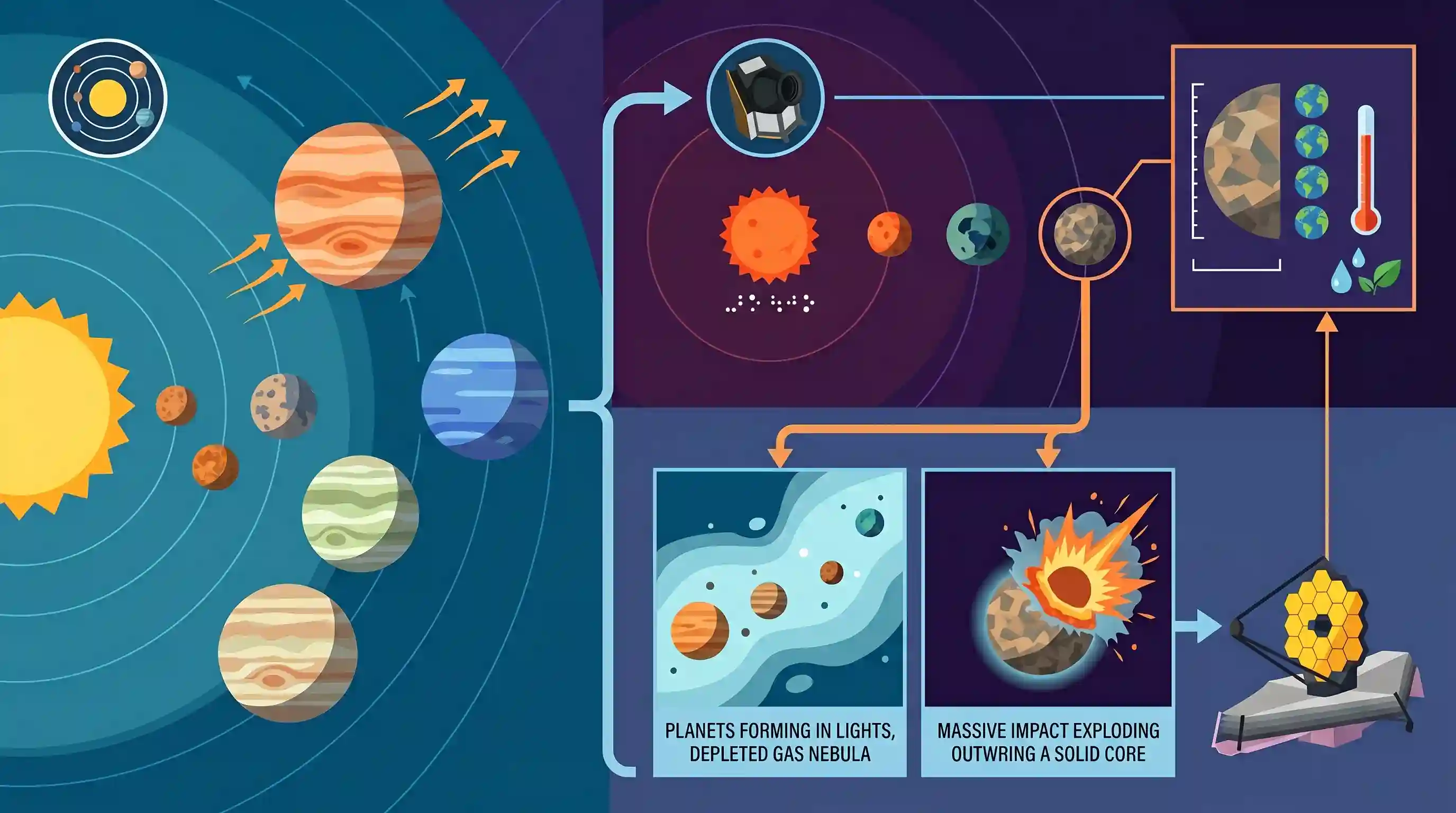
Astronomers using the European Space Agency's Cheops space telescope have discovered an unusual "inside-out" planetary system around LHS 1903, a red dwarf star 117 light-years away in the Lynx constellation. The system confounds conventional planetary formation theories because its outermost fourth planet is rocky rather than gaseous. Standard models suggest inner planets are rocky due to stellar heat blowing away gas, while outer planets accumulate thick gaseous atmospheres in colder regions. Researchers theorize the fourth planet either formed late in a gas-poor environment or lost its primordial atmosphere in a colossal impact. With a mass 5.8 times that of Earth and a temperature of roughly 60°C, it is potentially habitable and will be a prime target for future study by the James Webb Space Telescope.
Key Points
- The newly discovered LHS 1903 system contains a rocky innermost planet, two gaseous middle planets (mini-Neptunes), and an unexpectedly rocky outermost planet (super-Earth).
- This "inside-out" architecture challenges traditional planetary formation paradigms, which posit that planets forming further from the star should be gas-rich due to colder environments.
- Astronomers hypothesize the outermost rocky planet is either a 'late bloomer' formed after planetary gas was exhausted, or an atmospheric-stripped remnant of a collision.
- The fourth planet's surface temperature is estimated at 60°C, placing it in a potentially habitable zone.
- Future observations by the James Webb Space Telescope (JWST) will investigate its atmosphere and habitability.
Important Terms
CHEOPS (CHaracterising ExOPlanet Satellite)

An ESA-led space telescope designed to measure the sizes and bulk densities of known exoplanets through high-precision transit observations.
UPSC context
GS Paper III (Science & Technology); focuses on space missions, exoplanet characterization, and international collaboration in astronomy.
James Webb Space Telescope (JWST)
An international infrared observatory (NASA, ESA, CSA) situated at the L2 Lagrange point, designed to observe the early universe and characterize exoplanet atmospheres.
UPSC context
GS Paper III (S&T); frequently tested for its technological superiority over Hubble and its astrophysical objectives.
European Space Agency (ESA)
An intergovernmental organization of 22 member states dedicated to space exploration, including missions like CHEOPS and contributions to the JWST.
UPSC context
GS Paper II/III; relevant for international organizations and global cooperation in space research and satellite technology.
Exoplanet
Any planet located outside our Solar System, orbiting a star; they are primarily identified through methods like radial velocity and transits.
UPSC context
GS Paper III (S&T); essential for understanding planetary systems, habitability, and the search for extraterrestrial life.
Red Dwarf
A small, relatively cool, and faint star belonging to the M-spectral type; these are the most common stars in the Milky Way.
UPSC context
GS Paper I (Geography/Cosmology); important for understanding stellar evolution and types of stars hosting potentially habitable planets.
Inside-out Planet Formation
A theoretical model where planets form sequentially in a gas-poor environment, potentially placing rocky planets further from their star than gas giants.
UPSC context
GS Paper I (Geography/Universe); challenges standard planetary formation models like core accretion and enhances understanding of system evolution.
Prelims Trap
Outer planets in a star system are invariably gaseous because stellar heat only blows gas away from inner planets.
UPSC uses words like "invariably" to trap. The LHS 1903 system proves outer planets can be rocky, defying standard planetary formation models.
Static Concepts Connected
What distinguishes the 'Goldilocks Zone' around different types of stars?
- Definition: The specific orbital band around a star where temperatures allow liquid water to exist on a planet's surface.
- Star Dependency: Its distance depends heavily on the star's heat. It is much closer for cool Red Dwarfs (like LHS 1903) and further away for hotter stars.
How do CHEOPS and JWST differ in their exoplanet missions?
- CHEOPS: An ESA mission designed to precisely measure the size, density, and structure of ALREADY known exoplanets, not to discover new ones.
- JWST: A joint advanced infrared space observatory that analyzes the atmospheric composition and chemical signatures of exoplanets to assess habitability.
Cross-Topic Patterns
Telescope functions + Agency matches
UPSC frequently tests telescope functions. Distinguishing mission objectives—like CHEOPS (measuring size/density of known planets) versus JWST (analyzing atmospheric compositions via infrared)—is a classic exam pattern.
Red Dwarfs + Astrobiology habitable zones
Most exoplanet discoveries revolve around Red Dwarfs. Linking their low temperature to a much closer "Goldilocks Zone"—and the resulting tidal locking of planets—is a core astrophysics concept for UPSC.

Expect a 2026 question pairing ESA's Cheops vs JWST functions, alongside the definition of the Goldilocks zone around Red Dwarf stars.
Linked PYQs · 2
Linked PYQs · 2
- 2015PrelimsGS1
The term 'Goldilocks Zone' is often seen in the news in the context of
- 2022MainsGS3
Launched on 25th December, 2021, James Webb Space Telescope has been much in the news since then. What are its unique features which make it superior to its predecessor Space Telescopes ? What are the key goals of this mission ? What potential benefits does it hold for the human race?
