Astronomical Discovery of Circumbinary Exoplanets Using TESS Data
Source:Indian Express ↗
Why It Matters
The discovery introduces advanced techniques in astrophysics (like apsidal precession) for detecting exoplanets and highlights the continued importance of space observatories like TESS. Concepts such as the Goldilocks Zone and exoplanets are recurring themes in UPSC Science & Technology questions.
Summary
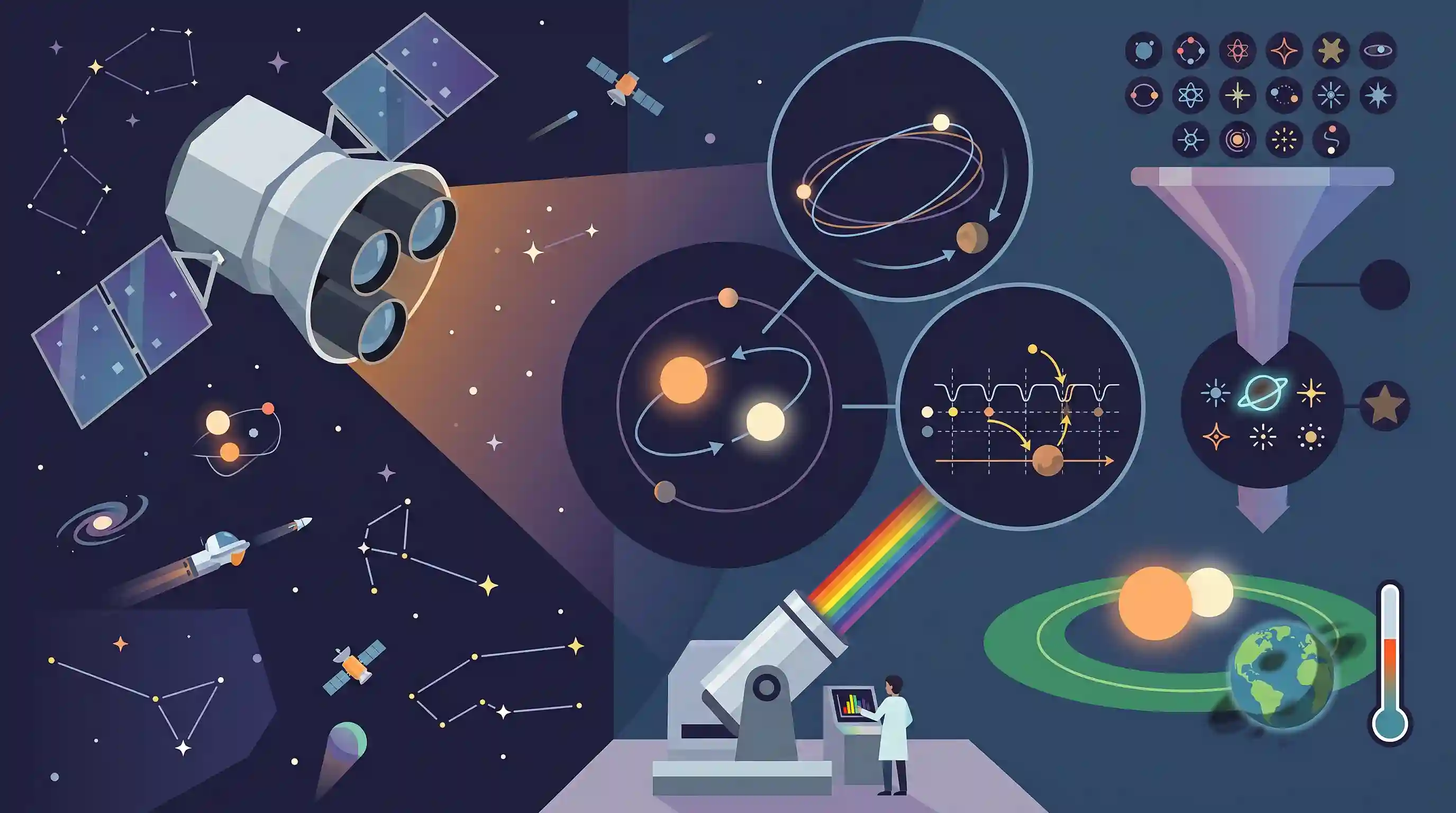
Astronomers have identified 27 potential circumbinary planets—planets that orbit two stars—using novel detection techniques on data from NASA's Transiting Exoplanet Survey Satellite (TESS). Utilizing "apsidal precession" and eclipse timing variations instead of standard transit methods, scientists observed anomalies in 36 binary star systems, 27 of which suggest the presence of planet-mass bodies. Further spectral analysis is required to formally confirm these discoveries. If situated in the habitable (Goldilocks) zone, such planets theoretically possess moderate temperatures, despite having extreme environments compared to our solar system.
Key Points
- Astronomers have identified 27 potential circumbinary planets, meaning they orbit around two stars instead of one, similar to the fictional planet Tatooine.
- The candidates were detected using data from NASA's Transiting Exoplanet Survey Satellite (TESS) launched in 2018.
- Scientists used techniques like "apsidal precession" and eclipse timing variations, searching for gravitational and timing anomalies between eclipsing binary stars.
- The potential planets are estimated to range from Neptune-sized to ten times heavier than Jupiter, and their confirmation requires further study of their light spectra.
- The discoveries spark interest in identifying such planets within the Goldilocks or habitable zones of binary star systems.
Important Terms
TESS (Transiting Exoplanet Survey Satellite)

NASA's space telescope launched in 2018 to discover exoplanets by monitoring the brightness of over 200,000 stars to detect periodic dimming (transits) caused by orbiting planets.
UPSC context
GS Paper 3: Science and Tech (Space). Important for awareness of international space missions and planetary discovery techniques.
Circumbinary Planet
A type of exoplanet that orbits a pair of stars (binary system) rather than a single sun, once thought rare but now central to understanding planetary formation diversity.
UPSC context
GS Paper 3: Science and Tech. Relevant for advanced orbital mechanics and habitable environment models in multi-star systems.
Apsidal Precession
The gradual rotation of the major axis (line of apsides) of an elliptical orbit, caused by gravitational perturbations from other planets or general relativistic effects.
UPSC context
GS Paper 3: Science and Tech. An advanced concept in celestial mechanics used as an alternative signature for detecting non-transiting planets.
Goldilocks Zone
The 'habitable zone' around a star where conditions are neither too hot nor too cold for liquid water to exist on a planet's surface, a key metric for life.
UPSC context
GS Paper 3: Science and Tech. Frequently tested in Prelims (e.g., 2015) regarding the search for Earth-like planets.
Binary Star System
A system where two stars are gravitationally bound and orbit around a common center of mass; they are crucial for measuring stellar mass and testing evolution theories.
UPSC context
GS Paper 1: Geography (Universe) and GS Paper 3 (Science). Fundamental to understanding stellar lifecycle and planetary dynamics.
Exoplanet
Any planet situated outside our solar system that orbits a star other than our Sun. Thousands have been confirmed using transit and radial velocity methods.
UPSC context
GS Paper 3: Science and Tech. A core topic in space exploration and the search for extraterrestrial habitability.
NASA
The National Aeronautics and Space Administration, an independent agency of the US federal government responsible for the civilian space program, aeronautics, and space research.
UPSC context
GS Paper 2 & 3: International Relations and Science and Tech. Relevant for India-US space collaboration (e.g., NISAR).
Prelims Trap
TESS strictly and exclusively relies on the transit method to detect exoplanets.
TESS data was utilized here for Eclipse Timing Variations (ETV) and apsidal precession to detect gravitational anomalies, proving its data supports non-transit methodologies.
Static Concepts Connected
What are the primary indirect methods used by astronomers to detect exoplanets?
- Transit Method: Observes the minute, periodic dimming of a star's brightness when a planet passes directly between the star and the telescope.
- Radial Velocity: Detects slight orbital wobbles in a host star caused by the gravitational tug of orbiting planets via Doppler shift.
- Eclipse Timing: Measures irregularities and timing anomalies in the eclipses of binary stars to mathematically infer hidden planetary masses.
What defines the Goldilocks (Habitable) Zone around a star?
- Liquid Water Capability: The specific orbital distance where a planet's surface temperature is moderate enough to sustain liquid water, neither freezing nor boiling.
- Star-Dependent Distance: The zone's exact distance varies based on the host star's size and luminosity; it is much closer for cool red dwarfs than for Sun-like stars.
Cross-Topic Patterns
Telescope generations: Kepler vs TESS vs JWST
UPSC tests satellite objectives. Kepler looked deeply at one sky patch; TESS surveys the whole sky; JWST follows up to analyze exoplanetary atmospheres via infrared spectroscopy.
Relativity and Apsidal Precession
Apsidal precession (orbit rotation) historically proved Einstein's General Relativity via Mercury's orbit. UPSC often links fundamental physics concepts to modern astrophysical discoveries.

Expect a 2026 match-the-following pairing space telescopes (TESS, JWST, Euclid) with their primary astrophysical detection methods.
Linked PYQs · 2
Linked PYQs · 2
- 2015PrelimsGS1
The term 'Goldilocks Zone' is often seen in the news in the context of
- 2022MainsGS3
Launched on 25th December, 2021, James Webb Space Telescope has been much in the news since then. What are its unique features which make it superior to its predecessor Space Telescopes ? What are the key goals of this mission ? What potential benefits does it hold for the human race?
