Sahara Desert Dinosaur Fossil Discovery and Paleoclimatology
Source:Indian Express ↗
Why It Matters
Provides concrete evidence of major geological and climatic shifts over millions of years (e.g., the Sahara's transition from a lush forest to a desert), which is relevant to UPSC topics on Earth's geographical history and the evolution of prehistoric species.
Summary
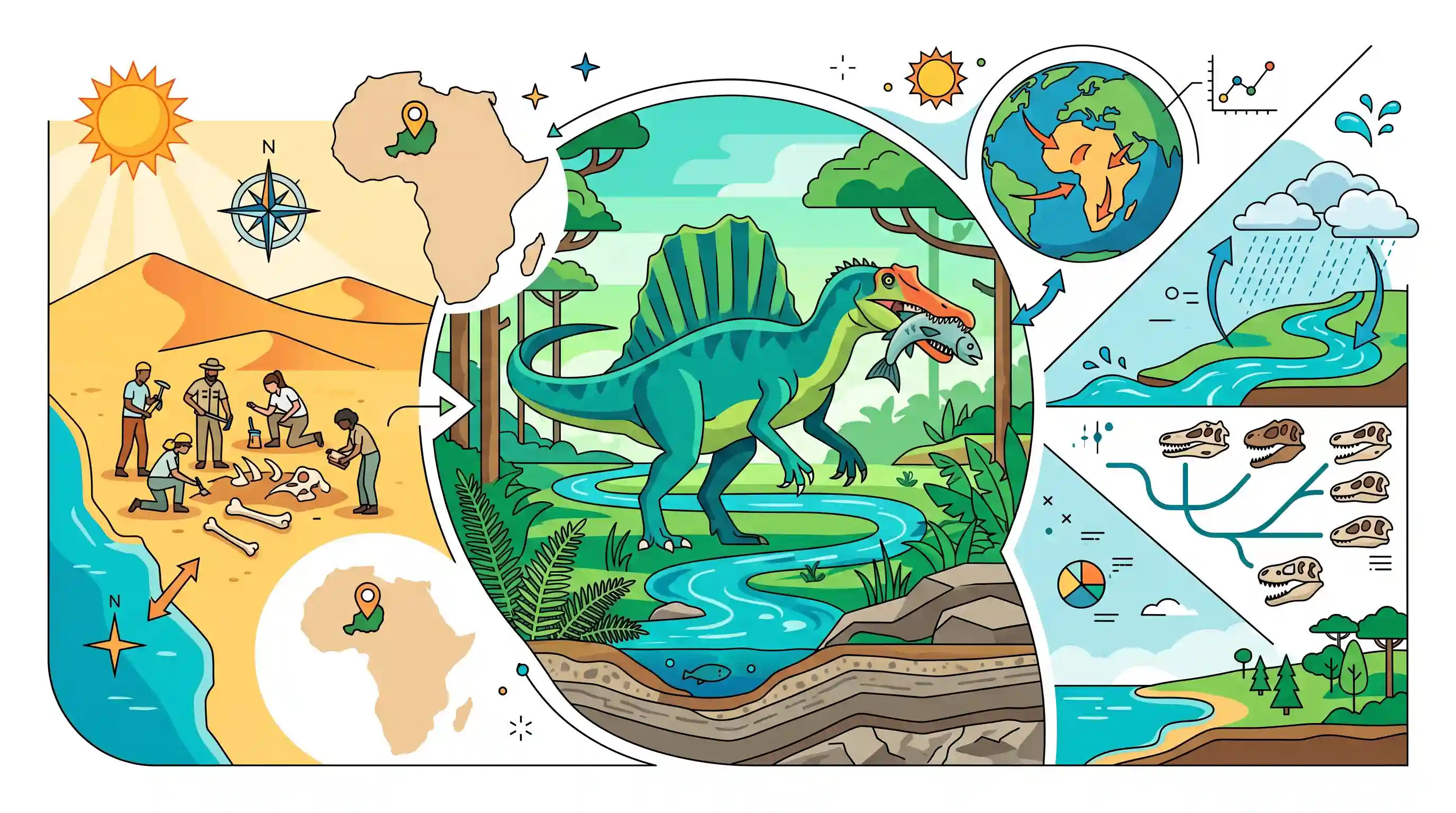
A newly discovered 95-million-year-old dinosaur species, Spinosaurus mirabilis, has been unearthed in the Sahara Desert in Niger. The massive, fish-hunting predator, known for its unique scimitar-shaped cranial crest, was found hundreds of kilometers inland by a team led by Paul Sereno of the University of Chicago. This contrasts with previous coastal Spinosaurus discoveries and suggests that the modern Sahara desert was once a lush, freshwater-rich landscape with rivers and forests. The finding provides crucial data for paleontology and paleoclimatology, highlighting profound geographical and climatic shifts in Earth's history.
Key Points
- A new 95-million-year-old dinosaur species, Spinosaurus mirabilis, was discovered in Niger's Sahara desert.
- Unlike previous coastal Spinosaurus finds, these fossils were discovered hundreds of kilometers inland.
- The dinosaur was a massive fish-hunting predator featuring a rare, scimitar-shaped cranial crest and interlocking conical teeth for catching fish.
- The inland location of the fossils indicates that the Sahara was once a lush, forested environment with freshwater rivers millions of years ago.
- This discovery offers significant insights into Earth's paleoclimate and the evolutionary history of prehistoric fauna across changing geographical landscapes.
Important Terms
Paleoclimatology

The scientific study of Earth's past climates using natural records like fossils, ice cores, and sediment layers to reconstruct historical atmospheric and environmental conditions.
UPSC context
GS Paper 1 (Geography) and GS Paper 3 (Environment). Crucial for understanding natural climate variability versus anthropogenic climate change.
Paleontology
The study of ancient life through the examination of plant and animal fossils, providing insights into evolutionary biology, biodiversity, and the history of Earth's ecosystems.
UPSC context
GS Paper 3 (Science & Technology). Tests knowledge of Earth's biological history and the process of scientific discovery.
Desertification
The process by which fertile land becomes increasingly arid and unproductive. The Sahara’s historical shift from a lush, river-rich landscape to a desert is a primary case study.
UPSC context
GS Paper 1 (Physical Geography). Essential for topics on environmental degradation, soil erosion, and climate-driven land transformations.
Cretaceous Period
A geological period from approximately 145 to 66 million years ago. It was the era of the Spinosaurus and the final period of the 'Age of Dinosaurs.'
UPSC context
GS Paper 1 (Geography). Relevant for the Geological Time Scale and understanding significant extinction events and Earth's tectonic history.
Tethys Ocean
An ancient ocean that existed between the continents of Gondwana and Laurasia during much of the Mesozoic Era before the opening of the Atlantic and Indian Oceans.
UPSC context
GS Paper 1 (Physical Geography). Key to Plate Tectonics theory and explaining the distribution of marine fossils in modern inland regions.
Subtropical Ridge
A large, semi-permanent belt of high pressure found around 30° latitude, which causes dry air to descend, leading to the formation of major deserts like the Sahara.
UPSC context
GS Paper 1 (Climatology). Fundamental for understanding global wind patterns, pressure belts, and the formation of world deserts.
Prelims Trap
"Aquatic Spinosaurus fossils prove that Niger was historically a coastal marine environment."
The fossils prove a lush freshwater river ecosystem, not a coastal/marine one. Aspirants might conflate 'aquatic/fish-hunting' with 'oceanic' or 'coastal', especially since Niger is landlocked today.
Static Concepts Connected
What are key evidences for paleoclimatic shifts in Earth's history?
- Paleontological: Fossils of tropical flora and fauna found in modern deserts (like the Sahara) or polar regions.
- Glaciological: Glacial striations and tillite deposits found in presently warm regions like India, Africa, and Australia.
- Sedimentary: Thick coal beds in high latitudes indicating these regions were once near the equator with dense forests.
What defined the Late Cretaceous period (Mesozoic Era)?
- Greenhouse Climate: Extreme global warming with high sea levels, lush vegetation, and largely ice-free poles.
- Tectonic Shifts: The continued fragmentation of Pangaea, isolating landmasses and driving highly localized, divergent evolutionary paths.
- Mass Extinction: Ended with the K-T extinction event (Chicxulub impact), wiping out non-avian dinosaurs approximately 66 million years ago.
Cross-Topic Patterns
Paleoclimate vs Sahel Desertification
The lush Cretaceous Sahara contrasts sharply with modern desertification in Niger, linking paleoclimatology to current UNCCD efforts and Great Green Wall initiatives in the Sahel.
Fossils as Continental Drift Evidence
UPSC frequently tests paleontology (like Mesosaurus fossils) as static evidence for Continental Drift, shifting tectonic plates, and ancient climatic zones.

Expect a 2026 prelims question linking paleoclimatic fossil evidence (like a lush Sahara) to Continental Drift and climate zones.
Linked PYQs · 4
Linked PYQs · 4
- 2019PrelimsGS1
The word 'Denisovan' is sometimes mentioned in media in reference to
- 2023PrelimsGS1
'Microsatellite DNA' is used in the case of which one of the following?
- 2025MainsGS1
Discuss how the changes in shape and sizes of continents and ocean basins of the planet take place due to tectonic movements of the crustal masses.
- 2020MainsGS1
The process of desertification does not have climatic boundaries. Justify with examples.
