Near Earth Object Trajectories and Planetary Defense Mechanics
Source:The Hindu ↗
Why It Matters
Asteroid impacts represent a low-probability but high-consequence global threat. Understanding the tracking of NEOs like Asteroid YR4 and the mechanics of gravitational keyholes is crucial for UPSC aspirants, as planetary defense and space technology are recurring themes in the GS-III Science and Technology syllabus, directly tested in recent Mains exams.
Summary
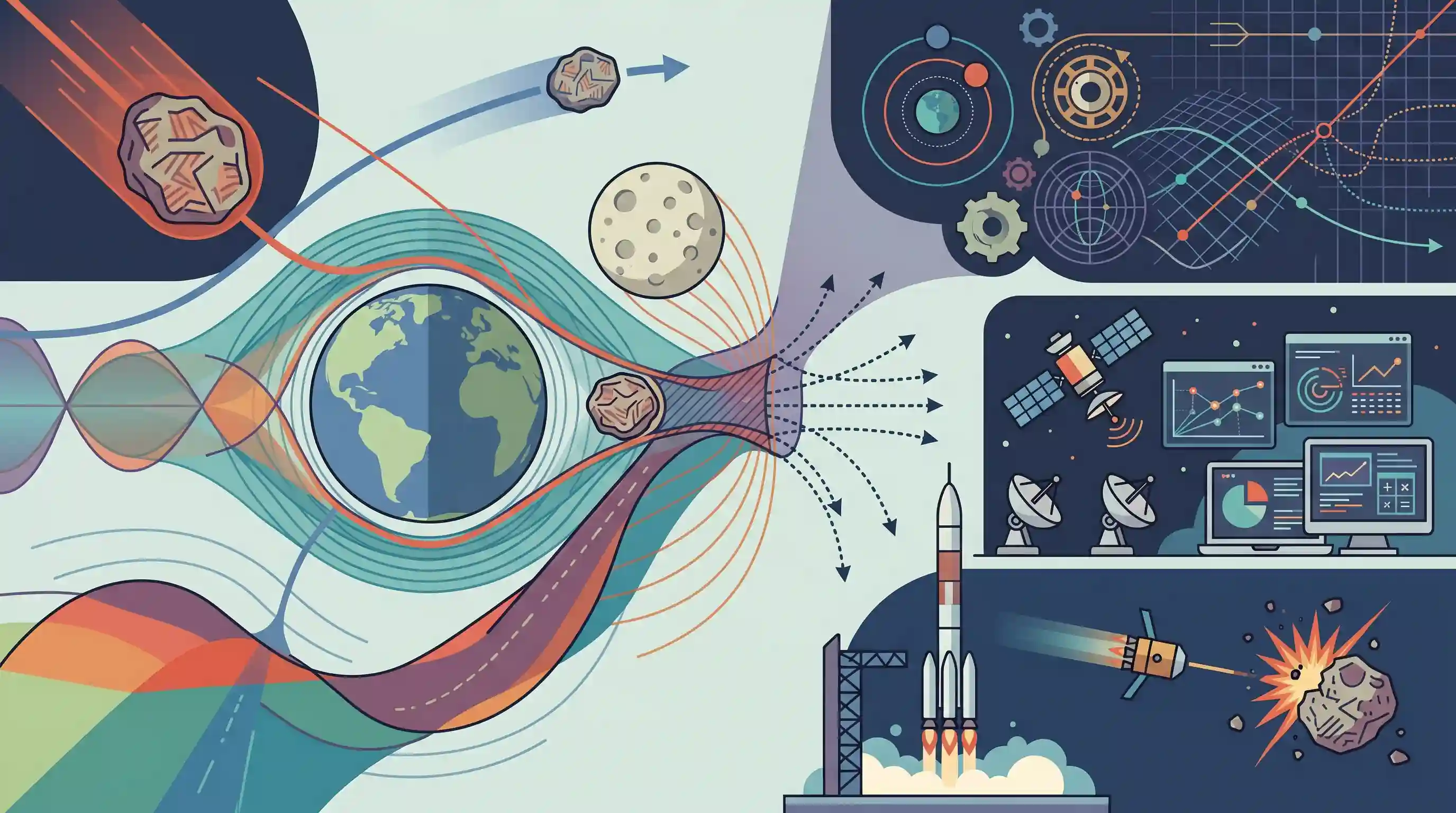
The article discusses the orbital trajectory of Asteroid YR4, a Near-Earth Object (NEO) that recently drew attention due to a slight potential for an Earth impact. While updated tracking suggests it will safely bypass Earth, the focus shifts to its interaction with the Moon. The complex gravitational pull of the Earth-Moon system can act as a 'gravitational keyhole', subtly altering the asteroid's future trajectory. This highlights the intricate celestial mechanics involved in tracking NEOs and underscores the critical importance of global planetary defense strategies, such as continuous monitoring and kinetic deflection missions, to prevent potential catastrophic impacts in the future.
Key Points
- Asteroid YR4 is a newly tracked Near-Earth Object (NEO) whose initial orbital projections indicated a remote but non-zero possibility of a future collision with Earth.
- Refined orbital calculations suggest that the asteroid will likely miss Earth, but its close approach involves complex gravitational dynamics.
- The asteroid's trajectory could interact with the Moon's gravity, potentially passing through a 'gravitational keyhole' that might unpredictably alter its long-term path for future orbits.
- The event underscores the necessity for continuous tracking of NEOs and the development of robust planetary defense mechanisms (such as kinetic impactors like the DART mission) to mitigate existential threats from space.
Important Terms
Near-Earth Objects (NEOs)

Asteroids or comets with orbits bringing them within 1.3 AU (195 million km) of the Sun. They are remnants of the early solar system.
UPSC context
GS III (Science & Tech); tests knowledge of space hazards and solar system evolution.
DART Mission
NASA’s 2022 mission that successfully tested the 'kinetic impactor' technique by crashing a spacecraft into the moonlet Dimorphos to alter its orbital path.
UPSC context
GS III (Science & Tech); tests awareness of planetary defense and latest space mission outcomes.
Project NETRA
ISRO's indigenous early warning system (Network for space object TRacking and Analysis) designed to monitor space debris and NEOs to protect Indian space assets.
UPSC context
GS III (Indigenous Technology); tests knowledge of India's Space Situational Awareness (SSA) capabilities.
Planetary Defense Coordination Office (PDCO)
A NASA office established in 2016 to manage the detection, tracking, and characterization of hazardous NEOs and coordinate international impact-threat responses.
UPSC context
GS III (International Relations/Space); tests understanding of global institutional frameworks for space disaster management.
Gravitational Keyhole
A tiny region of space where a planet's gravity can precisely alter a passing asteroid's orbit, leading to a future collision during a later encounter.
UPSC context
GS III (Science & Tech); tests technical understanding of orbital mechanics and asteroid monitoring risks.
Potentially Hazardous Asteroids (PHAs)
A subset of NEOs larger than 140 meters that pass within 0.05 AU (7.5 million km) of Earth's orbit, posing a significant impact risk.
UPSC context
GS III (Disaster Management); tests ability to categorize space threats based on size and proximity.
Prelims Trap
"All Near-Earth Objects (NEOs) inherently possess trajectories that intersect or cross Earth's orbit."
False. NEOs are defined as coming within 1.3 AU of the Sun. Asteroids in the 'Amor' group approach Earth but their orbits stay entirely outside Earth’s orbit.
Static Concepts Connected
What are the four classes of Near-Earth Asteroids based on their orbits?
- Atira and Aten: Atiras orbit entirely inside Earth's orbit. Atens cross Earth's orbit but have a semi-major axis smaller than Earth's.
- Apollo and Amor: Apollos cross Earth's orbit with a larger semi-major axis. Amors approach Earth but orbit entirely outside it, never crossing.
How does India independently track hazardous space objects and debris?
- Project NETRA: An ISRO early-warning network of indigenous radars and optical telescopes designed to detect space debris and NEOs, providing Space Situational Awareness (SSA).
- IS4OM Facility: ISRO System for Safe & Sustainable Space Operations Management. It actively monitors close approaches and safeguards Indian space assets from potential collisions.
Cross-Topic Patterns
Planetary defense as global commons governance
Deflecting asteroids requires unprecedented global cooperation, testing frameworks like the UN Outer Space Treaty and expanding the definition of global commons governance in international relations.
NEO tracking and extraterrestrial mining
Tracking NEOs directly feeds into the future space economy. Identifying accessible asteroids enables future mining of platinum-group metals, linking celestial mechanics to critical mineral security.

Expect a multi-statement question on NEO classifications (Apollo vs Aten) paired with ISRO's Project NETRA and kinetic impactor technology.
Linked PYQs · 1
Linked PYQs · 1
- 2024MainsGS3
What are asteroids? How real is the threat of them causing extinction of life? What strategies have been developed to prevent such a catastrophe?
