Combination Therapy Reduces Bladder Cancer Mortality Risk
Source:The Hindu ↗
Why It Matters
Cancer therapies involving monoclonal antibodies, ADCs, and immunotherapies are rapidly evolving fields in biotechnology. UPSC frequently tests the mechanisms of novel biotechnological tools (like RNAi, CAR-T, or monoclonal antibodies) and their applications in human health.
Summary
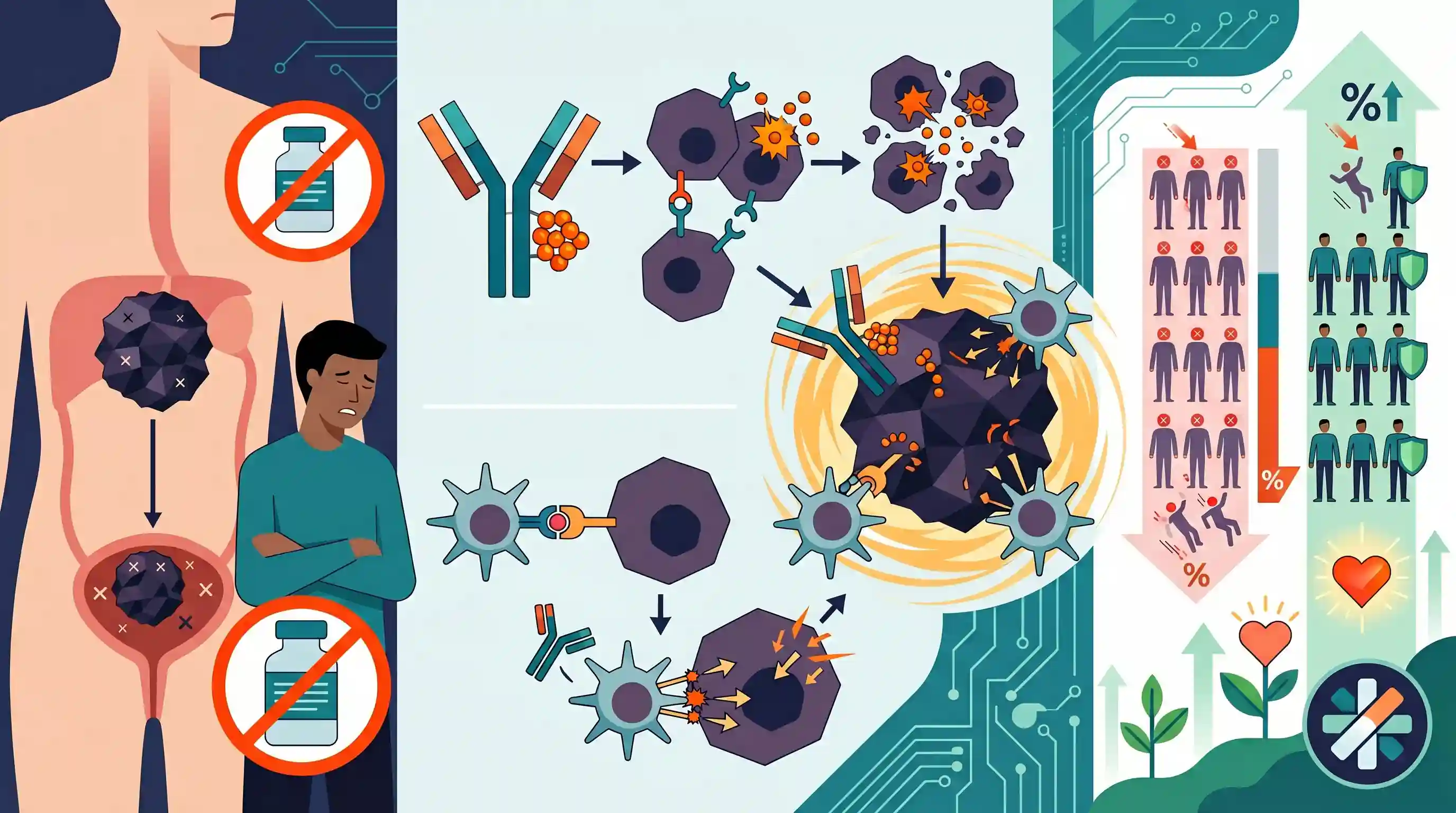
Clinical trial results reveal that a combination of the targeted drug Padcev (Astellas/Pfizer) and the immunotherapy Keytruda (Merck) halves the risk of death for patients with muscle-invasive bladder cancer (MIBC) who cannot undergo standard cisplatin chemotherapy. The combination works synergistically: Padcev acts as an antibody-drug conjugate to directly deliver toxins to tumor cells, while Keytruda blocks the PD-1 protein to help the immune system detect and destroy the cancer. This advancement highlights the growing efficacy of combining distinct biological therapies to treat severe, difficult-to-treat cancers.
Key Points
- Astellas-Pfizer's 'Padcev' combined with Merck's 'Keytruda' significantly improved survival rates for muscle-invasive bladder cancer (MIBC) patients.
- The trial targeted patients ineligible for or declining cisplatin-based chemotherapy, a group historically lacking effective treatment options.
- The combination therapy cut the risk of death by 50% and reduced the risk of tumor recurrence, progression, or death by 60%.
- Padcev is an antibody-drug conjugate (ADC) that delivers a toxic payload directly to cancer cells, minimizing damage to normal cells.
- Keytruda is an immunotherapy that blocks the PD-1 protein on cells, allowing the body's immune system to recognize and attack cancer cells.
Important Terms
Food and Drug Administration (FDA)

The U.S. federal agency regulating the safety and efficacy of pharmaceuticals and medical devices. It serves as a global benchmark for drug approvals and international regulatory standards.
UPSC context
GS Paper 2/3: International regulatory bodies, global health governance, and standards impacting India’s pharmaceutical export sector.
Antibody-drug conjugate (ADC)
A class of targeted cancer drugs combining a monoclonal antibody with a cell-killing toxin. They act as "smart bombs" by delivering chemotherapy directly to tumor cells, reducing damage to healthy tissue.
UPSC context
GS Paper 3: Science & Tech (Biotechnology). Important for understanding advanced drug delivery systems and precision medicine.
Immunotherapy
A biological therapy that boosts or restores the body’s immune system to identify and destroy cancer cells, often using checkpoint inhibitors to remove "brakes" on the immune response.
UPSC context
GS Paper 3: Science & Tech. Tests knowledge of modern medical breakthroughs and biological alternatives to traditional chemotherapy.
Programmed cell death protein 1 (PD-1)
An immune checkpoint protein on T-cells that regulates immune response. Blocking this protein helps the immune system recognize and kill cancer cells that otherwise hide from detection.
UPSC context
GS Paper 3: Biotechnology. A specific mechanism frequently tested in the context of Nobel Prize-winning research and cancer breakthroughs.
New England Journal of Medicine (NEJM)
A high-impact, peer-reviewed weekly medical journal. It publishes seminal clinical trials that define global standards of care and inform public health policy worldwide.
UPSC context
GS Paper 3: Science & Tech. Relevance of evidence-based research and peer-reviewed literature in evaluating global scientific progress.
Muscle-invasive bladder cancer (MIBC)
An advanced stage of bladder cancer where the tumor has grown into the bladder’s muscular wall, increasing the risk of spread and necessitating complex multi-modal treatment.
UPSC context
GS Paper 3: Issues related to health and disease; understanding severe non-communicable diseases and their treatment challenges.
Pfizer
A leading American pharmaceutical corporation. It is a major player in global R&D, vaccine production, and the manufacturing of advanced biologics through international partnerships.
UPSC context
GS Paper 3: Intellectual Property Rights (IPR) and the role of multinational corporations in global health and medical innovation.
Astellas Pharma
A Japanese multinational pharmaceutical company specializing in oncology and immunology. Its collaboration on breakthrough therapies highlights the globalized nature of modern drug development.
UPSC context
GS Paper 3: Global biotechnology industry trends and international cooperation in scientific research and development.
Prelims Trap
"Antibody-Drug Conjugates (ADCs) treat cancer by activating the body's T-cells to attack tumors."
ADCs do not activate the immune system; they are targeted vehicles that deliver cytotoxic drugs directly into tumors. Activating T-cells is the role of immune checkpoint inhibitors like Keytruda.
Static Concepts Connected
How do Antibody-Drug Conjugates (ADCs) differ from traditional chemotherapy?
- Traditional Chemotherapy: Systemic drugs that indiscriminately attack all rapidly dividing cells, causing significant collateral damage like hair loss and severe immune suppression.
- ADCs: Engineered biopharmaceuticals combining monoclonal antibodies with cytotoxic payloads. They bind specifically to tumor antigens, releasing the toxin only inside the cancer cell.
- Targeted Precision: By sparing healthy cells, ADCs vastly reduce the toxicity and side effects associated with standard cancer treatments.
What are immune checkpoints and how do PD-1 inhibitors work?
- Immune Checkpoints: Proteins like PD-1 on T-cells act as "off switches" (brakes) to prevent the immune system from mistakenly attacking normal, healthy cells.
- Cancer Evasion: Many tumors express proteins (like PD-L1) that bind to the PD-1 receptor, effectively tricking the T-cells into leaving the cancer cells alone.
- Checkpoint Inhibitors: Drugs like Keytruda block the PD-1 pathway, removing the "brakes" so the body's natural T-cells can recognize and destroy the tumor.
Cross-Topic Patterns
Biologics pricing & Compulsory Licensing
Advanced biologics like ADCs and immunotherapies are prohibitively expensive, triggering debates on invoking Section 84 (Compulsory Licensing) of the Indian Patents Act for life-saving oncology drugs.
CAR-T to ADCs: Oncology Tech Progression
UPSC recently tested CAR-T cell therapy. The next logical progression in oncology questions involves differentiating between cellular therapies, monoclonal antibodies, and Antibody-Drug Conjugates (ADCs).

A multi-statement question contrasting the mechanisms of CAR-T cells, Antibody-Drug Conjugates, and mRNA vaccines is highly probable in 2026.
Linked PYQs · 3
Linked PYQs · 3
- 2025PrelimsGS1
With reference to monoclonal antibodies, often mentioned in news, consider the following statements : I. They are man-made proteins. II. They stimulate immunological function due to their ability to bind to specific antigens. III. They are used in treating viral infections like that of Nipah virus. Which of the statements given above are correct?
- 2024PrelimsGS1
With reference to monoclonal antibodies, often mentioned in news, consider the following statements : I. They are man-made proteins. II. They stimulate immunological function due to their ability to bind to specific antigens. III. They are used in treating viral infections like that of Nipah virus. Which of the statements given above are correct?
- 2019PrelimsGS1
'RNA interference (RNAi)' technology has gained popularity in the last few years. Why? 1. It is used in developing gene silencing therapies. 2. It can be used in developing therapies for the treatment of cancer. 3. It can be used to develop hormone replacement therapies. 4. It can be used to produce crop plants that are resistant to viral pathogens. Select the correct answer using the code given below.
