US Assures Uninterrupted Access to Critical AI Technology
Source:The Hindu ↗
Why It Matters
The Pax Silica initiative represents a vital geopolitical realignment in technology supply chains, directly impacting India's strategic autonomy and its rivalry with China. It blends international relations (GS2) with emerging technologies (GS3), making it a high-probability topic for questions on critical minerals, the Minerals Security Partnership, and Indo-US tech cooperation (e.g., iCET).
Summary
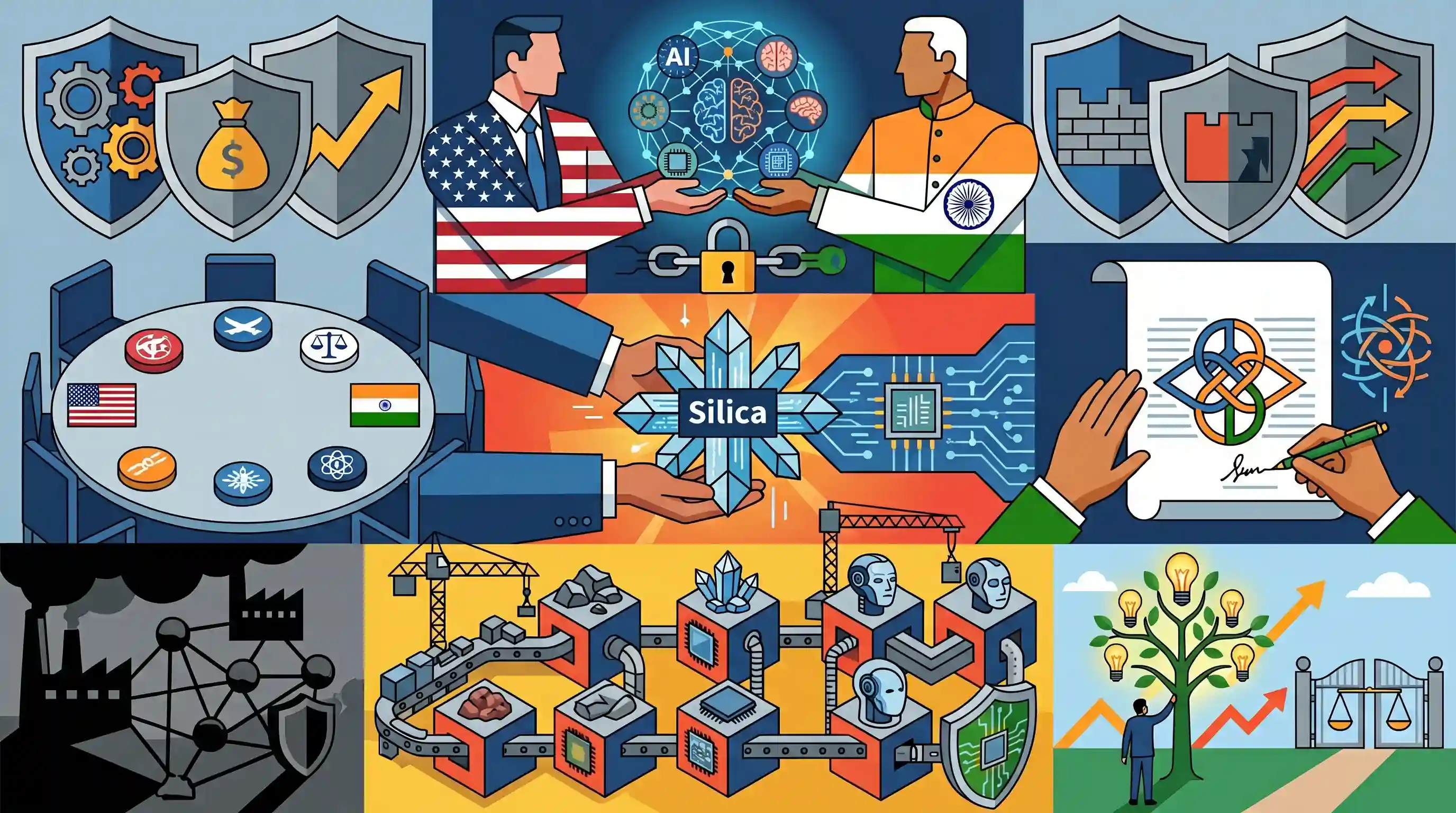
The United States has assured India that access to critical Artificial Intelligence (AI) technologies, once granted, will not be cut off. This assurance came during the Pax Silica Summit in the U.S., attended by India's MeitY Secretary S. Krishnan. The U.S.-led Pax Silica initiative, which India formally joined in February, is designed to secure vulnerable global supply chains in critical minerals, rare earths, semiconductors, and AI, thereby reducing dependence on China. Indian officials emphasized that Pax Silica serves as a pact for economic and military security, transcending a traditional trade agreement. Meanwhile, India's domestic stance on AI currently favors unhindered innovation, though the government remains open to future regulations should the need arise.
Key Points
- The U.S. has assured India that access to AI technologies will not be revoked once provided.
- This assurance was made during the Pax Silica Summit, a U.S.-led initiative focusing on securing supply chains for critical minerals, rare earths, semiconductors, and AI.
- India joined the Pax Silica initiative in February, viewing it as a strategic pact for economic and military security rather than a conventional trade agreement.
- The initiative aims to counter China's dominance in critical global technology supply chains.
- On AI regulation, India currently prioritizes fostering innovation but remains open to implementing regulations if necessary in the future.
Important Terms
Pax Silica Initiative

A US-led strategic framework aimed at securing global supply chains for semiconductors, AI, and critical minerals to reduce dependence on China-centric manufacturing and ensure technological security for partner nations.
UPSC context
Relevant for GS Paper II (International Relations) and GS Paper III (Science & Technology/Economy) regarding technology diplomacy and supply chain security.
Ministry of Electronics and Information Technology (MeitY)
The nodal Indian government ministry responsible for policy formulation and strategic development in electronics, IT, digital governance, and emerging technologies like AI and semiconductors.
UPSC context
Significant for GS Paper II (Governance) and GS Paper III (S&T) as the key implementation body for India's digital missions.
Critical Minerals
Naturally occurring metallic or non-metallic elements (e.g., lithium, cobalt, rare earths) that are essential for advanced technologies, defense systems, and the green energy transition.
UPSC context
Critical for GS Paper I (Geography) and GS Paper III (Economy/Security) concerning resource security and industrial strategy.
AI Sovereignty
The strategic ability of a nation to maintain control over its digital infrastructure, AI models, and data, ensuring that critical technology remains accessible and under domestic oversight.
UPSC context
Important for GS Paper III (S&T/Security) regarding the intersection of advanced technology and national interest.
Supply Chain Resilience
A strategy aimed at diversifying manufacturing bases and securing logistics to prevent disruptions caused by geopolitical tensions or single-source dependencies (primarily on China).
UPSC context
Key for GS Paper III (Economy/Security) in the context of global trade and domestic manufacturing (Atmanirbhar Bharat).
Prelims Trap
Pax Silica is a bilateral Free Trade Agreement (FTA) between India and the US.
Pax Silica is a multilateral strategic pact focused on supply chain and military security, explicitly transcending conventional trade agreements or FTAs.
Static Concepts Connected
What is the US-India Initiative on Critical and Emerging Technology (iCET)?
- Objective: To elevate and expand strategic technology partnerships and defense industrial cooperation between the two nations.
- Key Domains: Focuses on AI, quantum computing, semiconductors, 5G/6G, space exploration, and defense manufacturing.
- Mechanism: It is uniquely spearheaded by the National Security Councils of both countries, rather than traditional trade ministries.
What makes Critical Minerals geopolitically significant?
- Definition: They are essential for economic growth, clean energy transitions, and national security, lacking viable commercial substitutes.
- Applications: Crucial for manufacturing EVs, solar panels, semiconductors, AI infrastructure, and advanced defense systems.
- Geopolitical Risk: Extraction and refining are highly geographically concentrated, with China dominating the processing capacity, creating global vulnerabilities.
Cross-Topic Patterns
Tech alliances and strategic autonomy
India's participation in Pax Silica, iCET, and the Minerals Security Partnership highlights a shift toward deep-tech strategic alignment with the West to mitigate supply chain dependencies on China.
Divergent global AI governance models
India's current 'pro-innovation' AI stance contrasts sharply with the EU's strict, rights-based AI Act and the increasing use of technology export controls (kill switches) by the US.

Expect a Prelims paired-matching question linking tech alliances (Pax Silica, iCET, MSP) to their lead nations or objectives.
Linked PYQs · 5
Linked PYQs · 5
- 2026PrelimsGS1
Which of the following statements about Rare Earth Elements (REEs) and Critical Minerals is/are correct ? 1. Modern technological innovations including Artificial Intelligence, robotics and space exploration extensively utilise Rare Earth Elements (REEs). 2. China has the highest share in mining of REEs followed by India. 3. The Government of India launched the National Critical Mineral Mission (NCMM) in 2025 to establish a robust framework for self-reliance in the critical mineral sector. 4. Rare Earth Elements are a set of 13 metallic elements. Select the answer using the code given below :
- 2025PrelimsGS1
Consider the following statements : I. India has joined the Minerals Security Partnership as a member. II. India is a resource-rich country in all the 30 critical minerals that it has identified. III. The Parliament in 2023 has amended the Mines and Minerals (Development and Regulation) Act, 1957 empowering the Central Government to exclusively auction mining lease and composite license for certain critical minerals. Which of the statements given above are correct?
- 2012PrelimsGS1
Recently, there has been a concern over the short supply of a group of elements called 'rare earth metals'. Why? 1. China, which is the largest producer of these elements, has imposed some restrictions on their export. 2. Other than China, Australia, Canada and Chile, these elements are not found in any country. 3. Rare earth metals are essential for the manufacture of various kinds of electronic items and there is a growing demand for these elements. Which of the statements given above is/are correct?
- 2020MainsGS2
What is the significance of Indo-US defence deals over Indo-Russian defence deals? Discuss with reference to stability in the Indo-Pacific region.
- 2023MainsGS3
Introduce the concept of Artificial Intelligence (AI). How does Al help clinical diagnosis? Do you perceive any threat to privacy of the individual in the use of Al in healthcare?
