Ethanol Blended Fuel Policy Impact on Food and Energy Security
Source:The Hindu ↗
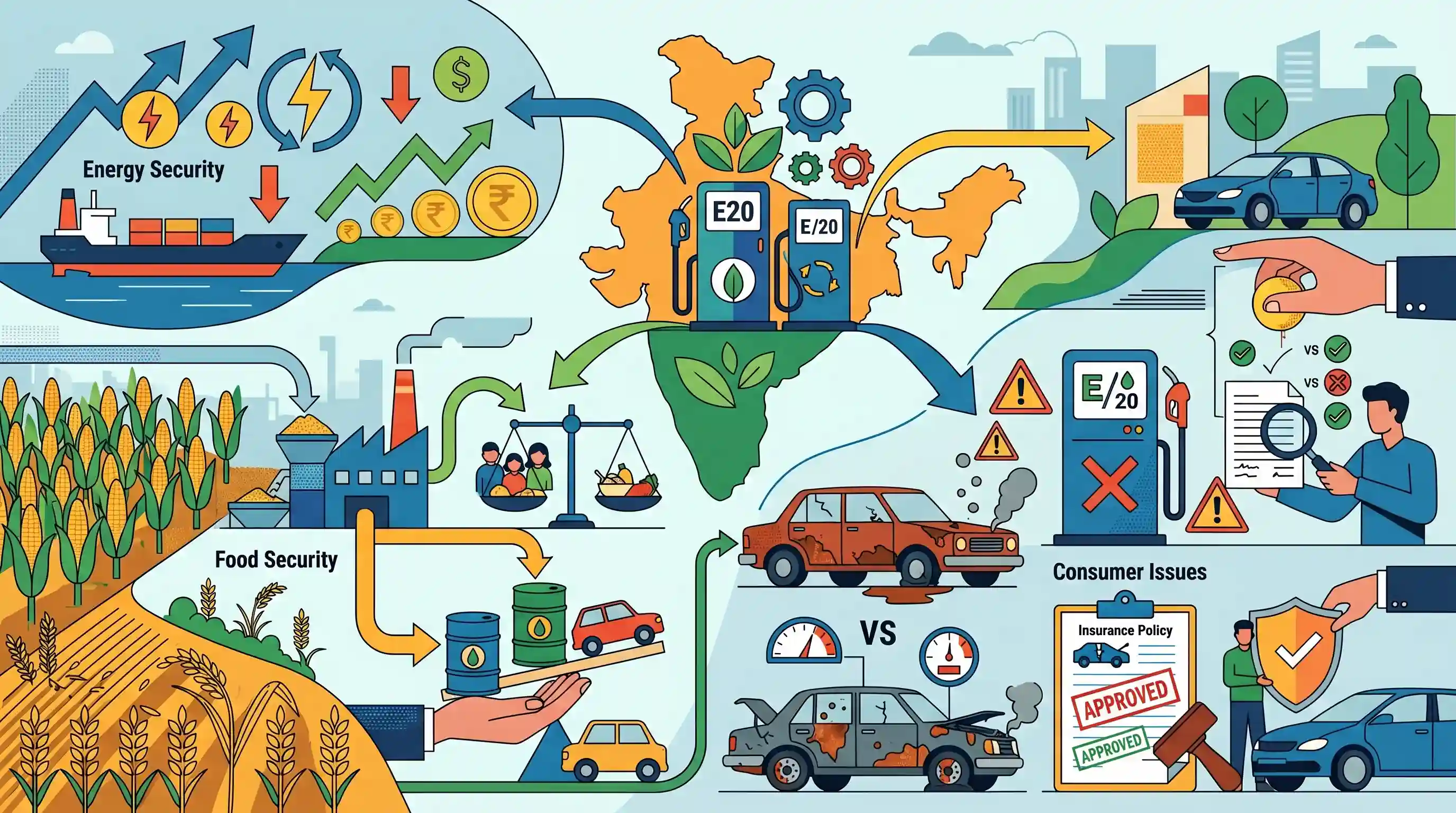
Why It Matters
The transition to ethanol-blended fuels is a prime example of a policy intersection spanning agriculture (food security), economy (import substitution), environment (emissions), and technology (BS norms). It highlights the 'food vs. fuel' debate and the practical implementation challenges of green transition policies, which are highly relevant for GS3 Mains and Prelims.
Summary
The editorial examines the multifaceted challenges of India's push towards 20% ethanol-blended petrol (E20). While the policy is driven by goals of import substitution and energy security, it risks straining food security by increasing the diversion of food crops like maize and broken rice for fuel production. On the consumer front, older vehicles are technically incompatible with E20, facing risks of fuel system corrosion, safety hazards, and reduced fuel efficiency. The article underscores the need for automotive manufacturers to provide transparent compatibility disclosures and for the government to protect consumers from unwarranted insurance claim rejections.
Key Points
- India is scaling up its Ethanol Blended Petrol (EBP) programme to E20 (20% ethanol) to achieve import substitution and foreign exchange savings.
- Heavy reliance on maize and broken rice to meet the ethanol targets risks exacerbating the 'food versus fuel' debate and threatening food security.
- Older vehicles, such as those compliant with BS-IV or older norms, are not designed for E20, making them prone to fuel line corrosion, leaks, and safety hazards.
- Ethanol has a lower energy density than petrol, leading to a noticeable drop in fuel efficiency for consumers.
- There is a lack of transparency from automakers regarding the compatibility of older vehicles with E20 fuel, which could lead to consumers facing denied insurance claims for engine damage.
Important Terms
Ethanol Blended Petrol (EBP) programme

A government initiative to blend ethanol (biofuel) with petrol to reduce crude oil imports and emissions. It utilizes agricultural surpluses like sugarcane and broken rice to bolster energy security.
UPSC context
GS-III/Energy Security & Agriculture; tests understanding of import substitution strategies and agricultural value-addition.
Bharat Stage (BS) norms
Government-instituted emission standards based on European norms that regulate air pollutants from vehicles. India transitioned from BS-IV directly to BS-VI in 2020 to rapidly reduce vehicular pollution.
UPSC context
GS-III/Environment; covers pollution control, vehicular technology shifts, and international environmental commitments.
Society of Indian Automobile Manufacturers (SIAM)
The apex national body representing major Indian vehicle and engine manufacturers. It influences policy, sets industry standards, and focuses on safety, environment, and sustainable mobility.
UPSC context
GS-III/Economy; tests knowledge of industry-government collaboration and manufacturing infrastructure under "Make in India."
E20 Fuel
A high-octane fuel blend consisting of 20% ethanol and 80% petrol. It aims to lower carbon footprints but requires specific engine compatibility to prevent material corrosion.
UPSC context
GS-III/Science & Tech; relevant for biofuel chemistry, engine engineering challenges, and green energy transitions.
National Policy on Biofuels
A 2018 policy framework (amended 2022) that advanced India’s 20% ethanol blending target to 2025-26. It categorizes biofuels (1G, 2G, 3G) to prioritize financial incentives.
UPSC context
GS-II/III (Governance/Environment); evaluates policy frameworks for renewable energy and inter-ministerial coordination.
Auto Alliance
A global automotive industry association (now Alliance for Automotive Innovation) whose technical research on engine-fuel compatibility often informs safety and insurance standards for high-ethanol blends.
UPSC context
GS-III/Science; pertains to international technical benchmarks for vehicular safety and consumer protection.
Prelims Trap
Ethanol blending increases the calorific value and fuel efficiency of petrol.
Ethanol actually has a lower energy density (calorific value) than pure petrol. Higher blends like E20 reduce a vehicle's mileage and overall fuel efficiency.
Static Concepts Connected
What are the four generations of biofuels?
- 1G (First Gen): Produced directly from edible food crops like sugarcane, maize, and broken rice. This generation triggers the 'food vs fuel' debate.
- 2G (Second Gen): Derived from non-food agricultural waste, crop stubble (lignocellulosic biomass), and wood chips, reducing strain on food security.
- 3G (Third Gen): Extracted from specially engineered algae. It offers high yields without requiring arable land or freshwater.
- 4G (Fourth Gen): Uses genetically modified organisms (cyanobacteria/algae) to capture and store CO2 while producing fuel, making it carbon negative.
How does ethanol blending alter engine combustion and emissions?
- Oxygenate effect: Ethanol naturally contains oxygen, which facilitates more complete fuel combustion, sharply reducing carbon monoxide and unburnt hydrocarbon emissions.
- Higher octane: Ethanol has a higher octane number than standard petrol, which prevents engine knocking and allows for better engine optimization in newer cars.
- Corrosion risk: Ethanol is hygroscopic (absorbs water) and highly corrosive to rubber hoses, plastic seals, and unoptimized metal components in older (pre-BS-VI) engines.
Cross-Topic Patterns
MSP, Food Inflation & Biofuels
Diversion of maize and broken rice to distilleries directly intersects with Minimum Support Price (MSP) policies and FCI buffer stock management during periods of high food inflation.
BS Norms vs Fuel Chemistry
The leapfrog to BS-VI norms focused on sulfur reduction. Pushing E20 introduces a separate variable of fuel chemistry compatibility, creating a consumer rights vs. environment dilemma.

A combined prelims question testing ethanol's lower calorific value, its oxygenate properties, and 1G vs 2G feedstocks is highly likely.
Linked PYQs · 5
Linked PYQs · 5
- 2025PrelimsGS1
Consider the following substances: I. Ethanol II. Nitroglycerine III. Urea Coal gasification technology can be used in the production of how many of them?
- 2009PrelimsGS1
In the context of alternative sources of energy, ethanol as a viable bio-fuel can be obtained from
- 2023MainsGS3
Discuss several ways in which microorganisms can help in meeting the current fuel shortage.
- 2024MainsGS3
Elucidate the importance of buffer stocks for stabilizing agricultural prices in India. What are the challenges associated with the storage of buffer stock? Discuss.
- 2020PrelimsGS1
Which of the following are the reasons/factors for exposure to benzene pollution? 1. Automobile exhaust 2. Tobacco smoke 3. Wood burning 4. Using varnished wooden furniture 5. Using products made of polyurethane Select the correct answer using the code given below:
