Women Association Demand Unconditional Implementation of Quota
Source:The Hindu ↗
ఇది ఎందుకు ముఖ్యం
The conditionality attached to the 106th Constitutional Amendment Act (Nari Shakti Vandan Adhiniyam) highlights critical debates around delimitation, the Census, and the pace of ensuring adequate political representation for women. It touches upon core GS-2 areas including constitutional amendments, the role of civil society in advocating for marginalized groups, and the legislative hurdles in enforcing social justice.
సారాంశం
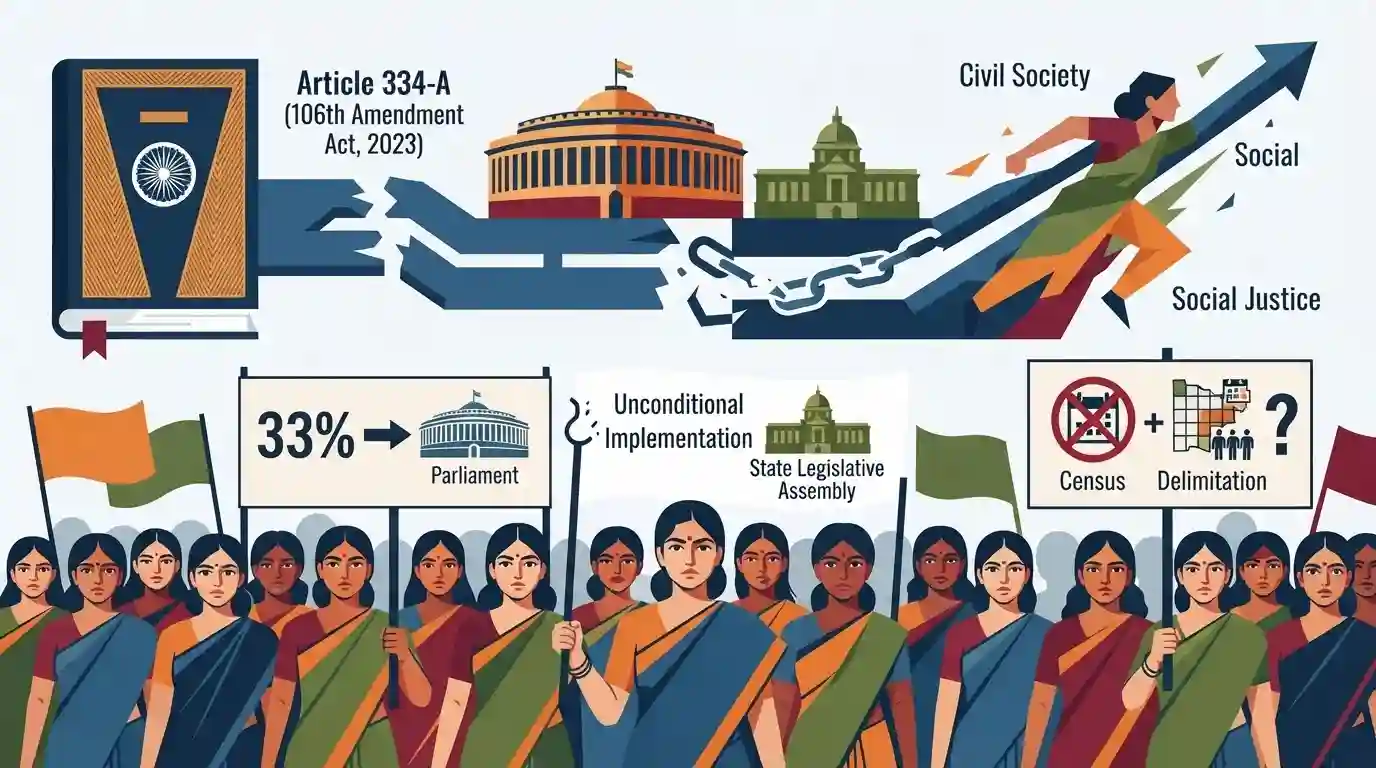
Various women's rights associations in Chennai are organizing a protest on July 22, 2026, demanding the immediate and unconditional implementation of 33% reservation for women in Parliament and State Legislative Assemblies. The groups are protesting against Article 334-A of the Constitution (106th Amendment) Act, 2023, also known as the Nari Shakti Vandan Adhiniyam, which links the quota's enforcement to a future Census and delimitation exercise. Leaders from organizations like AIDWA and NFIW argue this conditionality effectively delays women's representation, and they are urging the Union government to pass legislation delinking the two during the current monsoon session of Parliament.
ముఖ్య అంశాలు
- Several women's rights organizations will protest in Chennai on July 22 demanding the unconditional implementation of the 33% reservation for women in Parliament and State Assemblies.
- The protest targets Article 334-A of the Constitution (106th Amendment) Act, 2023, which conditions the implementation of the women's quota on the completion of the next Census and subsequent delimitation.
- Civil society leaders pointed out that the recent Constitution (131st Amendment) Bill, 2026, intended to expedite this reservation using the 2011 Census, was defeated in the Lok Sabha.
- The associations are urging political parties to raise the issue during the ongoing monsoon session of Parliament to delink the reservation from the delimitation exercise.
ముఖ్యమైన పదాలు
Constitution (106th Amendment) Act, 2023

A landmark constitutional amendment that mandates 33% reservation for women in the Lok Sabha, state legislative assemblies, and the Legislative Assembly of Delhi.
UPSC context
GS Paper II: Constitutional Amendments; vital for analyzing gender justice, legislative reforms, and political empowerment of women.
Nari Shakti Vandan Adhiniyam
The official and popular title of the Constitution (106th Amendment) Act, 2023, designed to boost representation of women in India's key legislative bodies.
UPSC context
GS Paper II: Social Justice and Governance; essential for discussing legislative strategies aimed at marginalized groups.
Article 334-A
A constitutional article inserted by the 106th Amendment that conditions the implementation of women's legislative quotas on the publication of a post-2023 Census and subsequent delimitation.
UPSC context
GS Paper II: Parliament and State Legislatures; tests knowledge of procedural delays, federal seat reallocation, and constitutional reservation frameworks.
Constitution (131st Amendment) Bill, 2026
A legislative bill introduced in 2026 seeking to expand Lok Sabha seats to 850 and enable immediate delimitation using 2011 Census data to fast-track women's quotas; it was defeated.
UPSC context
GS Paper II: Parliament and Legislative Processes; examines procedural challenges of constitutional amendments, the 2/3rd majority rule, and federal delimitation debates.
All India Democratic Women’s Association (AIDWA)
Founded in 1981, it is India’s largest progressive, left-oriented women’s mass organization, leading grassroots activism, policy advocacy, and protests for the immediate, unconditional rollout of women's reservation.
UPSC context
GS Paper II: Pressure Groups and Civil Society; relevant for studying the impact of non-state actors and mass movements on legislative reform.
National Federation of Indian Women (NFIW)
Established in 1954, it is one of India's oldest national-level women's organizations, focused on women's socio-economic empowerment and actively demanding the delinking of reservation from the census.
UPSC context
GS Paper II: NGOs and Pressure Groups; tests understanding of feminist advocacy and historic women's movements in policymaking.
ప్రిలిమ్స్ ఉచ్చు
The Nari Shakti Vandan Adhiniyam mandates 33% women's reservation across all legislative houses, including the Rajya Sabha and State Legislative Councils.
The 106th Amendment only applies to directly elected legislative bodies (Lok Sabha, State Assemblies, Delhi). It does not apply to Rajya Sabha or State Legislative Councils.
అనుసంధానమైన స్థిర భావనలు
What are the constitutional provisions and mechanisms governing delimitation in India?
- Constitutional Basis: Article 82 mandates Parliament to enact a Delimitation Act after every Census; Article 170 deals with state assembly division.
- Commission Composition: Appointed by the President; comprises a retired Supreme Court judge, the Chief Election Commissioner, and state election commissioners.
- Judicial Immunity: Orders have the force of law and cannot be challenged in any court to ensure election timelines are not disrupted.
What majorities are required to pass a Constitutional Amendment Bill under Article 368?
- Absolute Majority: Requires support of more than 50% of the total membership of each House of Parliament.
- Special Majority: Requires two-thirds of the members present and voting in each House, voted on separately.
- No Joint Sitting: There is no provision for a joint sitting of both Houses to resolve a deadlock on amendment bills.
- Federal Ratification: Amendments affecting federal structures also require ratification by legislatures of at least half of the States.
అంతర-అంశ నమూనాలు
Delimitation, Demography, and Federal Balance
Postponing the women's quota to post-2026 delimitation intersects gender justice directly with southern states' anxieties over losing Lok Sabha seats due to successful population control.
Pressure Groups and Legislative Agendas
Protests by groups like AIDWA showcase how civil society organizations attempt to bypass legislative deadlocks—such as the defeated 131st Amendment—to secure constitutional rights.

2026 Prelims will likely test the exact territorial applicability of the 106th Amendment alongside the mechanics of the 2026 delimitation freeze.
అనుసంధాన PYQలు · 3
అనుసంధాన PYQలు · 3
- 2024PrelimsGS1
Consider the following statements regarding 'Nari Shakti Vandan Adhiniyam' : 1. Provisions will come into effect from the 18th Lok Sabha. 2. This will be in force for 15 years after becoming an Act. 3. There are provisions for the reservation of seats for Scheduled Castes Women within the quota reserved for the Scheduled Castes. Which of the statements given above are correct?
- 2023MainsGS2
Discuss the contribution of civil society groups for women's effective and meaningful participation and representation in state legislatures in India.
- 2019MainsGS2
“The reservation of seats for women in the institutions of local self-government has had a limited impact on the patriarchal character of the Indian Political Process.” Comment.
