Assembly Election Results Redraw India Regional Political Landscape
Source:Indian Express ↗
Why It Matters
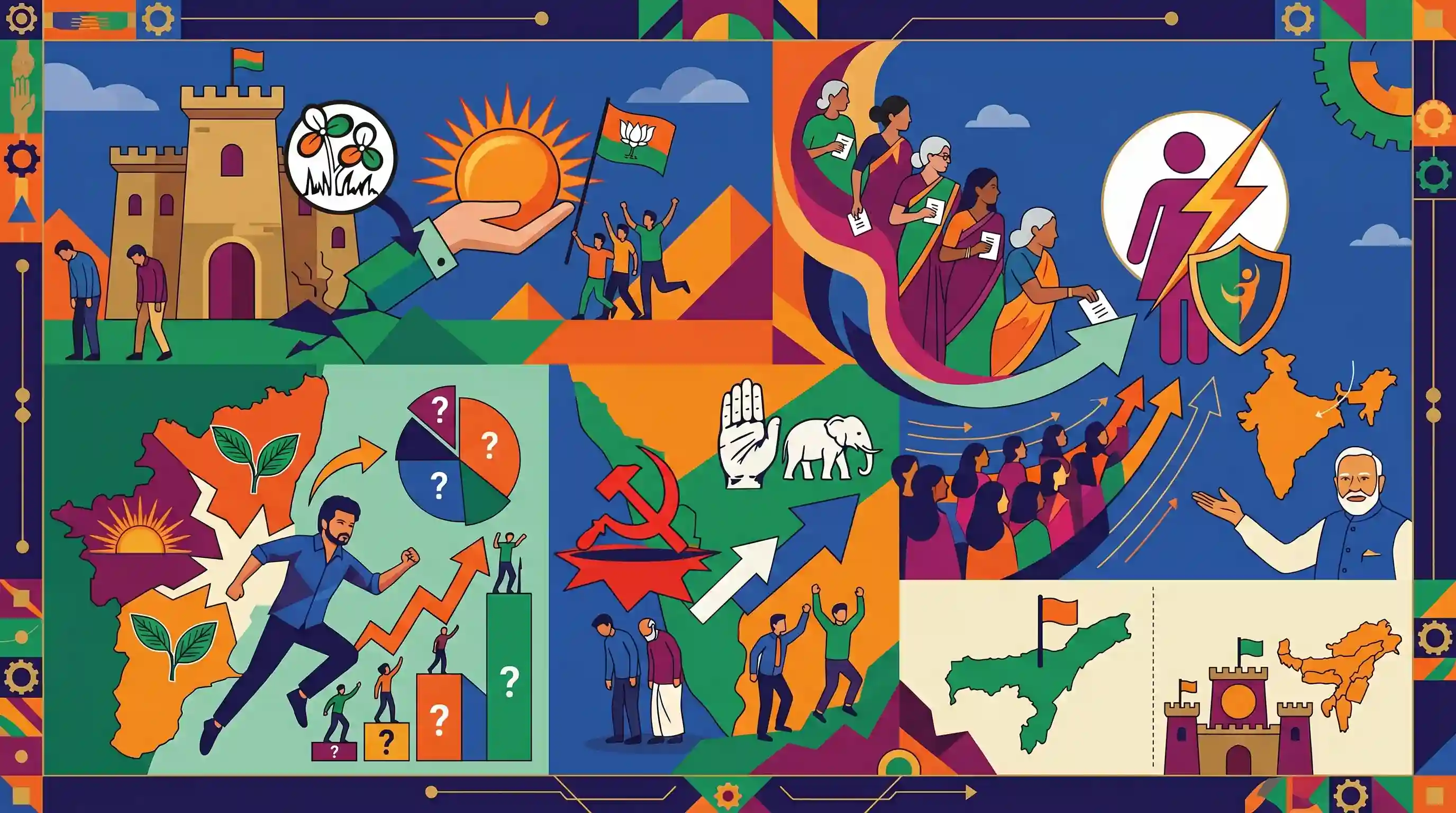
These election results represent significant shifts in India's federal and state-level politics. The fall of established regional heavyweights in West Bengal and Tamil Nadu illustrates the dynamic nature of electoral behavior and the potential for new political actors to disrupt entrenched systems. Furthermore, the explicit recognition of women as a distinct and decisive voting bloc highlights the evolving socio-political impact of gender-focused legislation like the women's reservation bill.
Summary
The 2026 Assembly election results across five states and Union Territories have fundamentally altered India's regional political landscapes. The BJP achieved a historic victory in West Bengal, ending Mamata Banerjee's 15-year TMC rule, while also retaining power in Assam. In Tamil Nadu, actor Joseph Vijay's newly formed TVK upended the six-decade-old DMK-AIADMK duopoly, securing the highest number of seats and pushing the state toward its first hung assembly. The Congress-led UDF made a decisive comeback in Kerala, defeating the incumbent LDF, while the NDA maintained its hold on Puducherry. The Prime Minister highlighted the BJP's expansion to the East and attributed the opposition's losses to the consolidation of women voters in response to the 'Nari Shakti Vandan Adhiniyam'.
Key Points
- Electoral Shifts: The 2026 assembly elections demonstrated strong anti-incumbency in West Bengal, Tamil Nadu, and Kerala, while Assam saw pro-incumbency with the BJP securing a third consecutive term.
- Demise of Dravidian Duopoly: Actor Joseph Vijay’s newly formed TVK emerged as the single largest party in Tamil Nadu, fracturing the 60-year dominance of the DMK and AIADMK, leading to a hung assembly.
- BJP's Eastern Expansion: The BJP secured a historic victory in West Bengal, toppling Mamata Banerjee's 15-year-old TMC government, fulfilling its objective of expanding its political footprint from 'Gangotri to Ganga Sagar'.
- Impact of Women Voters: Prime Minister Narendra Modi attributed the defeat of the TMC, DMK, and Congress in these states to a consolidated pushback by women voters, linking it to the passage of the Nari Shakti Vandan Adhiniyam.
- Kerala's Political Pendulum: The Congress-led UDF ended the Pinarayi Vijayan-led LDF's rule, restoring the state's traditional alternating power cycle.
Important Terms
Nari Shakti Vandan Adhiniyam

Formally the 106th Constitutional Amendment Act (2023), it reserves 33% of seats in the Lok Sabha and State Legislative Assemblies for women for a 15-year period.
UPSC context
GS Paper II (Constitution/Polity); tests knowledge of landmark legislative reforms and gender representation in governance.
Tamilaga Vettri Kazhagam (TVK)
A regional political party in Tamil Nadu founded in 2024 by actor Joseph Vijay, advocating for secularism, social justice, and an end to dynastic politics.
UPSC context
GS Paper II (Regionalism/Political Parties); tests understanding of regional party emergence and its impact on the federal structure.
United Democratic Front (UDF)
An Indian National Congress-led coalition in Kerala consisting of parties like the Indian Union Muslim League; it alternates power with the Left in the state.
UPSC context
GS Paper II (Coalition Politics); tests awareness of multi-party systems and alliance dynamics at the state level.
Left Democratic Front (LDF)
A CPI(M)-led alliance of left-wing parties in Kerala that emphasizes socialist ideologies and has historically dominated the state’s political landscape alongside the UDF.
UPSC context
GS Paper II (Political Parties); tests knowledge of ideological shifts and competitive party systems in Indian states.
Anti-Incumbency
An electoral trend where voters reject the current ruling party or candidate due to dissatisfaction with their performance, often leading to a change in government.
UPSC context
GS Paper II (Elections); tests understanding of voter behavior, accountability mechanisms, and factors influencing democratic transitions.
Hung Assembly
A legislative scenario where no single party or pre-poll alliance secures an absolute majority of seats, often necessitating the Governor’s situational discretion for government formation.
UPSC context
GS Paper II (State Executive); tests understanding of the Governor’s role and constitutional provisions regarding government formation.
Prelims Trap
"The 106th CAA reserves 33% seats for women in the Lok Sabha, Rajya Sabha, and all State Legislative Assemblies."
The 106th Constitutional Amendment Act does not apply to the Rajya Sabha or State Legislative Councils. It only reserves seats in the Lok Sabha, State Legislative Assemblies, and the NCT of Delhi.
Static Concepts Connected
What are the Governor's powers during a hung assembly?
- Situational Discretion: Under Article 164, the Governor uses situational discretion to appoint the Chief Minister when no single party or pre-poll alliance has a clear majority.
- Sarkaria Commission Guidelines: Conventions dictate inviting a pre-poll alliance first, followed by the single largest party, and then a post-poll coalition to form the government.
- Mandatory Floor Test: As reinforced by the S.R. Bommai judgment, the appointed Chief Minister must prove their majority on the floor of the House, not at the Governor's Raj Bhavan.
What are the key provisions of the 106th Constitutional Amendment Act, 2023?
- Extent of Reservation: Provides 33% reservation for women in the Lok Sabha, State Legislative Assemblies, and the Legislative Assembly of the NCT of Delhi.
- SC/ST Sub-quota: Includes a 33% sub-reservation for women within the existing seats already reserved for Scheduled Castes (SCs) and Scheduled Tribes (STs).
- Sunset Clause: The reservation is initially valid for 15 years from commencement, requiring Parliamentary legislation for any further extension.
Cross-Topic Patterns
Feminization of Indian Electoral Behavior
The consolidation of female voters across states links the 106th CAA directly to shifting electoral outcomes, signaling the rise of a distinct "vote bank" that supersedes traditional caste or patriarchal household dictates.
Fluidity in State Party Systems
The shattering of Tamil Nadu's 60-year Dravidian duopoly by a new regional outfit heavily contrasts with the BJP's eastern expansion, highlighting the complex, dual-track nature of India's federal political structure.

Expect a multi-statement question on Governor's situational discretion in hung assemblies or the exact constitutional scope of the 106th CAA.
Linked PYQs · 3
Linked PYQs · 3
- 2022MainsGS2
“While the national political parties in India favour centralisation, the regional parties are in favour of State autonomy.” Comment.
- 2023MainsGS2
Discuss the contribution of civil society groups for women's effective and meaningful participation and representation in state legislatures in India.
- 2019MainsGS2
“The reservation of seats for women in the institutions of local self-government has had a limited impact on the patriarchal character of the Indian Political Process.” Comment.
