Amaravati Assembly building planned for future delimitation capacity
Source:The Hindu ↗
Why It Matters
The development of Amaravati's legislative complex is directly linked to the constitutional process of delimitation, highlighting how physical state infrastructure is planned around demographic and electoral shifts. It is relevant for understanding State Legislature composition and capital city development in Andhra Pradesh.
Summary
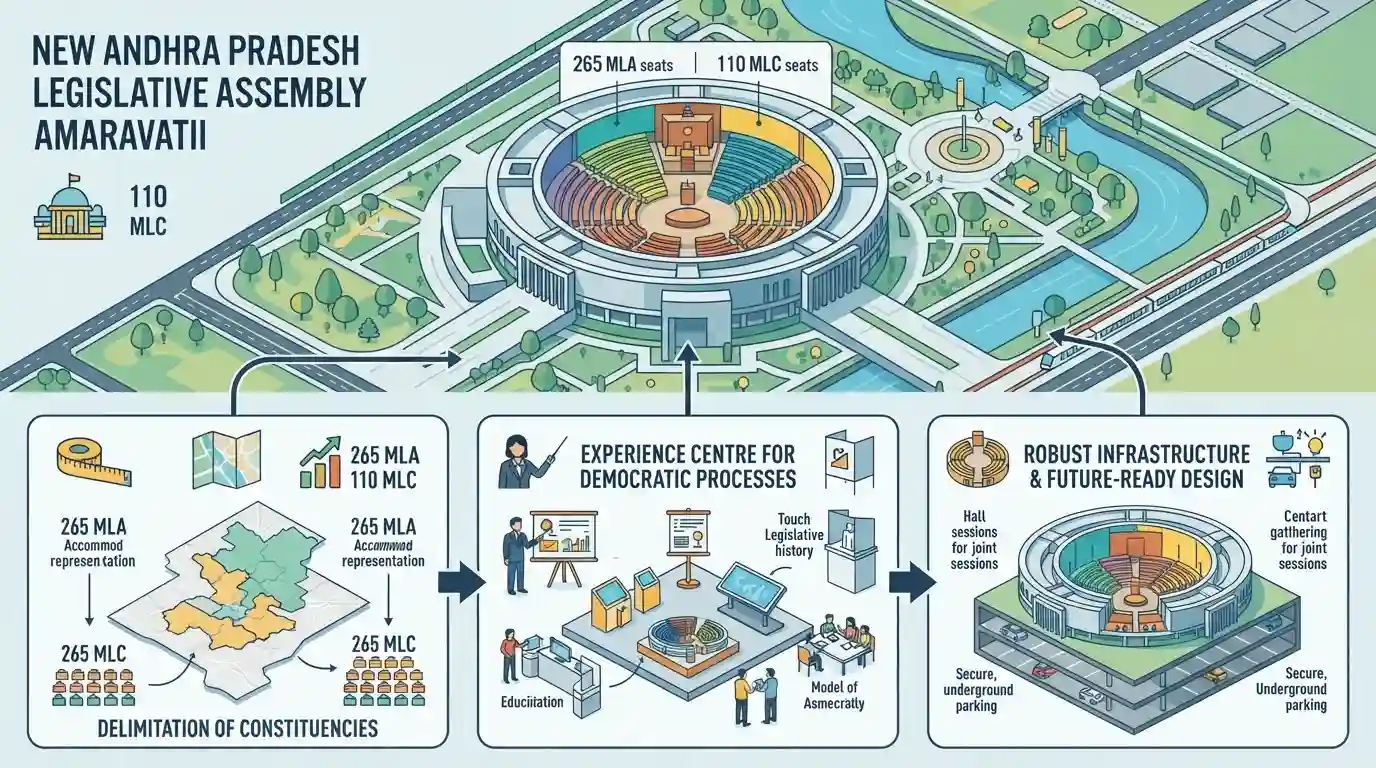
The Andhra Pradesh Legislative Assembly building in the upcoming capital of Amaravati is being designed by Norman Foster + Partners to be future-ready and people-friendly. State Assembly Speaker Ch. Ayyanna Patrudu emphasized that the complex must accommodate the impending delimitation of constituencies, providing for 265 MLA seats and 110 MLC seats. The design will also feature an Experience Centre for public education on democratic processes, alongside robust infrastructure like a central hall and secure underground parking.
Key Points
- AP Assembly Speaker Ch. Ayyanna Patrudu directed architects from Norman Foster + Partners to design the Amaravati Assembly building as a future-ready, iconic, and people-friendly structure.
- The building is being designed to accommodate future delimitation, with a proposed seating capacity of 265 for the Legislative Assembly and 110 for the Legislative Council.
- An 'Experience Centre' will be established within the complex to educate students and visitors about the state's democratic and administrative systems.
- The infrastructure will include a central hall for both Houses, a secure underground parking facility, separate lobbies, and extensive green spaces.
Important Terms
Norman Foster + Partners

An internationally renowned British architectural firm commissioned to design the Amaravati government complex, including the future-ready Legislative Assembly building and its high-rise viewing tower.
UPSC context
Important for AP Geography and Current Affairs. Tests knowledge of the master architects designing Amaravati's capital infrastructure.
AP Capital Region Development Authority (APCRDA)
The statutory urban planning agency responsible for overseeing the development, infrastructure, and execution of the Amaravati capital region, including the construction of the new Assembly.
UPSC context
Essential for AP Economy and State Administration. Tests the institutional framework and nodal agency executing the state capital's master plan.
Andhra Pradesh Legislative Assembly
The lower house of the state's bicameral legislature. The new Amaravati complex is being designed with a 265-MLA seating capacity to accommodate the impending delimitation of constituencies.
UPSC context
Core AP Polity topic. Tests the structure of the state government, future legislative capacity, and implications of the AP Reorganisation Act.
Andhra Pradesh Legislative Council
The upper house of AP's state legislature. The Amaravati Assembly complex is being designed with a dedicated council hall capable of seating 110 MLCs, factoring in future state expansion.
UPSC context
Highly relevant for AP Polity. Evaluates knowledge of the state's bicameral legislative system and projected seat increases post-delimitation.
Delimitation of Constituencies
The process of redrawing electoral boundaries based on census data. Amaravati’s assembly is proactively designed to accommodate the seat increases expected from upcoming constituency delimitation.
UPSC context
Crucial for APPSC Polity. Tests constitutional provisions regarding electoral boundaries, federal representation, and the AP Reorganisation Act mandates.
Prelims Trap
"The AP Reorganisation Act 2014 mandates an increase in Andhra Pradesh Assembly seats to 265."
The Act (Section 26) actually mandates an increase from 175 to 225 seats. The building is designed for 265 seats to future-proof the infrastructure.
Static Concepts Connected
What are the delimitation provisions under the AP Reorganisation Act, 2014?
- Section 26: Subject to Article 170 of the Constitution, it mandates increasing the AP Legislative Assembly seats from 175 to 225.
- Constitutional Freeze: Implementation remains delayed due to the 84th Constitutional Amendment, which froze seat adjustments until after the first census post-2026.
What are the constitutional limits on a State Legislative Council's strength?
- Maximum Limit: Under Article 171, the total number of MLCs shall not exceed one-third of the total MLAs in that state's assembly.
- Minimum Limit: The Legislative Council must have at least 40 members, regardless of the State Assembly's size.
Cross-Topic Patterns
AP Reorganisation Act + 2026 Delimitation Freeze
The statutory mandate to increase AP's seats conflicts with the national constitutional freeze on delimitation till post-2026, prompting forward-looking infrastructure planning.
New Capital Infra + Civic Education
Similar to the New Parliament's Constitutional Hall, Amaravati's 'Experience Centre' reflects an ongoing trend of blending core administrative buildings with democratic tourism and civic education.

Expect a statement question contrasting the Assembly's future-proof design capacity (265) with the AP Reorganisation Act's actual mandate (225).
Linked PYQs · 1
Linked PYQs · 1
- 2024APPSC_PRELIMSGS1
Which of the following statement/statements can be attributed correctly to the exercise of Delimitation ? I. The principle of 'one man, one vote' reiterates the need for the exercise of Delimitation. II. The Government of India can set up a Delimitation Commission for the purpose of delimitation of Parliamentary and Assembly Constituencies in a select few States or UTs. III. The Delimitation Commission can only recommend the re-delimitation of territorial Parliamentary and Assembly Constituencies but cannot recommend on the reservation of seats for the Scheduled Castes and Scheduled Tribes. IV. The Nodal Ministry for the Delimitation Commission of India is the Ministry of Law and Justice. Select the correct answer using the codes given below :
