Assam temple emerges as sanctuary for freshwater turtles
Source:The Hindu ↗
Why It Matters
Highlights an innovative and successful model of community-based conservation that utilizes religious institutions (sacred ponds) to protect highly endangered freshwater turtle species, relevant to UPSC questions on biodiversity strategies and Schedule I species protection.
Summary
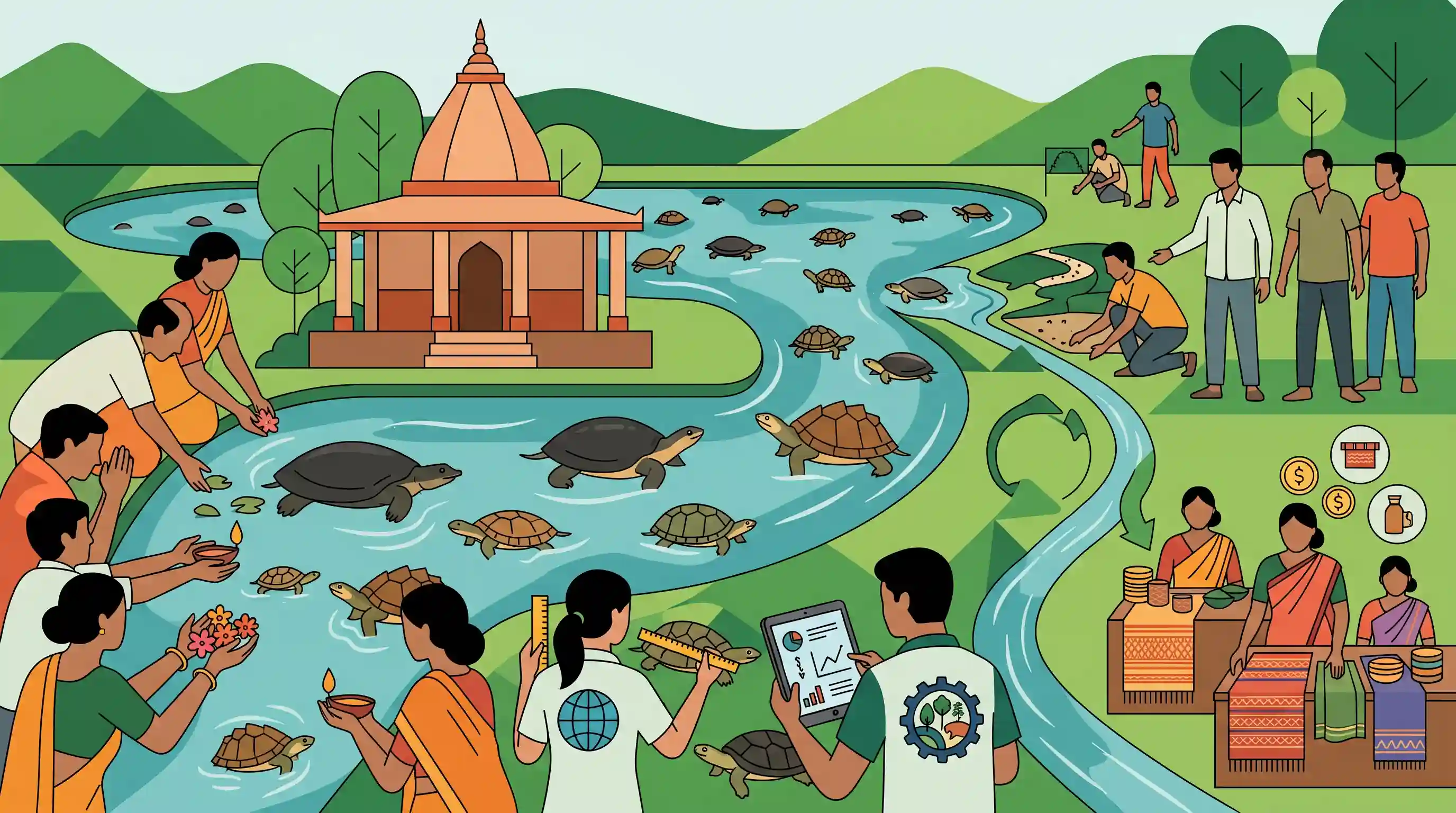
Assam's Nagshankar temple has emerged as a model for freshwater turtle conservation by successfully protecting 13 species, including the critically endangered black softshell and Assam roofed turtles. The initiative leverages traditional cultural reverence for turtles, integrating it with scientific conservation methods through partnerships with organizations like TSA Foundation India and Aaranyak. Furthermore, it incorporates community-driven programs like 'Kaso Mitras' and 'Kaso Sakhi' to promote grassroots stewardship and alternative livelihoods.
Key Points
- Assam's centuries-old Nagshankar temple has been recognized as a model for turtle conservation, housing 13 species of freshwater turtles in its pond.
- The effort represents a successful collaboration between temple authorities, conservation NGOs (TSA Foundation India, Aaranyak), and state wildlife agencies.
- The initiative integrates community involvement through 'Kaso Mitras' (youth turtle guardians) and 'Kaso Sakhi' (a women's weaving group producing turtle motif handlooms to support livelihoods).
- The temple provides sanctuary to highly threatened species, including the critically endangered black softshell and Assam roofed turtle, highlighting the role of sacred spaces in preserving species known as 'vultures of the aquatic ecosystem'.
Important Terms
Nagshankar Temple

A 4th-century temple in Assam’s Biswanath district, recognized as a model for freshwater turtle conservation by integrating traditional religious reverence with scientific management of over 13 species.
UPSC context
GS Paper III (Environment/Conservation). Tests understanding of community/faith-based conservation models and their role in protecting biodiversity.
Kaso Mitras
Local community volunteers in Assam who act as 'turtle friends,' monitoring nesting sites, preventing poaching, and assisting in the scientific management of turtles within temple ponds and natural habitats.
UPSC context
GS Paper III (Environment). Relevant for questions on grassroots stewardship and participatory conservation strategies in India.
Kaso Sakhi
A grassroots women’s weavers collective in Assam that promotes turtle conservation by integrating turtle motifs into traditional handloom products like 'Gamosas,' providing alternative livelihoods to fishing communities.
UPSC context
GS Paper III (Conservation/Livelihood). Demonstrates the link between economic empowerment, traditional art, and wildlife protection.
Turtle Survival Alliance (TSA) Foundation India
A global conservation organization’s Indian chapter that partners with government and religious institutions to restore wild populations of endangered freshwater turtles through breeding and 'head-starting' programs.
UPSC context
GS Paper III (Environment). Represents the role of specialized NGOs and international collaborations in species-specific conservation.
Aaranyak
A prominent Guwahati-based non-profit organization dedicated to biodiversity conservation in Northeast India, playing a major role in research and community engagement for the Nagshankar turtle project.
UPSC context
GS Paper III (Environment). Illustrates the impact of regional civil society organizations in protecting Northeast India's unique biodiversity hotspots.
Black Softshell Turtle
A critically endangered freshwater turtle species (Nilssonia nigricans), once considered 'Extinct in the Wild' but now successfully reared in Assam's temple ponds for reintroduction into the Brahmaputra River.
UPSC context
GS Paper III (Biodiversity). Essential for questions on IUCN Red List species and successful reintroduction programs in India.
Assam Roofed Turtle
A critically endangered turtle endemic to the Brahmaputra basin; it is a primary focus of ex-situ breeding at the Assam State Zoo and community-led conservation at Nagshankar.
UPSC context
GS Paper III (Biodiversity). Tests knowledge of endemic species and the significance of 'Priority Turtle Areas' in India.
Prelims Trap
"The Black Softshell turtle is classified as Extinct in the Wild and is found exclusively in captive temple ponds."
While historically thought to be "Extinct in the Wild" and confined to temple ponds, wild populations have since been discovered in the Brahmaputra basin. It is now Critically Endangered.
Static Concepts Connected
Why are freshwater turtles known as the "vultures of the aquatic ecosystem"?
- Scavenging role: They feed on dead and decaying aquatic organisms, acting as natural scavengers that prevent water contamination and disease spread.
- Water quality regulation: By consuming decaying matter, they naturally regulate algal blooms and improve critical water quality metrics like Biochemical Oxygen Demand (BOD).
- Seed dispersal: They act as carriers for aquatic plant seeds and small invertebrates, aiding in habitat connectivity across different freshwater bodies.
What are the conservation statuses of key turtles found in Assam?
- Black Softshell Turtle: Critically Endangered (IUCN). Endemic to Northeast India and Bangladesh. Protected under Schedule I of the Wildlife Protection Act (WPA), 1972.
- Assam Roofed Turtle: Endangered (IUCN). Endemic to the Brahmaputra-Meghna drainage basin. Also listed under WPA Schedule I and CITES Appendix II.
Cross-Topic Patterns
Sacred ecology + In-situ conservation
Like Rajasthan's Orans or Meghalaya's sacred groves, temple ponds act as vital refugia for highly threatened species, bridging traditional religious belief (Kurma avatar) with modern scientific conservation.
Biodiversity + Women's SHG livelihoods
'Kaso Sakhi' (women's handlooms) mirrors initiatives like the 'Hargila Army' (Assam's Greater Adjutant Stork), highlighting UPSC's increasing focus on gendered, community-led wildlife protection and alternative livelihoods.

Expect a 2026 prelims question on freshwater turtles linking their "aquatic vulture" ecological role with their IUCN/WPA statuses.
Linked PYQs · 1
Linked PYQs · 1
- 2017PrelimsGS1
In India, if a species of tortoise is declared protected under Schedule I of the Wildlife (Protection) Act, 1972, what does it imply?
