Bodoland Space Education Programme for Tribal Schools and STEM
Source:The Hindu ↗
Why It Matters
This provides a brilliant case study for Mains answers: an autonomous tribal council (under the Sixth Schedule) using cutting-edge STEM education and space technology to fulfill a Fundamental Duty (developing scientific temper) to combat a severe social issue (witch-hunting) in a marginalized area.
Summary
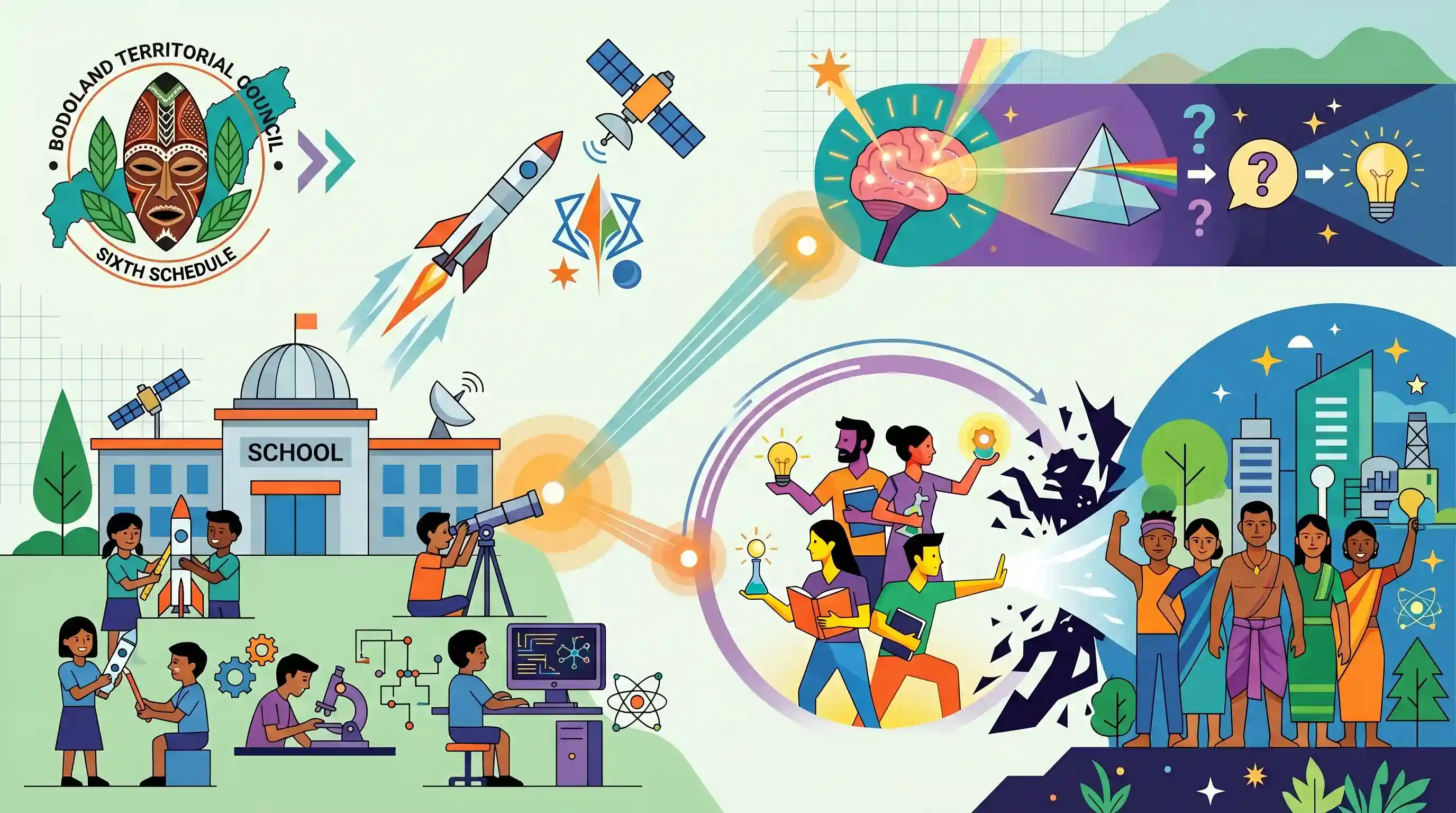
The Bodoland Territorial Council (BTC) in Assam has initiated the Bodoland Space Education Programme to establish ISRO-backed space labs in government-run schools across the Bodoland Territorial Region (BTR). Partnering with Vyomika Space Academy, the program aims to provide hands-on STEM education to tribal students. Crucially, the initiative seeks to cultivate a scientific temper in these remote areas, using modern science education as a tool to eradicate regressive social practices such as witch-hunting.
Key Points
- The Bodoland Territorial Council (BTC), an autonomous body under the Sixth Schedule, has launched the Bodoland Space Education Programme in Assam.
- An MoU was signed with Vyomika Space Academy, an ISRO Space Tutor partner, to establish space labs in government-run schools.
- The initiative focuses on promoting practical STEM (Science, Technology, Engineering, and Mathematics) education among tribal students in remote areas.
- Beyond education, the core objective is to foster a scientific temper to help eradicate deep-rooted social evils like witch-hunting in the region.
Important Terms
Sixth Schedule of the Constitution

A constitutional provision (Articles 244(2) and 275(1)) establishing Autonomous District Councils in Assam, Meghalaya, Tripura, and Mizoram to ensure tribal self-governance through legislative, executive, and judicial autonomy.
UPSC context
GS Paper II: Polity/Tribal Governance; tests understanding of asymmetrical federalism and the protection of indigenous rights.
Bodoland Territorial Council (BTC)
An autonomous administrative body in Assam established under the Sixth Schedule following the 2003 Bodo Accord to govern the Bodoland Territorial Region (BTR) with delegated legislative and financial powers.
UPSC context
GS Paper II & III: Governance/Internal Security; relevant for studying peace accords and regional autonomy in Northeast India.
Scientific Temper
Enshrined in Article 51A(h) as a Fundamental Duty, it is a rational attitude of logical thinking, questioning, and reform aimed at eliminating superstitions and promoting humanism.
UPSC context
GS Paper II & IV: Fundamental Duties/Ethics; tests the application of rational inquiry in social reform and governance.
Bodoland Territorial Region (BTR)
An autonomous region in Assam comprising five districts (Kokrajhar, Chirang, Baksa, Udalguri, Tamulpur) administered by the BTC to safeguard Bodo ethnic identity and regional development.
UPSC context
GS Paper I & II: Social Issues/Polity; significant for regionalism and ethnic movements in Northeast India.
Assam Witch Hunting (Prohibition, Prevention and Protection) Act, 2015
A state law making witch-branding and related violence cognizable, non-bailable, and non-compoundable offences to curb superstition-led persecution and protect human rights.
UPSC context
GS Paper I: Social Issues; tests knowledge of state-level social reform laws and the eradication of regressive practices.
ISRO (Indian Space Research Organisation)
The Indian national space agency that supports the Bodoland Space Education Programme through "Space Tutor" partners, facilitating grassroots STEM education and scientific curiosity.
UPSC context
GS Paper III: Science & Technology; focuses on societal applications of space technology and national capacity building.
Prelims Trap
ISRO directly funds and builds space labs in Sixth Schedule areas under the Space Tutor program.
ISRO partners with NGOs and ed-tech startups (like Vyomika Space Academy) to execute the Space Tutor program; it does not directly fund or build these local labs.
Static Concepts Connected
What are the legislative powers of Autonomous District Councils under the Sixth Schedule?
- Law-making scope: Can make laws on land, forests, village administration, inheritance of property, marriage, and social customs.
- Governor's Assent: All laws passed by ADCs require the assent of the State Governor to take effect.
- Jurisdiction: Applies exclusively to specific tribal areas in Assam, Meghalaya, Tripura, and Mizoram (AMTM).
How does the Constitution mandate the eradication of superstitions like witch-hunting?
- Article 51A(h): Mandates citizens to develop the scientific temper, humanism, and the spirit of inquiry and reform.
- Judicial validation: While not directly enforceable, courts use Fundamental Duties to uphold the constitutional validity of laws like the Assam Witch Hunting Act.
Cross-Topic Patterns
ADCs expanding beyond traditional governance
ADCs are traditionally viewed through the lens of land and customary laws. This initiative highlights their evolving role in modern socio-educational interventions to fulfill Fundamental Duties like scientific temper.
ISRO Space Tutors & Private Startups
Connects India's space privatization push with grassroots education, showing how private ed-techs execute ISRO's mandates in remote tribal belts under the Space Tutor program.

Expect a mixed prelims question linking Article 51A(h) (Scientific Temper) to the legislative capacity of Sixth Schedule ADCs in 2026.
Linked PYQs · 4
Linked PYQs · 4
- 2021MainsGS2
Explain the constitutional provisions under which Legislative Councils are established. Review the working and current status of Legislative Councils with suitable illustrations.
- 2025MainsGS3
The fusion energy programme in India has steadily evolved over the past few decades. Mention India's contributions to the international fusion energy project International Thermonuclear Experimental Reactor (ITER). What will be the implications of the success of this project for the future of global energy?
- 2019PrelimsGS1
Under which Schedule of the Constitution of India can the transfer of tribal land to private parties for mining be declared null and void?
- 2012PrelimsGS1
Which of the following is/are among the Fundamental Duties of citizens laid down in the Indian Constitution? 1. To preserve the rich heritage of our composite culture 2. To protect the weaker sections from social injustice 3. To develop the scientific temper and spirit of inquiry 4. To strive towards excellence in all spheres of individual and collective activity Select the correct answer using the codes given below:
