Assam Passes Uniform Civil Code Bill with Tribal Exemptions
Source:Indian Express ↗
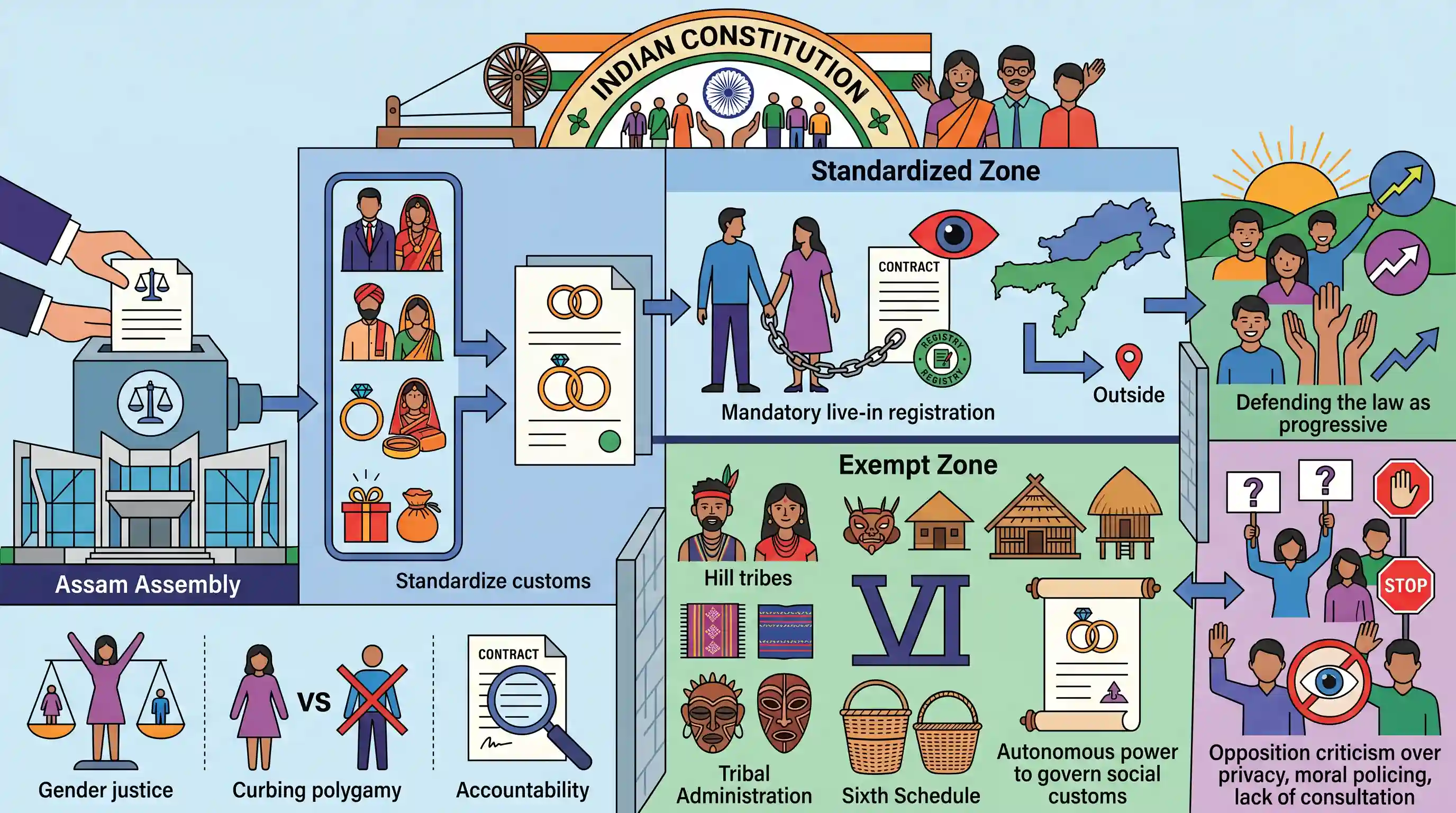
Why It Matters
The passage of a state-level UCC that exempts tribal populations highlights the complex constitutional interplay between Article 44 (Directive Principles of State Policy) and the Sixth Schedule (protection of tribal customary laws). It also raises critical Article 21 (Right to Privacy) concerns regarding state regulation and penalization of live-in relationships.
Summary
The Assam Assembly has passed a Uniform Civil Code (UCC) Bill aimed at standardizing laws surrounding marriage, divorce, succession, and live-in relationships. A key feature of the legislation is its exemption of Scheduled Tribes (ST), which comprise 12.44% of the state's population. This carve-out aligns with Paragraph 3 of the Sixth Schedule, which grants autonomous district councils—such as those in Bodoland, North Cachar Hills, and Karbi Anglong—the power to govern social customs and inheritance. The Bill also generated intense debate over a provision that makes the registration of live-in relationships mandatory for Assam residents, including those residing outside the state. While the government defends the law as a progressive step towards gender justice, curbing polygamy, and ensuring accountability in relationships, the Opposition criticized it for threatening privacy, enforcing moral policing, and being enacted without adequate public consultation.
Key Points
- The Assam Assembly passed the Uniform Civil Code (UCC) Bill in May 2026, aimed at regulating marriage, divorce, succession, and live-in relationships.
- The legislation explicitly exempts Assam's Scheduled Tribe (ST) communities, honoring the Sixth Schedule's provisions granting autonomy to tribal councils to preserve their customary laws.
- A heavily debated clause mandates the formal registration of live-in relationships, applying even to residents of Assam living outside the state, with non-registration attracting penal provisions.
- The Opposition criticized the Bill for bypassing wider public consultation, citing the 2018 Central Law Commission report, and raised concerns regarding privacy infringement and moral policing over live-in rules.
Important Terms
Uniform Civil Code (UCC) Bill

A proposed legislation to replace religion-based personal laws with a common framework for marriage, divorce, succession, and live-in relationships for all residents, excluding Scheduled Tribes.
UPSC context
GS Paper II: Government policies, secularism, and the challenge of balancing uniform laws with diverse personal/religious practices.
Article 44
A Directive Principle of State Policy (DPSP) that mandates the State to endeavor to secure a uniform civil code for all citizens throughout India.
UPSC context
GS Paper II: Indian Constitution (DPSP); tests understanding of non-justiciable principles and the constitutional vision for national integration.
Sixth Schedule
Provisions under Articles 244(2) and 275(1) providing for the administration of tribal areas in Assam, Meghalaya, Tripura, and Mizoram through Autonomous District Councils.
UPSC context
GS Paper II: Tribal administration and federalism; tests knowledge of special autonomy and legislative powers of ADCs in NE India.
Autonomous District Councils (ADCs)
Constitutional bodies in Sixth Schedule areas with legislative, executive, and judicial powers to govern local matters like land, marriage, and social customs.
UPSC context
GS Paper II: Local self-governance and tribal autonomy; specifically tests Paragraph 3 powers over customary laws.
Registration of Live-in Relationships
A legal requirement in the Assam UCC for couples to register their relationship with a sub-registrar within 30 days, including residents living outside the state.
UPSC context
GS Paper II: Fundamental Rights (Privacy) and state intervention in personal liberty; tests the limits of "moral policing" vs. protection.
Supreme Court of India
The apex court that has frequently nudged the government (e.g., in Sarla Mudgal case) to implement a UCC to achieve gender justice and national unity.
UPSC context
GS Paper II: Judiciary; tests understanding of judicial activism and the interpretation of DPSP vs. Fundamental Rights.
Prelims Trap
"The Assam Uniform Civil Code applies uniformly to all citizens residing within the territorial jurisdiction of the state."
The Bill explicitly exempts Scheduled Tribes. Under the Sixth Schedule, Autonomous District Councils have the power to regulate marriage, divorce, and social customs independently.
Static Concepts Connected
How does the Constitution regulate state laws with extraterritorial application?
- General Limitation: Under Article 245(1), state legislatures can generally make laws only for the whole or any part of the state.
- Territorial Nexus Doctrine: A state law can operate outside its borders if there is a legitimate, substantial 'territorial nexus' between the state and the object being legislated.
- Current Context: Assam’s requirement for state residents to register live-in relationships even while living outside Assam relies on this doctrine.
What are the powers of Autonomous District Councils under the Sixth Schedule regarding customary laws?
- Legislative Powers: ADCs are empowered to make laws regarding inheritance of property, marriage, divorce, and social customs for tribal populations.
- Governor's Assent: Laws passed by the ADCs do not take effect until they are submitted to and receive the assent of the state Governor.
- Exemption from General Laws: Acts of Parliament or the State Legislature on these subjects generally do not apply to autonomous districts unless specifically extended.
Cross-Topic Patterns
UCC mandates vs. Right to Privacy (Art 21)
The mandate to register live-in relationships pits the State's DPSP mandate (Article 44) against the fundamental right to privacy and informational autonomy established in the Puttaswamy judgment (Article 21).
State UCCs and Article 254(2) Repugnancy
Personal laws fall under the Concurrent List. State UCC bills amending existing central laws (like Hindu Marriage Act) require the President's assent under Article 254(2) to overcome repugnancy.

Expect a multi-statement question on State UCCs testing the Concurrent List (Entry 5), Territorial Nexus, and Sixth Schedule exemptions.
Linked PYQs · 2
Linked PYQs · 2
- 2015MainsGS2
Discuss the possible factors that inhibit India from enacting for its citizens a uniform civil code as provided for in the Directive Principles of State Policy.
- 2015PrelimsGS1
The provisions in Fifth Schedule and Sixth Schedule in the Constitution of India are made in order to
