Assam electoral roll revision and tea industry policy updates
Source:The Hindu ↗
Why It Matters
This article serves as a comprehensive case study for UPSC aspirants across multiple subjects: it highlights GS-2/GS-3 polity and security issues related to citizenship and demographic changes in border states, GS-3 environment topics dealing with encroachment versus indigenous rights, and GS-3 economy issues concerning export competitiveness in the agricultural (tea) sector.
Summary
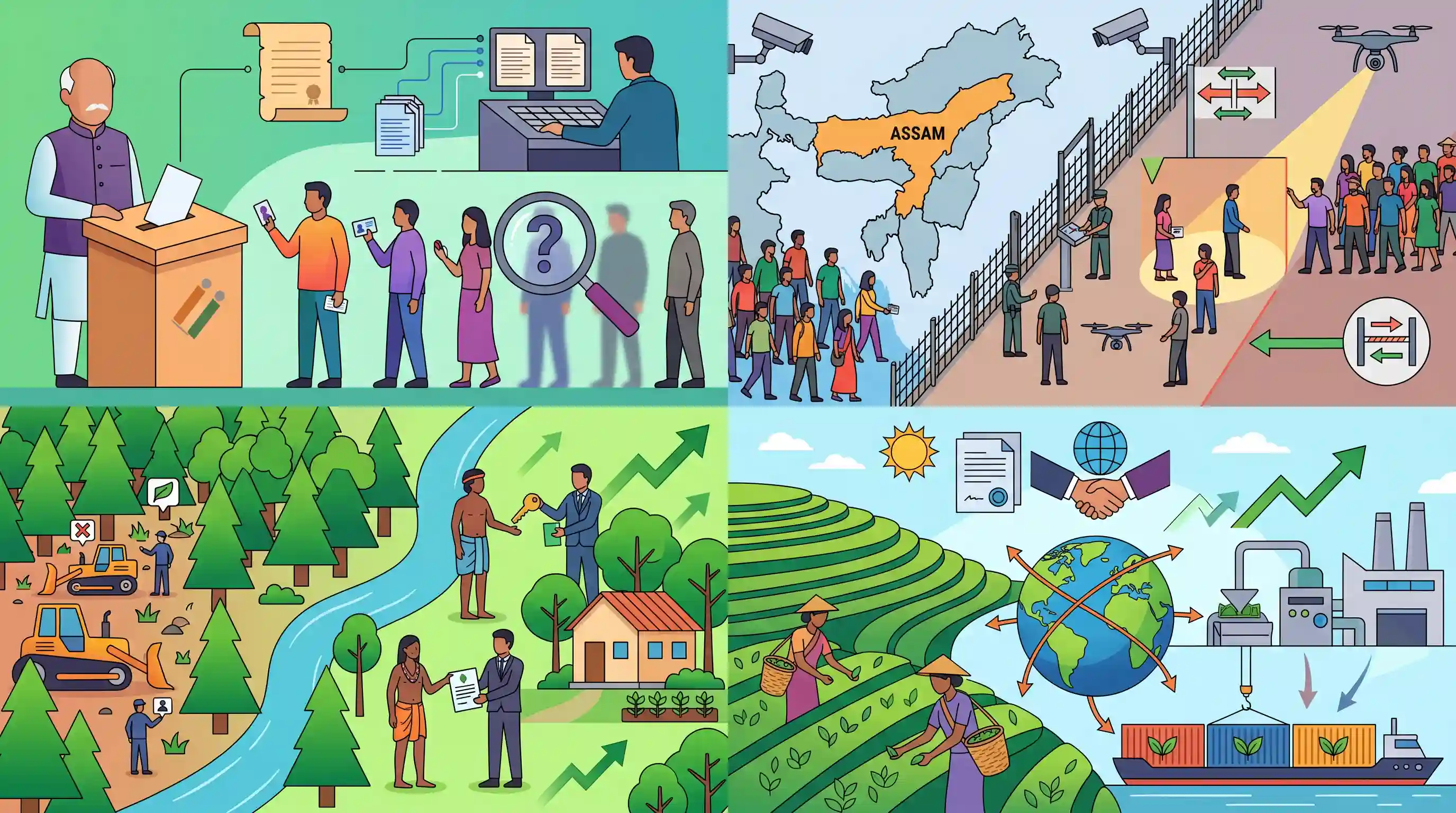
Assam Chief Minister Himanta Biswa Sarma announced significant developments spanning electoral polity, environmental management, and economic policy. Ongoing and upcoming revisions of the state’s electoral rolls target 'doubtful voters' amid political contention over illegal immigration and legacy data stemming from the Assam Accord. Simultaneously, the state is addressing large-scale encroachments in reserved forests—evicting illegal settlers while granting 'forest pattas' to indigenous people. Economically, Assam aims to boost its ailing tea industry by incentivizing orthodox tea production for global markets, anticipating new free trade agreements.
Key Points
- The Assam government is undertaking revisions of its electoral rolls, with almost 1% of voters deleted as 'doubtful voters' following BJP complaints.
- A Special Intensive Revision (SIR) of electoral rolls is planned to further identify and remove individuals lacking proper documentation or legacy data.
- The state is clearing massive encroachments on forest lands (e.g., Doyang Reserved Forest) while issuing forest pattas to secure land rights for indigenous communities.
- Assam is attempting to revitalize its tea sector by doubling subsidies (from ₹10 to ₹20 per kg) on orthodox tea to compete internationally, pending favorable Free Trade Agreements (FTAs) with the EU and UK.
Important Terms
Assam Accord (1985)

A 1985 Memorandum of Settlement ending the Assam Agitation. It established March 24, 1971, as the cut-off date for detecting and deporting illegal immigrants in Assam.
UPSC context
GS Paper II: Governance and Regionalism; tests knowledge of landmark settlements and citizenship cut-off dates.
Doubtful Voters (D-voters)
A category of individuals in Assam whose citizenship is unverified. Introduced by the ECI in 1997, they are barred from voting until cleared by a Foreigners Tribunal.
UPSC context
GS Paper II: Elections and Citizenship; crucial for understanding electoral reforms and minority rights in the Northeast.
Forest Rights Act, 2006
A 2006 Act (FRA) that recognizes the land and resource rights of forest-dwelling Scheduled Tribes and traditional dwellers, correcting 'historical injustices' through legal land titles or 'pattas'.
UPSC context
GS Papers II & III: Social Justice and Environment; tests land reforms and rights of vulnerable sections.
National Register of Citizens (NRC)
A register of genuine Indian citizens, updated in Assam to identify illegal immigrants. It uses 'legacy data' to verify ancestral residency before the 1971 cut-off.
UPSC context
GS Paper III: Internal Security; essential for topics on migration, border management, and demographic shifts.
Orthodox Tea
Tea processed through traditional methods (withering, rolling, oxidation) rather than machine-intensive CTC. It is high-value, export-oriented, and specifically incentivized by the Assam government to boost global trade.
UPSC context
GS Paper III: Indian Economy and Agriculture; tests knowledge of high-value agri-exports and state-level economic incentives.
Foreigners Tribunals (FT)
Quasi-judicial bodies established under the Foreigners (Tribunal) Order, 1964. They are the final authority in Assam for determining if a person is an illegal migrant or an Indian citizen.
UPSC context
GS Paper II: Judiciary; tests understanding of specialized administrative law and judicial processes in citizenship disputes.
Prelims Trap
"Individuals categorized as D-voters by the ECI automatically and permanently lose their Indian citizenship."
D-voter status causes temporary disenfranchisement, not permanent loss of citizenship. Final citizenship status is determined by quasi-judicial Foreigners' Tribunals, not the Election Commission.
Static Concepts Connected
How does Assam's citizenship cut-off structurally differ from the rest of India?
- Section 6A: Inserted into the Citizenship Act, 1955, it provides statutory recognition to the 1985 Assam Accord.
- Unique cut-off date: Midnight of March 24, 1971 is the exclusive cut-off for Assam, differing from the July 1948 cut-off applicable to the rest of India.
- Foreigners' Tribunals: Quasi-judicial bodies created under the Foreigners (Tribunals) Order, 1964, that hold the final authority to determine a suspected D-voter's citizenship.
What are the core eligibility and procedural criteria under the Forest Rights Act (FRA), 2006?
- Other Traditional Dwellers: Must prove residence in and dependence on the forest for at least three generations (75 years) prior to December 13, 2005.
- Gram Sabha authority: Statutorily empowered to initiate the process of determining the nature and extent of individual or community forest rights.
- Land ceiling: FRA grants titles (pattas) for land actually cultivated by forest dwellers, capped at a maximum of 4 hectares per family.
Cross-Topic Patterns
Agriculture exports & upcoming FTAs
Assam's push for 'orthodox tea' subsidies anticipates standard-heavy FTAs with the EU and UK, linking state-level agricultural value-addition directly to India's macroeconomic trade negotiations.
Evictions vs. Forest Rights Act
The dual policy of evicting encroachers in reserved forests while issuing 'forest pattas' to indigenous tribes highlights the perennial UPSC theme of ecological conservation vs. tribal rights.

Expect a multi-statement MCQ merging ECI's powers to designate 'D-voters' with the recent SC ruling on Section 6A of the Citizenship Act.
Linked PYQs · 4
Linked PYQs · 4
- 2025MainsGS3
What are the major challenges to internal security and peace process in the North-Eastern States? Map the various peace accords and agreements initiated by the government in the past decade.
- 2022MainsGS2
“Right of movement and residence throughout the territory of India are freely available to the Indian citizens, but these rights are not absolute.” Comment.
- 2022PrelimsGS1
With reference to the "Tea Board" in India, consider the following statements : 1. The Tea Board is a statutory body. 2. It is a regulatory body attached to the Ministry of Agriculture and Farmers Welfare. 3. The Tea Board's Head Office is situated in Bengaluru. 4. The Board has overseas offices at Dubai and Moscow. Which of the statements given above are correct?
- 2017PrelimsGS1
'Broad-based Trade and Investment Agreement (BTIA)' is sometimes seen in the news in the context of negotiations held between India and
