Assam Bans Drones Near Amur Falcon Roosting Sites
Source:The Hindu ↗
Why It Matters
This development highlights emerging challenges in wildlife management, specifically the threat posed by modern technology like drones to sensitive migratory species and the regulatory steps taken by state forest departments.
Summary
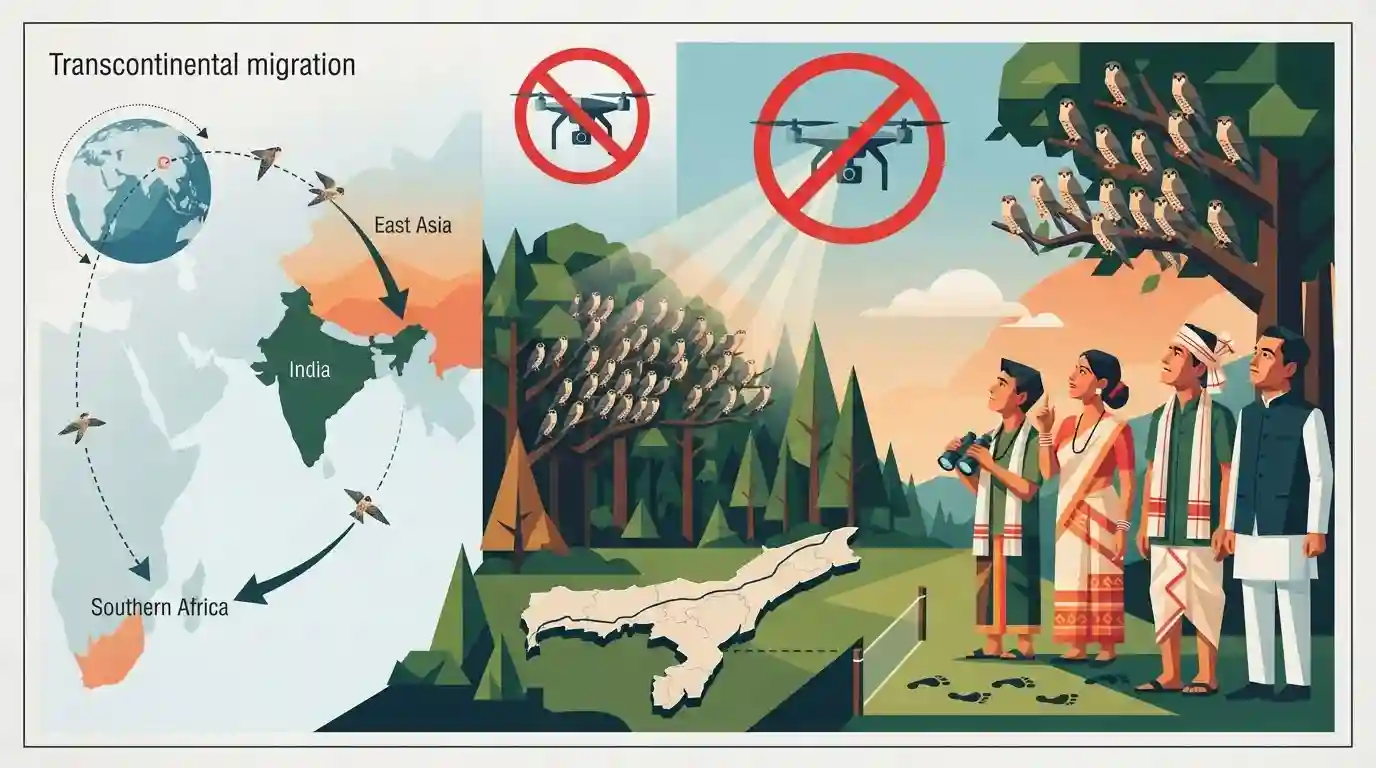
The Assam government has banned drone operations near Amur falcon roosting sites to protect the migratory raptors from human disturbance and habitat stress during their transit through the region. Amur falcons undertake a remarkable transcontinental migration from East Asia to southern Africa, making temporary stopovers in Northeast India where community and administrative conservation efforts are vital to their protection.
Key Points
- Assam has prohibited drone operations near Amur falcon roosting sites to prevent disturbance to the migratory birds.
- Amur falcons undertake one of the longest long-distance migrations, stopping over in Northeast India (Assam and Nagaland) during their journey from breeding grounds in East Asia to wintering sites in Africa.
- Unregulated drone usage poses severe stress, disruption of natural behavior, and collision risks to roosting raptors.
- Conservation authorities are increasingly utilizing regulatory tools and local community vigilance to safeguard migratory corridors.
Important Terms
Amur Falcon

A small migratory raptor known for undertaking one of the longest transcontinental migrations of any bird of prey, traveling from East Asia across India to southern Africa.
UPSC context
UPSC Prelims/Mains (Environment & Biodiversity): Important migratory species, conservation status, stopover protection in Northeast India.
Assam Forest Department
State-level statutory authority responsible for the protection, conservation, and management of forests and wildlife resources within the state of Assam.
UPSC context
UPSC Mains (Governance & Environment): State forest administration, wildlife management, enforcement of protected-area regulations.
Wild Life Protection Act 1972
India's umbrella legislation for the protection of wild animals, birds, and plant species, providing legal frameworks such as sanctuaries, national parks, and schedules of protection.
UPSC context
UPSC Prelims/Mains (Environment & Ecology): Core environmental legislation frequently tested for species schedules and wildlife offenses.
Static Concepts Connected
What is the legal protection status of Amur falcons and migratory species under Indian law?
- Legal Status: Protected status: Amur falcons are fully protected under Schedule IV of the Wild Life (Protection) Act, 1972, making killing, trapping, or possessing them illegal.
- Global Treaties: CMS Convention: India is a signatory to the Convention on the Conservation of Migratory Species of Wild Animals (CMS), obligating protection of transboundary corridors.
Cross-Topic Patterns
Migratory Species & Community Conservation Models
Migratory species protection requires balancing local indigenous community stewardship with administrative bans, echoing similar participatory conservation models seen in Hornbill festivals and Doyang Lake roosting protection.
Tech Regulation in Ecological Zones
The intersection of emerging civilian tech like drones with environmental regulation highlights new challenges under the Wildlife Protection Act for protected species and migratory corridors.

Amur falcon migration routes, Arabian Sea non-stop flight, and Wildlife Protection Act schedule status are high-yield Prelims targets.
Linked PYQs · 3
Linked PYQs · 3
- 2026PrelimsGS1
Which of the following statements with regard to the arrival of Amur Falcons at Doyang Lake in Nagaland each year from Mongolia is/are correct ? 1. It showcases how sustained local conservation efforts can contribute to the arrival and protection of international migratory birds. 2. It reflects the global success of advanced tracking technologies that guide migratory birds back to their stopover sites. 3. It confirms that Amur Falcons have adapted to permanent residency in India due to favourable habitat changes. Select the answer using the code given below :
- 2022PrelimsGS1
With reference to Indian laws about wildlife protection, consider the following statements : 1. Wild animals are the sole property of the government. 2. When a wild animal is declared protected, such animal is entitled for equal protection whether it is found in protected areas or outside. 3. Apprehension of a protected wild animal becoming a danger to human life is sufficient ground for its capture or killing. Which of the statements given above is/are correct?
- 2017PrelimsGS1
In India, if a species of tortoise is declared protected under Schedule I of the Wildlife (Protection) Act, 1972, what does it imply?
