Assam State Policy against Trafficking and Witch Hunting
Source:The Hindu ↗
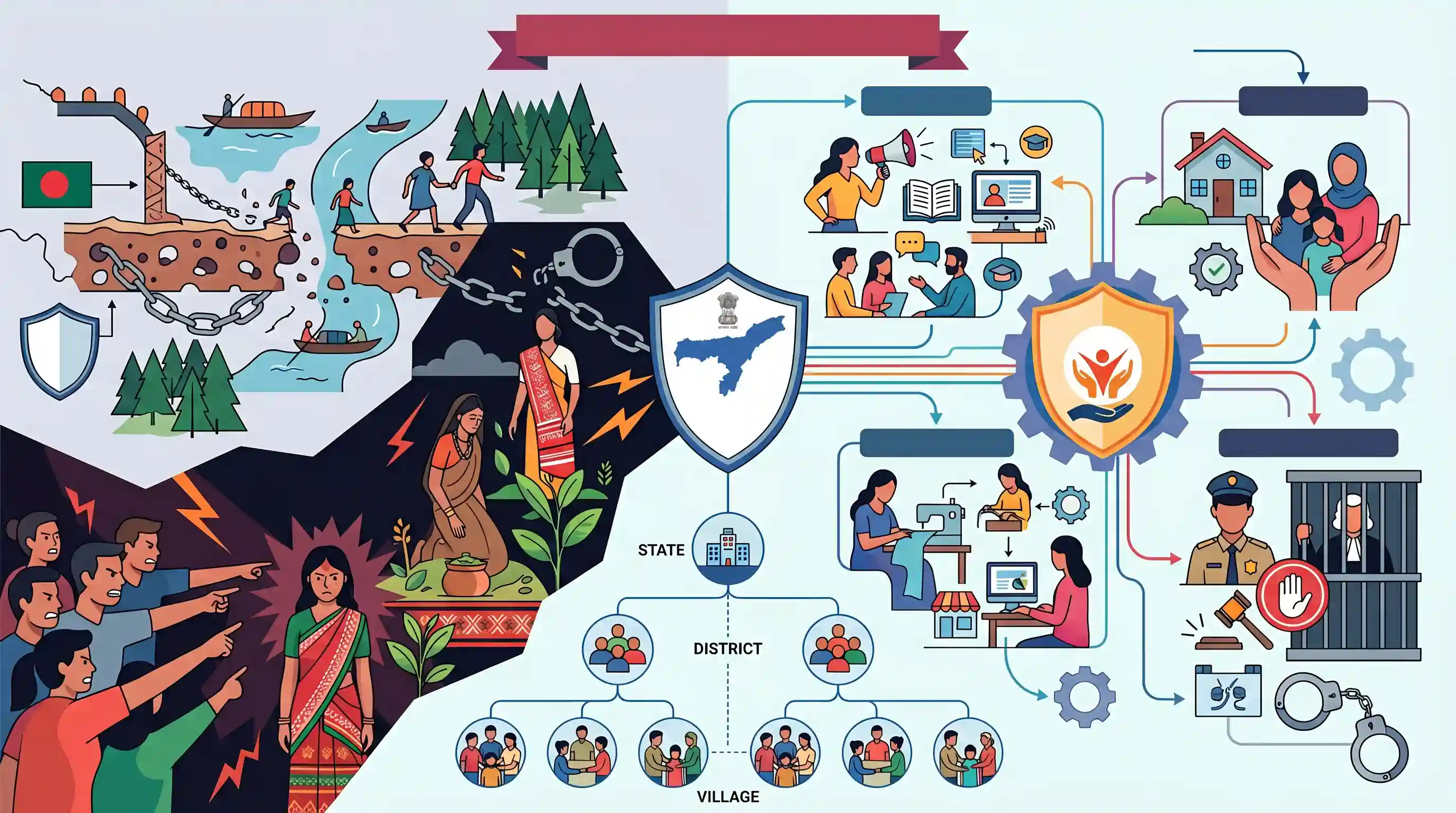
Why It Matters
The article highlights critical interventions by state governments to curb deeply rooted social evils (witch-hunting) and organized trans-border crimes (human trafficking). It is vital for understanding the intersection of geography, social vulnerability, and the legal/policy mechanisms required to protect marginalized communities and ensure internal security.
Summary
The Assam government has officially notified the "Assam State Policy to Combat Human Trafficking and End Witch-Hunting" to tackle two deeply entrenched crimes that disproportionately impact women and girls. Acknowledging Assam's vulnerability to organized trafficking due to its porous international borders with Bangladesh and Bhutan, as well as the persistence of witch-hunting among tea plantation workers and indigenous ethnic groups like the Rabhas, the policy adopts a comprehensive framework. It mandates multi-departmental convergence to ensure prevention, protection, and survivor rehabilitation while bolstering the strict deterrents already established under the Assam Witch Hunting Act of 2018. The Department of Women and Child Development will serve as the nodal implementing agency, executing the policy through dedicated multi-tier committees at the State, district, and village levels to ensure effective, ground-level enforcement.
Key Points
- The Assam government notified the "Assam State Policy to Combat Human Trafficking and End Witch-Hunting" to comprehensively address prevention, protection, and rehabilitation of survivors.
- Assam\'s geographical location, bordering six northeastern states, West Bengal, Bangladesh, and Bhutan, increases its vulnerability to human trafficking, an organized trans-border crime.
- Witch-hunting persists as a significant social crime among tea plantation workers and ethnic communities like the Rabhas.
- The Assam Witch Hunting Act of 2018 categorizes witch-hunting as a cognisable, non-bailable, and non-compoundable offence.
- The Department of Women and Child Development is the nodal agency for the policy, with implementation driven by dedicated committees at the State, district, and village levels.
Important Terms
Assam State Policy to Combat Human Trafficking and End Witch-Hunting

A multi-sectoral 2025 framework using village-to-state committees to prevent organized trafficking and superstitious violence, prioritizing survivor rehabilitation and inter-departmental convergence.
UPSC context
GS II: Government Policies; tests state-specific interventions for vulnerable groups and human rights protection.
Assam Witch Hunting (Prohibition, Prevention and Protection) Act, 2018
A stringent law making witch-branding and related violence cognizable, non-bailable, and non-compoundable offenses, with punishments ranging up to life imprisonment for perpetrators.
UPSC context
GS II: Social Justice; tests knowledge of legislative measures against deep-rooted social evils and superstitions.
Department of Women and Child Development (WCD), Assam
The nodal implementing agency for Assam's 2025 policy, coordinating multi-tier committees and leveraging missions like Shakti and Vatsalya for victim protection.
UPSC context
GS II: Welfare Schemes/Statutory Bodies; tests understanding of nodal agencies in policy implementation.
Anti-Human Trafficking Units (AHTUs)
Specialized police cells mandated by the policy to investigate organized trafficking, rescue victims, and ensure inter-state coordination for crime deterrence.
UPSC context
GS III: Internal Security/Organized Crime; tests institutional mechanisms for border management and crime prevention.
Project Prahari
An innovative community-policing initiative by Assam Police designed to tackle witch-hunting through social mobilization, awareness, and alternative livelihoods.
UPSC context
GS IV: Ethics/GS II: Social Justice; an example of community-led social reform and administrative innovation.
Prelims Trap
Witch-hunting is an offence governed by a comprehensive central legislation in India.
India currently has no specific central law against witch-hunting. It is governed by general penal provisions (IPC/BNS) and state-specific legislation like the Assam Witch Hunting Act.
Static Concepts Connected
How does the Indian Constitution and law address Human Trafficking?
- Article 23: Fundamental Right under Part III that explicitly prohibits traffic in human beings, begar, and similar forms of forced labor.
- ITPA 1956: The primary statutory framework penalizing human trafficking, specifically targeting trafficking for commercial sexual exploitation.
Which geographical borders make Assam highly vulnerable to trans-border organized crimes?
- International Borders: Assam shares highly porous international boundaries with Bhutan to the north and Bangladesh to the southwest, facilitating illicit trans-border movements.
- Internal Transit Hub: Assam touches West Bengal and six other northeastern states, acting as the critical transit hub (via Siliguri Corridor) for regional trafficking syndicates.
Cross-Topic Patterns
Border Management & Social Vulnerability
Porous international borders (Bangladesh, Bhutan) are not solely internal security threats; they directly exacerbate social exploitation by providing easy transit routes for organized human trafficking networks.
State Laws vs. Customary Crimes
Without a dedicated national anti-witch-hunting legislation, states with high prevalence (Assam, Jharkhand, Odisha) must enact their own stringent, non-bailable acts to bypass limitations in the general penal code.

Expect a multi-statement Prelims question testing Assam's border geography (Bhutan/Bangladesh, not Myanmar) linked to trans-border crime.
Linked PYQs · 4
Linked PYQs · 4
- 2020MainsGS3
Analyze internal security threats and transborder crimes along Myanmar, Bangladesh and Pakistan borders including Line of Control (LoC). Also discuss the role played by various security forces in this regard.
- 2023MainsGS3
The use of unmanned aerial vehicles (UAVs) by our adversaries across the borders to ferry arms/ammunitions, drugs, etc., is a serious threat to the internal security. Comment on the measures being taken to tackle this threat.
- 2023MainsGS1
Explain why suicide among young women is increasing in Indian society.
- 2019MainsGS1
“Empowering women is the key to control population growth.” Discuss.
