Assam and Meghalaya Villagers Oppose Joint Hydropower Project
Source:The Hindu ↗
কেন এটি গুরুত্বপূর্ণ
It exemplifies the friction between large infrastructure/hydropower development and grassroots environmental movements, highlighting how local communities across state lines organize against perceived ecological and livelihood risks.
সারসংক্ষেপ
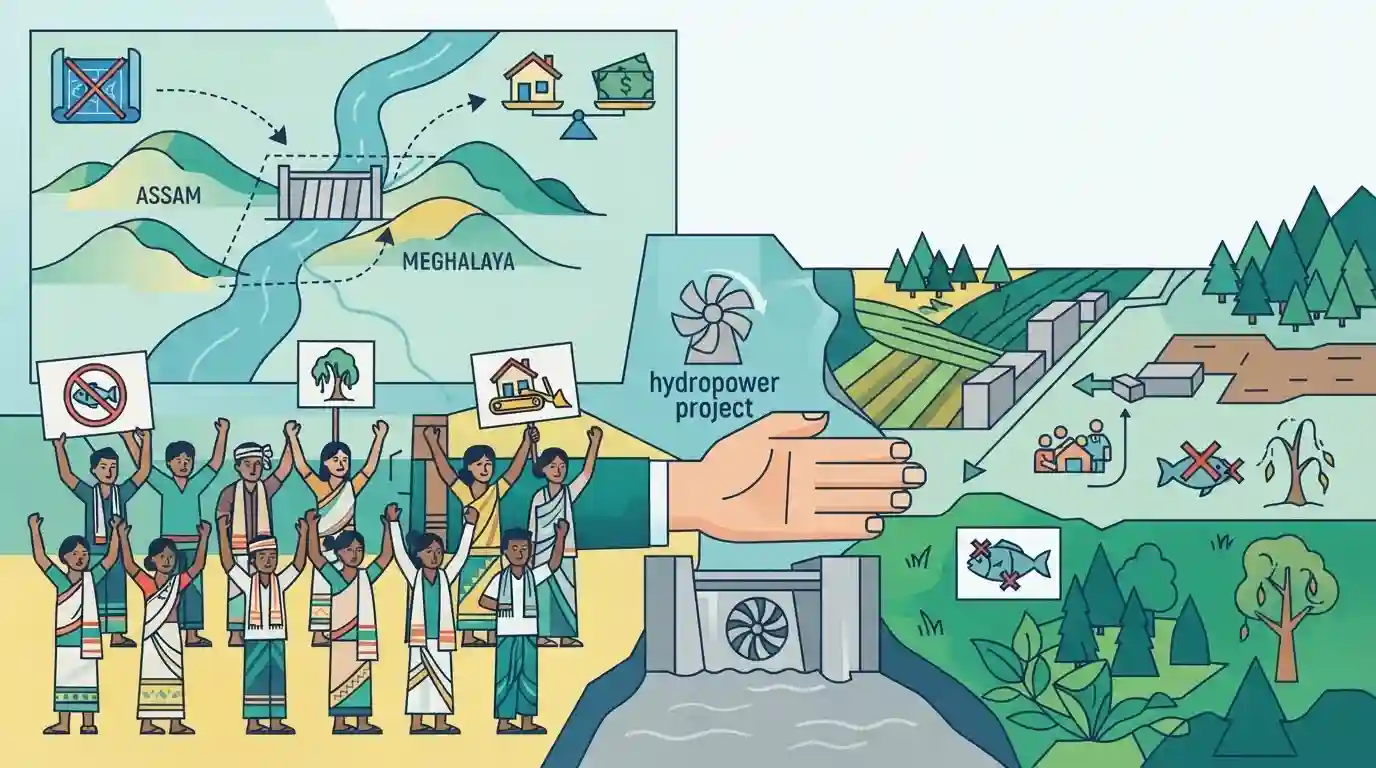
Villagers across the Assam-Meghalaya border have joined hands to oppose a joint hydropower project planned by their respective State governments, citing severe environmental concerns and threats to their local livelihoods.
মূল বিষয়
- Villagers from Assam and Meghalaya have united to oppose a joint hydropower project planned by the two State governments.
- The joint venture project raises concerns regarding local ecological degradation, displacement, and livelihood impacts on riparian communities.
- The resistance highlights grassroots mobilization cutting across State boundaries on development and environmental issues.
গুরুত্বপূর্ণ শব্দ
Kulsi Hydropower Project

A proposed 55-megawatt joint hydroelectric and irrigation project on the Kulsi River at Ukiam along the Assam-Meghalaya border, facing stiff local resistance due to environmental and displacement concerns.
UPSC context
GS Paper 3 (Environment & Infrastructure): Tests understanding of developmental projects, ecological conflicts, biodiversity threats (Gangetic dolphins), and displacement issues.
Kulsi River
A major tributary of the Brahmaputra River flowing through Meghalaya and Assam, vital for irrigation, fisheries, and as a critical natural habitat for the endangered Gangetic river dolphin.
UPSC context
GS Paper 1 & 3 (Geography & Environment): Tests knowledge of river systems, aquatic biodiversity, and conservation challenges in Northeast India.
Gangetic River Dolphin
An endangered freshwater dolphin species found in the Ganga and Brahmaputra river systems, protected under Schedule I of the Wildlife Protection Act, 1972, and threatened by the proposed Kulsi dam.
UPSC context
GS Paper 3 (Biodiversity & Conservation): Tests knowledge of protected species, riverine ecology, and threats from river-damming infrastructure projects.
প্রিলিমস ফাঁদ
joint state-level administrative agreements automatically bypass grassroots local resistance in border regions
Aspirants may assume that inter-state border disputes or joint economic projects preclude local cross-border unity; however, affected riparian communities frequently organize across administrative boundaries against ecological threats.
সংযুক্ত স্থির ধারণা
What are the mandatory clearances and statutory bodies involved in hydropower projects in India?
- EAC Clearance: Statutory appraisal by the Expert Appraisal Committee (EAC) under the Ministry of Environment, Forest and Climate Change (MoEFCC).
- EIA Notification: Mandatory environmental clearance (EC) under the EIA Notification, 2006, requiring public consultations in affected districts.
- CWC Concurrence: Concurrence from the Central Water Commission (CWC) for techno-economic viability and interstate water sharing aspects.
- NBWL Approval: Statutory clearances from the National Board for Wildlife (NBWL) if projects affect wildlife sanctuaries or critical dolphin habitats.
আন্তঃবিষয় প্যাটার্ন
Cooperative Federalism vs. Grassroots Environmental Resistance
Interstate border dispute resolution pacts between North-Eastern states can pivot to joint infrastructure projects, triggering cross-border grassroots resistance on ecological grounds that test cooperative federalism limits.
Hydropower Dams vs. Endangered Species Habitats
Hydropower interventions in fragile river basins intersect with Wildlife Protection Act provisions when critical habitats of endangered species like the Gangetic dolphin are threatened.

Expect a statement-based question combining interstate joint ventures, riparian rights, and the statutory role of EIA/tribal bodies in NE India.
সংযুক্ত PYQ · 2
সংযুক্ত PYQ · 2
- 2024MainsGS3
What role do environmental NGOs and activists play in influencing Environmental Impact Assessment (EIA) outcomes for major projects in India? Cite four examples with all important details.
- 2020MainsGS2
How far do you think cooperation, competition and confrontation have shaped the nature of federation in India? Cite some recent examples to validate your answer.
