Assam and Meghalaya Plan Joint Hydel Project and Border Resolution
Source:The Hindu ↗
Why It Matters
This development provides an integrated case study for UPSC aspirants covering multiple syllabus domains: cooperative federalism in resolving historic inter-state border disputes, ecological concerns of infrastructure projects (impact of dams on Gangetic dolphins), and disaster management strategies for urban flooding influenced by regional topography.
Summary
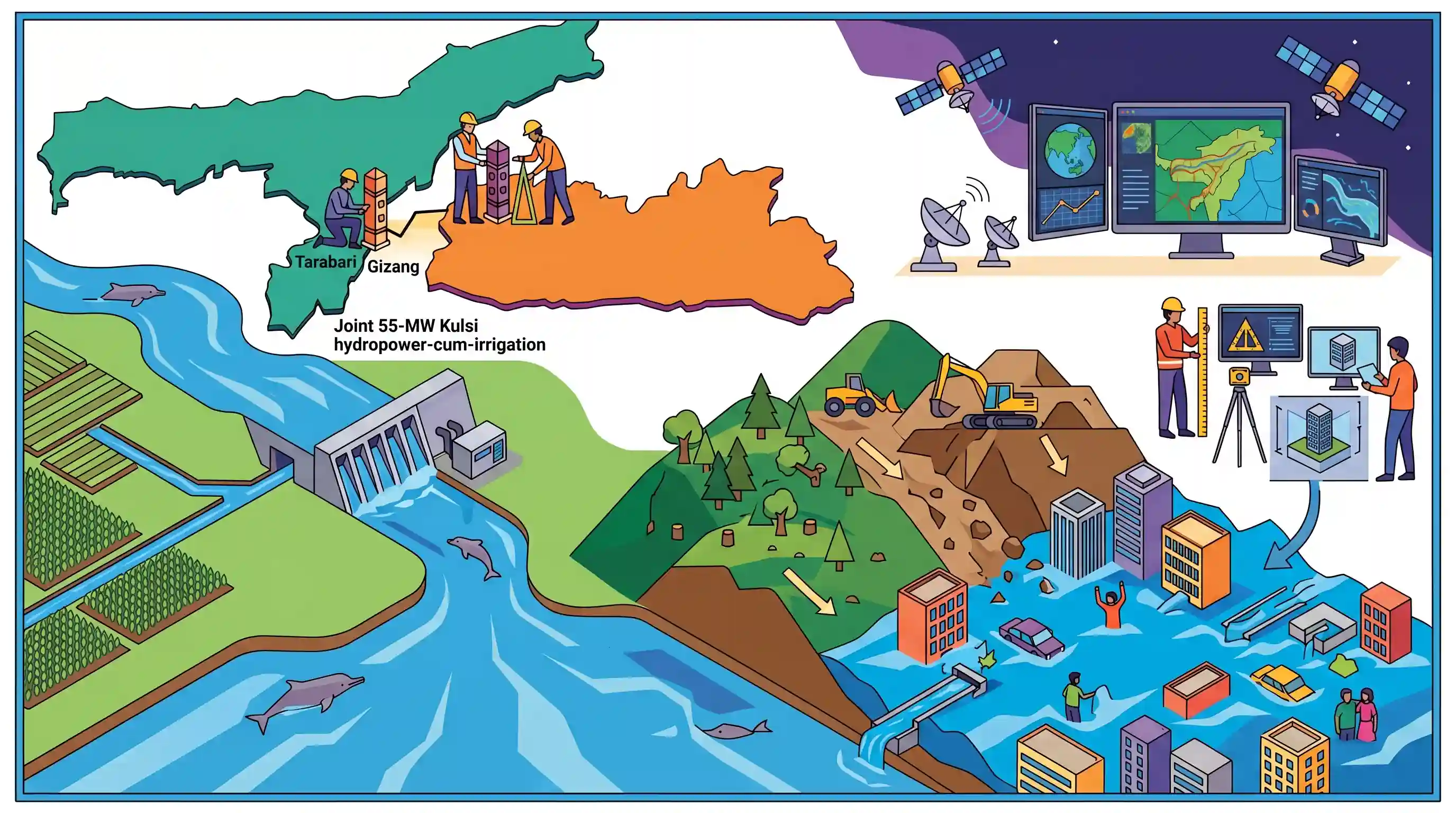
Assam and Meghalaya have agreed to jointly establish the 55-MW Kulsi hydropower-cum-irrigation project on the Kulsi river, a Brahmaputra tributary that serves as a critical habitat for the endangered Gangetic river dolphin. The two states are also actively concluding the resolution of their 52-year-old inter-state border dispute by erecting boundary pillars in contested zones like Tarabari and Gizang. Additionally, the North East Space Application Centre and IIT Roorkee have been roped in to study and mitigate urban flooding in Guwahati, which is heavily impacted by deforestation and hill flattening in neighboring Meghalaya.
Key Points
- Assam and Meghalaya have agreed to construct the 55-MW Kulsi hydropower-cum-irrigation project as a joint venture.
- The Kulsi river, a tributary of the Brahmaputra, is ecologically significant as a major habitat and nesting site for the endangered Gangetic river dolphin.
- The two states are erecting boundary pillars across contested sectors like Tarabari and Gizang to finalize the second phase of resolving their 52-year-old border dispute.
- To combat urban flooding in Guwahati, exacerbated by hill deforestation in Meghalaya, the North East Space Application Centre will conduct satellite mapping and IIT Roorkee will devise flood management solutions.
Important Terms
Gangetic River Dolphin

India's National Aquatic Animal and an 'Endangered' freshwater species (IUCN) found in the Ganga-Brahmaputra-Meghna river systems. It is protected under Schedule I of the Wildlife (Protection) Act, 1972.
UPSC context
GS3 (Environment & Ecology); tests species conservation status, habitat (like Kulsi river), and legal protection frameworks.
North East Space Application Centre (NESAC)
A joint initiative of the Department of Space and the North Eastern Council (NEC) that uses space technology for regional development, disaster management, and resource planning.
UPSC context
GS3 (Science & Tech/Disaster Management); tests application of remote sensing and GIS in regional governance.
Assam-Meghalaya Border Dispute
A 52-year-old conflict over 12 sectors along an 885 km border, rooted in differing interpretations of the Assam Reorganisation Act of 1971 and traditional tribal rights.
UPSC context
GS2 (Polity/Federalism); tests inter-state relations, constitutional mechanisms for dispute resolution, and regional internal security.
Urban Flooding
The inundation of densely populated areas caused by heavy rainfall overwhelming inadequate drainage systems, often categorized as a 'man-made disaster' due to unplanned urbanization.
UPSC context
GS3 (Disaster Management); tests knowledge of urban planning failures, NDMA guidelines, and climate change impacts.
Kulsi River
A south-bank tributary of the Brahmaputra River originating in Meghalaya; it is a critical nesting and breeding habitat for the endangered Gangetic river dolphin.
UPSC context
GS1 (Geography); tests knowledge of Northeast river systems and the intersection of infrastructure development with ecology.
Prelims Trap
"The Gangetic River Dolphin is found exclusively in the Ganga river basin and is absent from the Brahmaputra system."
Aspirants often assume the "Gangetic" prefix restricts the species to the Ganga. It is actually endemic to the Ganges-Brahmaputra-Meghna systems, including Assam's Kulsi river.
Static Concepts Connected
What are the constitutional mechanisms for resolving inter-state boundary disputes?
- Original Jurisdiction: Under Article 131, the Supreme Court of India holds exclusive original jurisdiction over legal disputes between two or more states.
- Inter-State Council: Article 263 empowers the President to establish an Inter-State Council to inquire into, discuss, and advise upon disputes between states.
- Zonal Councils: Statutory bodies established under the States Reorganisation Act of 1956 to foster cooperative federalism and discuss boundary tensions amicably.
What is the ecological profile of the Gangetic river dolphin?
- Habitat: Endemic to the Ganges-Brahmaputra-Meghna and Karnaphuli-Sangu river systems of India, Nepal, and Bangladesh.
- Conservation Status: Recognized as the National Aquatic Animal of India, listed as Endangered (IUCN) and protected under Schedule I of the WPA, 1972.
- Unique Features: They are essentially blind, relying entirely on echolocation (ultrasonic sounds) to navigate and hunt. Known locally as 'Susu'.
Cross-Topic Patterns
Space Tech in Disaster Mitigation
Using NESAC for Guwahati’s flood mapping links GS3 Science (remote sensing/GIS) directly with GS3 Disaster Management, highlighting space tech applications in urban planning.
Hydropower vs. Endangered Species
The Kulsi dam project highlights a classic GS3 conflict: renewable energy infrastructure (hydropower) directly fragmenting the natural habitat of a Schedule I flagship species (Gangetic dolphin).
Executive Bilateralism in Border Pacts
The Assam-Meghalaya pacts demonstrate a shift from judicial reliance (Article 131) to political bilateral dispute resolution, heavily mediated by the Home Ministry to foster cooperative federalism.

Expect a multi-statement question mapping Brahmaputra tributaries (Kulsi) with Gangetic dolphin habitats and anthropogenic dam threats.
Linked PYQs · 3
Linked PYQs · 3
- 2024MainsGS3
Flooding in urban areas is an emerging climate-induced disaster. Discuss the causes of this disaster. Mention the features of two such major floods in the last two decades in India. Describe the policies and frameworks in India that aim at tackling such floods.
- 2014PrelimsGS1
Other than poaching, what are the possible reasons for the decline in the population of Ganges River Dolphins? 1. Construction of dams and barrages on rivers 2. Increase in the population of crocodiles in rivers 3. Getting trapped in fishing nets accidentally 4. Use of synthetic fertilizers and other agricultural chemicals in crop-fields in the vicinity of rivers Select the correct answer using the code given below.
- 2016PrelimsGS1
Which of the following is/are tributary/tributaries of Brahmaputra? 1. Dibang 2. Kameng 3. Lohit Select the correct answer using the code given below.
