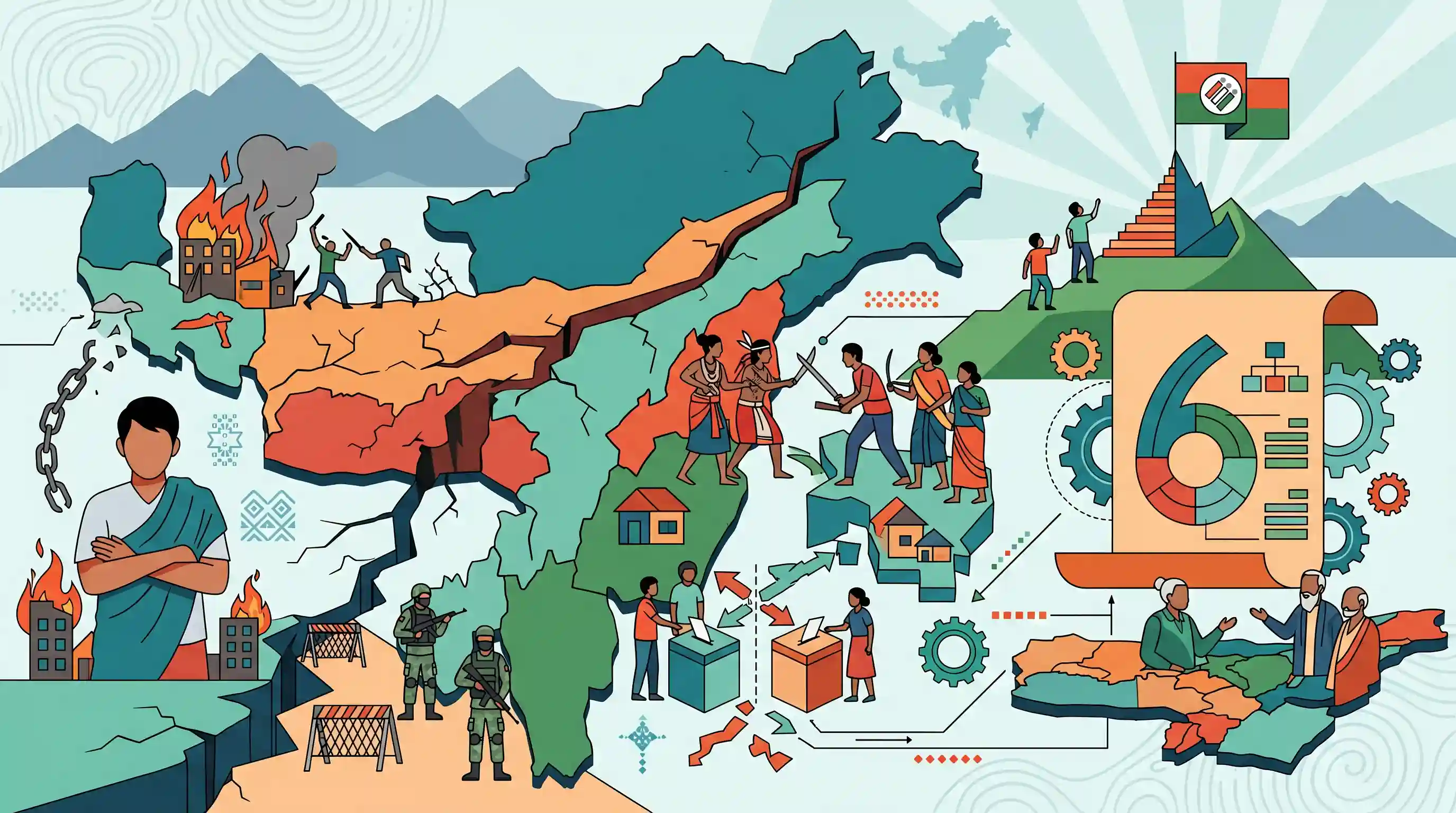
Karbi Anglong Violence and Sixth Schedule Tribal Administration
Source:Indian Express ↗
Why It Matters
Understanding the Karbi Anglong dispute is essential for the UPSC exam as it connects core constitutional provisions (Sixth Schedule, Article 244A) with practical governance and internal security challenges in Northeast India. It provides a real-world case study on ethnic conflicts, autonomy demands, and tribal land rights.
Summary
The article details the recent outbreak of violence in Assam's Karbi Anglong district, which was triggered by a hunger strike over land rights and disputes concerning non-tribal participation in local elections. It explores the historical background of the conflict, focusing on the region's administration under the Sixth Schedule of the Constitution and the unfulfilled demands for an autonomous state under Article 244A. The situation highlights the deep-rooted ethnic fault lines in Northeast India and the continuous internal security challenges stemming from competing claims over land, political representation, and tribal autonomy.
Key Points
- A hunger strike regarding land rights and the inclusion of non-tribals on the Karbi Anglong Autonomous Council (KAAC) electoral rolls served as the immediate trigger for the recent violence in the region.
- Karbi Anglong is governed under the Sixth Schedule of the Indian Constitution, which grants significant administrative, legislative, and judicial autonomy to tribal areas to protect indigenous rights.
- The region has a long history of ethnic tension and insurgency, largely driven by the longstanding demand for an autonomous state within Assam under Article 244A.
- The ongoing conflict illustrates the delicate and complex challenge of balancing the protection of indigenous tribal identities and land with the rights of non-tribal populations residing in autonomous districts.
Important Terms
Sixth Schedule of the Constitution of India

Constitutional provision (Articles 244(2) and 275(1)) providing autonomous governance to tribal areas in Assam, Meghalaya, Tripura, and Mizoram via Autonomous District Councils.
UPSC context
GS Paper II (Polity) and GS III (Internal Security); tests understanding of tribal self-rule and federalism.
Article 244A of the Constitution
A provision allowing for the creation of an 'autonomous state' within Assam, granting more powers (including law and order) than the Sixth Schedule.
UPSC context
GS II; key to understanding specific tribal demands and asymmetric federalism in Northeast India.
Karbi Anglong Autonomous Council (KAAC)
A self-governing body in Assam's Karbi Anglong and West Karbi Anglong districts, empowered under the Sixth Schedule to manage land and local administration.
UPSC context
GS II/III; functional example of decentralized governance and its role in conflict/peace processes.
22nd Constitutional Amendment Act, 1969
The constitutional amendment that inserted Article 244A, enabling the creation of an autonomous region or state within Assam to address tribal aspirations.
UPSC context
GS II; significant for historical context of Northeast statehood movements and constitutional evolution.
Autonomous District Councils (ADCs)
Elected bodies established under the Sixth Schedule with legislative, judicial, and executive powers to manage tribal land, customs, and local governance.
UPSC context
GS II; critical for questions on local self-government and protective discrimination for STs.
Professional and Village Grazing Reserves (PGR/VGR)
Land traditionally reserved for cattle grazing and community use, which became a flashpoint for conflict over encroachment and illegal settlements.
UPSC context
GS III (Land Reforms/Security); illustrates triggers of ethnic conflict and challenges in land-use management.
Bordoloi Committee
A sub-committee of the Constituent Assembly that recommended the Sixth Schedule to protect the unique cultural and political identity of Northeast tribes.
UPSC context
GS II (History/Polity); key committee for questions on the origin of tribal constitutional safeguards.
Prelims Trap
"Article 244A empowers Parliament to create an autonomous state within any of the Sixth Schedule states (Assam, Meghalaya, Tripura, Mizoram)."
Article 244A applies exclusively to Assam. It was inserted by the 22nd Amendment (1969) to create an autonomous state within Assam, not for Meghalaya, Tripura, or Mizoram.
Static Concepts Connected
How does Article 244A differ from Article 244 (Sixth Schedule)?
- Article 244: Creates Autonomous District Councils (ADCs) in AMTM states, but law and order remains firmly with the respective state governments.
- Article 244A: Empowers Parliament to form an 'autonomous state' comprising certain tribal areas strictly within Assam, allowing local control over law and order.
- 22nd Amendment: Inserted by the 22nd Constitutional Amendment Act, 1969, to accommodate specific tribal aspirations in Assam without creating a fully separate state.
What are the key administrative features of Sixth Schedule Autonomous District Councils (ADCs)?
- Governor's Authority: The Governor has sweeping powers to organize, reorganize, alter boundaries, and even dissolve these autonomous districts.
- Council Composition: Typically comprises 30 members (4 nominated by Governor, 26 elected by adult franchise) serving a 5-year term. (Exceptions like Bodoland exist).
- Legislative Powers: Can make laws on land, forests, shifting cultivation, and social customs, subject to the Governor's assent.
Cross-Topic Patterns
Demographic shifts and border state insurgency
Clashes over Professional/Village Grazing Reserves (PGR/VGR) mirror the Meitei-Kuki conflict in Manipur, tying GS2 constitutional protections (Sixth Schedule) directly to GS3 Internal Security and border state demography.
PESA vs Sixth Schedule administrative powers
KAAC's governance structures highlight the distinct administrative silos of the Sixth Schedule, often compared in Mains to the Fifth Schedule (PESA) regarding indigenous land rights and tribal political representation.

Expect a paired-statement Prelims question comparing the Governor's powers in 5th vs 6th Schedule areas, or Article 244A's applicability.
Linked PYQs · 2
Linked PYQs · 2
- 2017MainsGS3
The North-East region of India has been infested with insurgency for a very long time. Analyze the major reasons for the survival of armed insurgency in this region.
- 2015PrelimsGS1
The provisions in Fifth Schedule and Sixth Schedule in the Constitution of India are made in order to
