Assam and Gujarat collaborate on cooperative sugar price stability
Source:chinimandi ↗
Why It Matters
The cooperative sector, particularly in agriculture and sugar production, is vital for rural economic development and price stabilization in India. Successful models from states like Gujarat provide blueprints for other states aiming to revitalize their cooperative societies and improve market interventions for agricultural commodities.
Summary
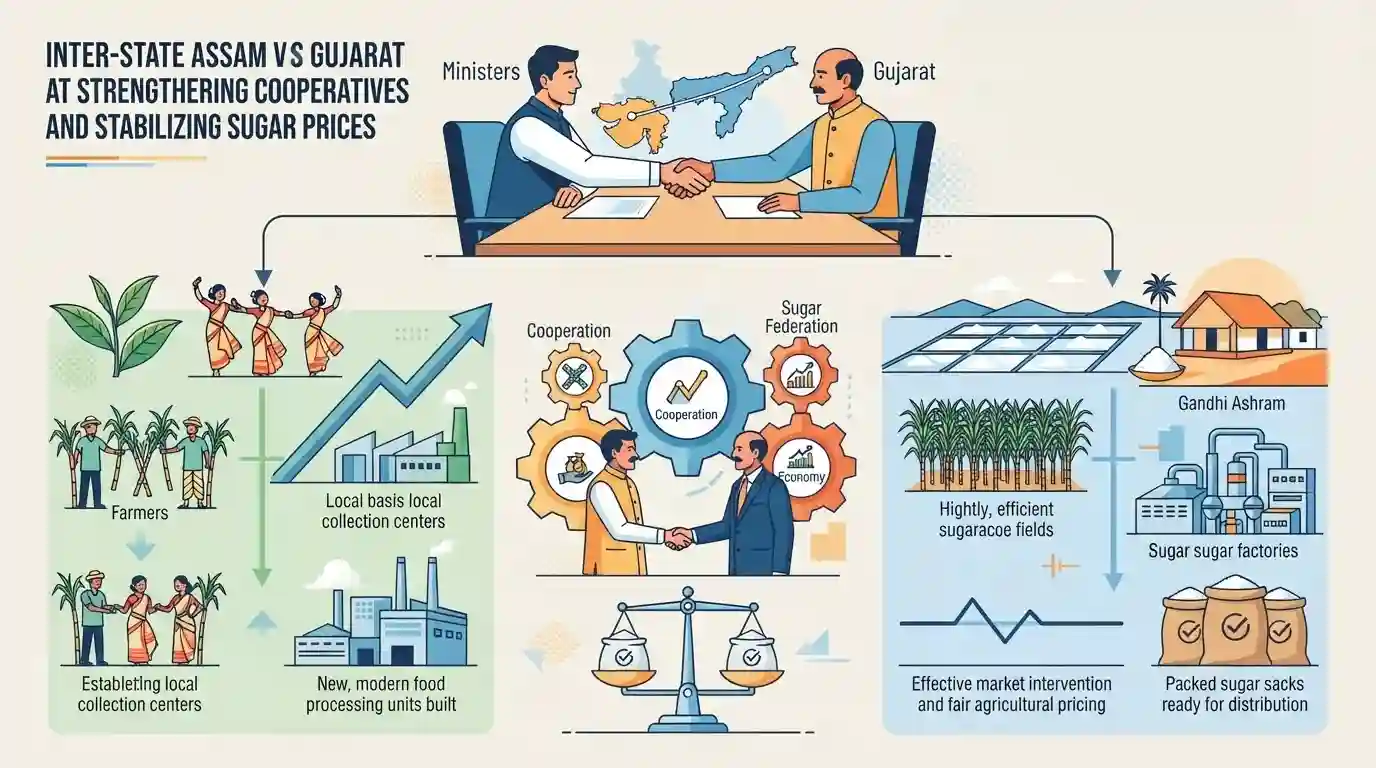
Representatives from Assam and Gujarat recently met to discuss strategies for maintaining sugar price stability and implementing effective market interventions. Assam Cooperation Minister Kaushik Rai engaged with Gujarat's Cooperation Minister Jitubhai Vaghani and other key officials, aiming to utilize Gujarat's highly successful cooperative model to develop and strengthen the cooperative sector in Assam. The discussions also involved the Chairman of the Gujarat State Federation of Cooperative Sugar Factories Ltd, underscoring the critical role of agricultural cooperatives in the economy and the value of inter-state collaboration.
Key Points
- Officials from Assam and Gujarat held discussions focusing on sugar price stability and market intervention strategies.
- Assam's Cooperation Minister sought to leverage Gujarat's extensive experience and successful model to strengthen Assam's own cooperative sector.
- The meeting highlighted the importance of inter-state knowledge sharing and collaboration in enhancing the efficiency of cooperative institutions.
- Key representatives from Gujarat's cooperative sugar sector participated, emphasizing the role of cooperatives in managing agricultural commodities and ensuring economic stability.
Important Terms
Gujarat State Federation of Cooperative Sugar Factories Ltd

The apex coordinating body for cooperative sugar mills in Gujarat. It supports the state's sugar industry through policy advocacy, financial management, and integrating ethanol and green energy production.
UPSC context
Crucial for GS Paper 3 (Cooperatives) to understand how apex bodies ensure agricultural price stabilization and support rural economies.
Gujarat Government
The state administration of Gujarat, noted for fostering a highly successful, farmer-centric agricultural cooperative model that ensures remunerative prices for sugarcane growers while maintaining market stability.
UPSC context
Relevant for GS Paper 3 (Agriculture) as a prime case study of effective state-led cooperative governance and market intervention.
Assam Government
The state administration of Assam, actively engaging in inter-state collaboration with Gujarat to study and implement its successful cooperative frameworks for strengthening Assam's own agricultural sector.
UPSC context
Highlights collaborative federalism (GS Paper 2) as states share best practices to resolve agricultural pricing issues and strengthen cooperatives.
Prelims Trap
The CACP approves the Fair and Remunerative Price (FRP) for sugarcane.
The CACP only recommends the FRP. It is the Cabinet Committee on Economic Affairs (CCEA), chaired by the Prime Minister, that officially approves it.
Static Concepts Connected
How is sugarcane pricing uniquely determined in India?
- FRP Mechanism: Recommended by CACP and approved by CCEA, ensuring a guaranteed minimum price to sugarcane farmers.
- State Advised Price: Several states announce their own State Advised Price (SAP), which is typically higher than the FRP.
- Legal Backing: Sugar mills are legally bound to pay these prices under the Sugarcane (Control) Order, 1966.
What are the constitutional provisions governing cooperative societies?
- Fundamental Right: The 97th Amendment Act (2011) added the right to form cooperatives under Article 19(1)(c).
- DPSP: Article 43B was inserted to mandate the State to promote the autonomous functioning and management of cooperatives.
- Seventh Schedule: Cooperative societies are a State subject (Entry 32, List II), while Multi-State Cooperatives fall under the Union List.
Cross-Topic Patterns
Sugar Industry's Geographical Shift
Gujarat and Maharashtra's successful cooperative models heavily contributed to the historical shift of the sugar industry from North to Peninsular India.
Horizontal Cooperative Federalism
Assam adopting Gujarat's model highlights horizontal (state-to-state) knowledge sharing, a crucial dimension of cooperative federalism distinct from vertical Centre-State ties.

Expect a multi-statement question combining sugarcane pricing (FRP vs SAP) with the constitutional provisions of the 97th Amendment.
Linked PYQs · 1
Linked PYQs · 1
- 2026GPSC_PRELIMSGS1
Food subsidy is the difference between
