Illegal Coal Mining Threats Near Northeast Border
Source:The Hindu ↗
Why It Matters
The persistence of illegal rat-hole mining highlights the tension between resource extraction and environmental conservation, a frequent theme in UPSC GS3. It emphasizes governance gaps in enforcing NGT bans and underscores the importance of elevating protection statuses (from reserved forests to wildlife sanctuaries) to safeguard biodiversity hotspots like the Dehing-Patkai landscape.
Summary
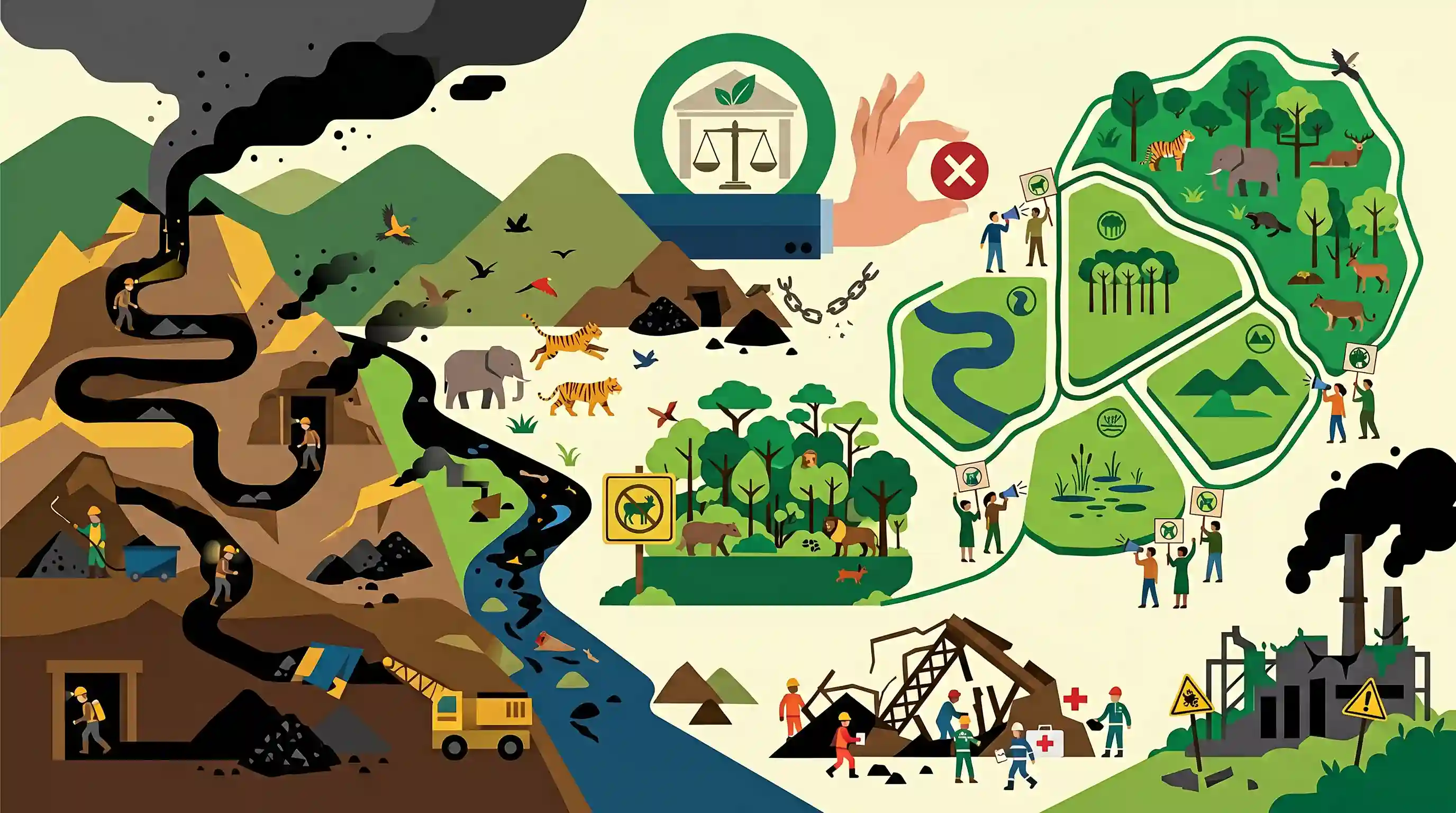
Illegal rat-hole coal mining continues unabated along the Assam-Arunachal Pradesh border, particularly threatening the fragile ecosystems near the Dehing-Patkai National Park. Activists are demanding that five adjacent reserved forests—Tinkopani, Tipong, Tirap, Saleki, and Makumpani—be officially designated as wildlife sanctuaries to combat this ecological degradation. The persistence of these highly unsafe and polluting operations highlights significant regulatory enforcement gaps despite the National Green Tribunal's 2014 blanket ban on rat-hole mining, which recently led to another deadly mining disaster in Meghalaya.
Key Points
- Illegal rat-hole coal mining is actively taking place along the Assam-Arunachal Pradesh border, posing severe environmental risks.
- The operations are located near the ecologically sensitive Dehing-Patkai National Park, often termed the 'Amazon of the East'.
- Environmental activists are urging the government to upgrade five reserved forests in the coal belt into wildlife sanctuaries to strengthen conservation efforts.
- Despite a 2014 ban by the National Green Tribunal (NGT), rat-hole mining persists in the Northeast, as evidenced by a recent fatal mine blast in Meghalaya.
Important Terms
National Green Tribunal (NGT)

A statutory judicial body established under the NGT Act (2010) for the effective and expeditious disposal of cases relating to environmental protection and conservation.
UPSC context
GS II/III: Tests knowledge of statutory bodies, environmental jurisprudence (Polluter Pays Principle), and the judicial enforcement of ecological rights.
Rat-hole Mining
An illegal, manual method of coal extraction involving narrow horizontal tunnels (3-4 feet high) dug into hillsides, primarily practiced in Northeast India.
UPSC context
GS III: Focuses on illegal mining, internal security, environmental degradation, and the human rights of vulnerable labor populations.
Dehing-Patkai National Park
Known as the 'Amazon of the East,' it is India's largest stretch of lowland tropical rainforest, located in Assam's Dibrugarh and Tinsukia districts.
UPSC context
Prelims/GS III: Important for mapping, protected area status, and biodiversity (Asian elephants, rare wild cats, and the Hollong tree).
Wildlife Sanctuary
A protected area notified under the Wildlife (Protection) Act, 1972, intended to protect specific animal species while permitting limited human activities like grazing.
UPSC context
Prelims: Tests the legal distinctions between National Parks, Sanctuaries, and Reserved Forests under the WPA 1972.
Reserved Forest
Forest land notified under the Indian Forest Act, 1927, where most activities are prohibited unless specifically permitted by the state government.
UPSC context
GS III: Relevant for forest management, the Indian Forest Act, and the conversion of forest land for conservation.
Indo-Burma Biodiversity Hotspot
A biogeographic region with significant levels of biodiversity that is under threat from human habitation; the Dehing-Patkai landscape is part of this global hotspot.
UPSC context
Prelims/GS III: Core concept in ecology regarding species richness, endemism, and conservation priorities in Northeast India.
Prelims Trap
"Only the Central Government can upgrade a Reserved Forest into a Wildlife Sanctuary."
Under the Wildlife (Protection) Act, 1972, State Governments hold the primary power to declare an area as a Wildlife Sanctuary.
Static Concepts Connected
What is Acid Mine Drainage (AMD) and its ecological impact?
- Chemical Mechanism: High-sulfur coal reacts with surface water and atmospheric oxygen to produce highly corrosive sulfuric acid.
- Aquatic Toxicity: It severely lowers the pH of local water bodies, triggering heavy metal toxicity that destroys local aquatic life and contaminates drinking water sources.
- Soil Degradation: Toxic runoff degrades soil quality in adjacent protected areas, directly threatening fragile ecosystems like lowland tropical rainforests.
How does a Wildlife Sanctuary legally differ from a Reserved Forest?
- Legal Backing: Sanctuaries are notified under the Wildlife (Protection) Act, 1972, whereas Reserved Forests are constituted under the Indian Forest Act, 1927.
- Rights Allowed: In a Reserved Forest, all activities are banned unless explicitly permitted. In a Sanctuary, protection is stricter, completely barring extractive industries like mining.
Cross-Topic Patterns
Rat-hole mining and river pollution
The Lukha (Meghalaya) and Kopili (Assam) rivers often turn blue or yellow due to Acid Mine Drainage. UPSC frequently links specific polluting industries to regional drainage basin degradation.
6th Schedule vs Environmental regulations
Meghalaya's coal extraction relies heavily on tribal land ownership rights under the 6th Schedule, creating a persistent jurisdictional friction with national environmental statutes and NGT bans.

Dehing-Patkai's rainforest ecology, Acid Mine Drainage, and State powers to declare Sanctuaries will likely merge in a 2026 Prelims MCQ.
Linked PYQs · 2
Linked PYQs · 2
- 2025MainsGS3
Mineral resources are fundamental to the country's economy and these are exploited by mining. Why is mining considered an environmental hazard? Explain the remedial measures required to reduce the environmental hazard due to mining.
- 2013MainsGS3
What are the consequences of Illegal mining ? Discuss the Ministry of Environment and Forests' concept of GO AND NO GO zones for coal mining sector.
