Assam Floods and Wildlife Conservation Crises in Protected Areas
Source:The Hindu ↗
Why It Matters
Recurring floods in Assam present a persistent disaster management challenge with severe socioeconomic and environmental consequences. The issue is vital for UPSC aspirants as it integrates riverine geography (Brahmaputra basin), disaster response, and the conservation of critical habitats for endangered species like the one-horned rhinoceros.
Summary
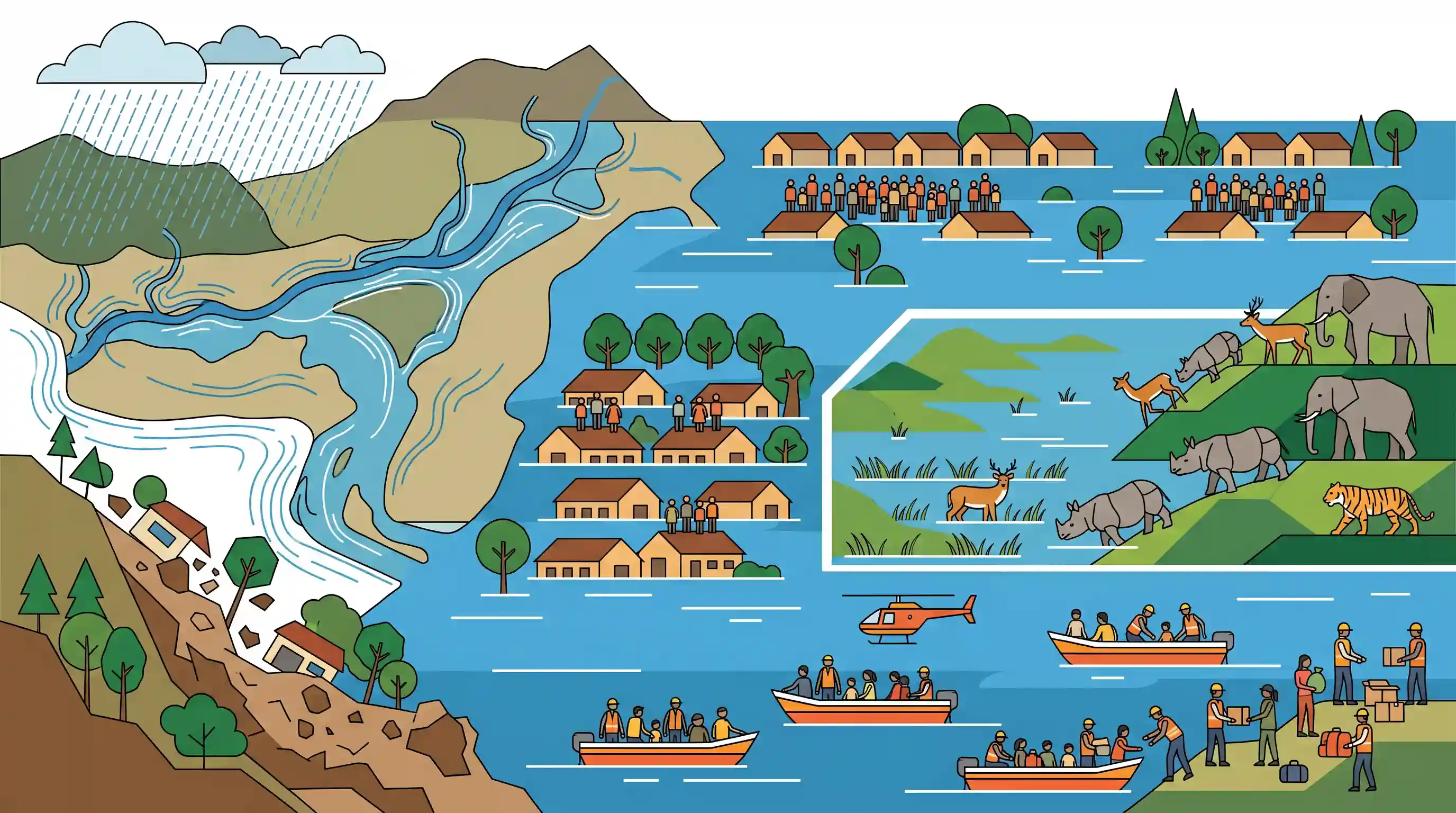
The flood situation in Assam is showing marginal improvement as major rivers, including the Brahmaputra, begin to recede, though several continue to flow above the danger mark. The deluge and accompanying landslides have affected over four lakh people across 18 districts and claimed 21 lives so far. Key biodiversity hotspots, such as the Kaziranga National Park and Pobitora Wildlife Sanctuary, are severely inundated, forcing wildlife like the one-horned rhinoceros to seek shelter on higher ground. Relief and rescue operations are ongoing.
Key Points
- The flood situation in Assam improved marginally with the Brahmaputra and other major rivers showing a receding trend, although many remain above the danger level.
- Over 4 lakh people across 18 districts have been affected by the floods, which, along with landslides, have claimed 21 lives.
- Kaziranga National Park, a UNESCO World Heritage Site, and Pobitora Wildlife Sanctuary have been heavily inundated.
- Wildlife, including the one-horned rhinoceros, has been forced to move to higher ground due to floodwaters.
Important Terms
Brahmaputra River

A major transboundary river originating in Tibet (as Yarlung Tsangpo), flowing through Assam and Bangladesh. Known for its braided course, heavy siltation, and annual monsoonal flooding in Northeast India.
UPSC context
GS Paper I (Geography) and III (Disaster Management). Essential for understanding river systems, flood causes, and regional topography.
One-horned Rhinoceros
The 'Vulnerable' (IUCN) species native to the Indian subcontinent, primarily found in Assam's floodplains. It is protected under Schedule I of the Wildlife Protection Act, 1972.
UPSC context
GS Paper III (Environment and Biodiversity). Tests knowledge of flagship species, conservation status, and protected area management.
Kaziranga National Park
A UNESCO World Heritage site in Assam, hosting two-thirds of the world's one-horned rhinoceroses. It is a critical biodiversity hotspot located in the Brahmaputra floodplain ecosystem.
UPSC context
GS Paper III (Environment). Frequent topic regarding conservation successes, threats like poaching/floods, and international heritage designations.
Disaster Management Cycle
A four-stage framework (Mitigation, Preparedness, Response, Recovery) used to manage disasters. Floods in Assam trigger the 'Response' phase, involving immediate rescue and relief operations.
UPSC context
GS Paper III (Disaster Management). Tests the ability to apply theoretical management frameworks to real-world natural calamities.
UNESCO World Heritage Site
A United Nations designation for sites of outstanding cultural or natural importance. Kaziranga and Manas in Assam hold this status, requiring international standard conservation protocols.
UPSC context
GS Paper I (Culture) and III (Environment). Relevant for international conservation cooperation and protected area hierarchies.
Braided River
A river channel consisting of multiple small, temporary islands (chars) and shifting threads. The Brahmaputra's braided nature in Assam significantly complicates flood control and erosion management.
UPSC context
GS Paper I (Geography). Key concept in geomorphology explaining why certain rivers are prone to high siltation and frequent course changes.
Prelims Trap
"Kaziranga National Park has the highest population density of the one-horned rhinoceros in the world."
Kaziranga has the highest absolute number of one-horned rhinos, but Pobitora Wildlife Sanctuary holds the highest population density. UPSC often swaps these facts.
Static Concepts Connected
Why is the Brahmaputra river so prone to catastrophic flooding in Assam?
- Braided channel: High sediment load from the young Himalayas causes rapid riverbed aggradation, making the river shallow and reducing its water-carrying capacity.
- Gradient shift: The abrupt flattening of the river's slope as it enters the Assam Valley reduces flow velocity, forcing water to spill laterally over its banks.
- Catchment rainfall: Intense monsoon rainfall across a vast, steep catchment area rapidly converges into the relatively narrow funnel of the Assam valley.
What is the ecological relationship between Kaziranga and the Karbi Anglong hills?
- Floodplain dynamics: Kaziranga is a dynamic floodplain relying on annual Brahmaputra floods to replenish its wetlands and maintain its tall elephant grass ecosystem.
- Altitudinal refuge: Karbi Anglong hills to the south serve as the critical elevated escape route for wildlife during peak inundation via designated corridors.
Cross-Topic Patterns
Linear infrastructure vs. Wildlife corridors
The forced migration of wildlife across NH-715 during floods connects disaster management directly to the ecological impacts of linear infrastructure projects in eco-sensitive zones.
Himalayan geomorphology + Assam floods
The high rate of soil erosion in the seismically active Himalayas directly dictates the severe sediment aggradation and shifting braided channels of the Brahmaputra downstream.

Map-based questions linking Kaziranga’s animal corridors, the Brahmaputra riverbed, and Karbi Anglong hills are highly probable in 2026.
Linked PYQs · 5
Linked PYQs · 5
- 2013PrelimsGS1
Consider the following pairs : National Park River flowing through the Park 1. Corbett National Park : Ganga 2. Kaziranga National Park : Manas 3. Silent Valley National Park : Kaveri Which of the above pairs is/are correctly matched?
- 2019PrelimsGS1
Consider the following statements: 1. Asiatic lion is naturally found in India only. 2. Double-humped camel is naturally found in India only. 3. One-horned rhinoceros is naturally found in India only. Which of the statements given above is/are correct?
- 2021MainsGS3
Describe the various causes and the effects of landslides. Mention the important components of the National Landslide Risk Management Strategy.
- 2019MainsGS3
Disaster preparedness is the first step in any disaster management process. Explain how hazard zonation mapping will help disaster mitigation in the case of landslides.
- 2024MainsGS3
Flooding in urban areas is an emerging climate-induced disaster. Discuss the causes of this disaster. Mention the features of two such major floods in the last two decades in India. Describe the policies and frameworks in India that aim at tackling such floods.
