Biochar from Invasive Plants Aids Elephant Habitat Recovery in Assam
Source:The Hindu ↗
Why It Matters
This article is highly relevant as it showcases an innovative, eco-friendly, circular solution to complex conservation issues (invasive weeds and habitat loss). Converting ecological liabilities (invasive plants) into carbon-rich, soil-enhancing assets (biochar) addresses multiple syllabus verticals in GS3—namely climate change mitigation (carbon sequestration), biodiversity conservation, and managing human-wildlife conflict by restoring natural forage.
Summary
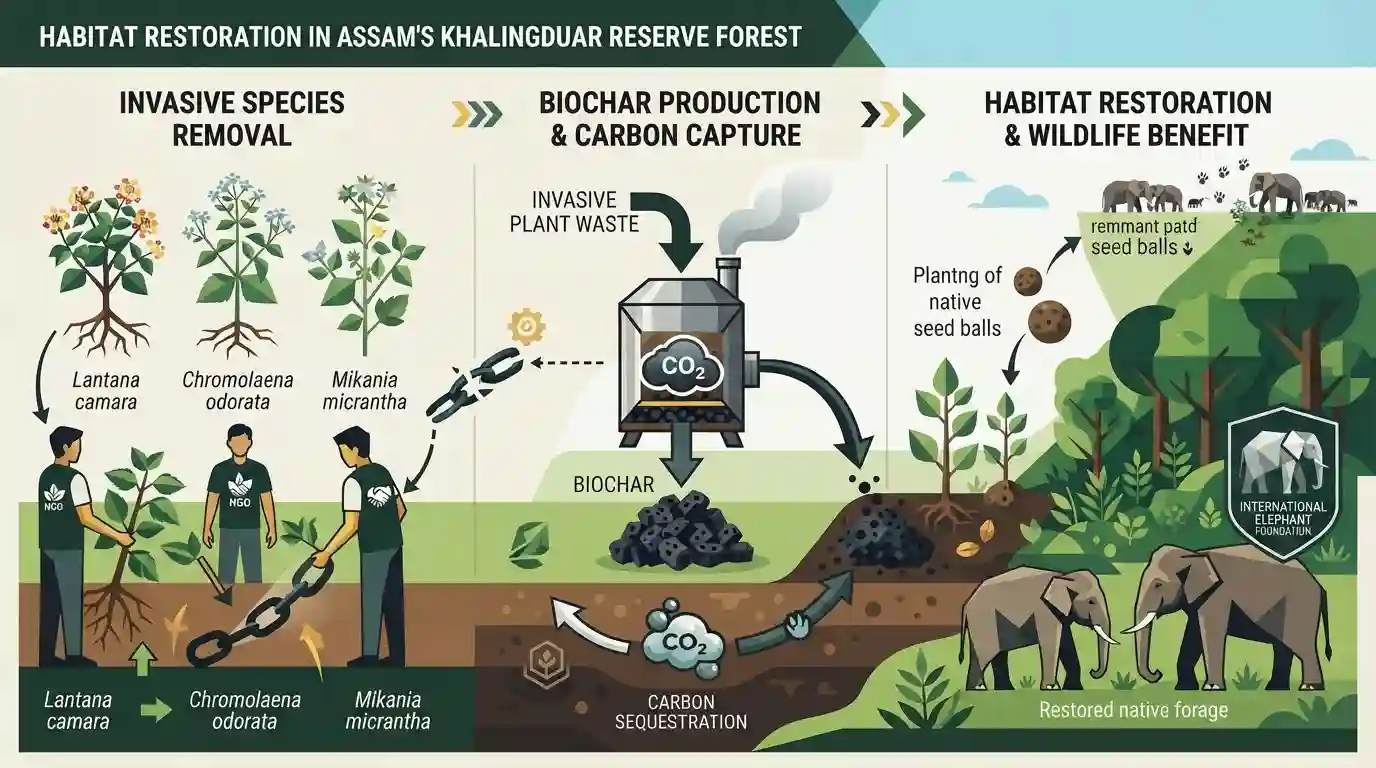
In Assam's Khalingduar Reserve Forest, a targeted habitat restoration project supported by the International Elephant Foundation is converting invasive alien plants (Lantana camara, Chromolaena odorata, and Mikania micrantha) into biochar. This initiative, executed by the NGO Aaranyak, addresses the dual challenge of ecological degradation caused by invasive species and carbon emissions. By uprooting the invasive weeds and pyrolyzing them into biochar, the project sequesteres carbon, enhances soil properties, and paves the way for seed-ball-assisted native vegetation recovery, securing crucial forage ground for local wild elephants.
Key Points
- Assam Forest Department and Aaranyak (a Guwahati-based conservation NGO) have initiated a habitat recovery project in a two-hectare area of the Khalingduar Reserve Forest in Udalguri district, bordering Bhutan.
- The project targets three highly problematic Invasive Alien Plant (IAP) species: Lantana camara, Chromolaena odorata, and Mikania micrantha, which compete with native flora and deplete the food/forage base of elephants and other herbivores.
- Rather than traditionally burning the cleared invasive biomass, which releases carbon into the atmosphere, the project converts the uprooted plants into biochar—a stable, porous, charcoal-like substance created via oxygen-deprived pyrolysis.
- Biochar serves as a carbon sequestration tool, locking carbon in the soil for thousands of years, while its porous structure enhances soil water retention, nutrient capacity, and microbial habitat for native vegetation recovery.
- To assist in the natural regeneration of native grasses and trees, the project also utilizes seed-ball-assisted regeneration, creating a scalable model for ecological restoration and mitigating human-elephant conflicts by enriching forest forage.
Important Terms
Bodoland Territorial Council

An autonomous administrative body established under the Sixth Schedule of the Indian Constitution. It governs the Bodoland Territorial Region in Assam, safeguarding the political, economic, and socio-cultural identity of the local Bodo population.
UPSC context
Crucial for GS Paper 2 (Polity). Highlights asymmetrical federalism, 6th Schedule provisions, and decentralized self-governance in tribal areas.
Aaranyak
A premier, Assam-based biodiversity conservation NGO and recognized Scientific and Industrial Research Organization (SIRO). It specializes in applied wildlife research, anti-poaching operations, and habitat restoration across Northeast India.
UPSC context
Relevant for GS Paper 3 (Environment). Demonstrates the role of civil society and scientific NGOs in wildlife conservation and managing human-animal conflict.
International Elephant Foundation (IEF)
A global non-profit organization focused on the conservation of African and Asian elephants. It funds science-based solutions, anti-poaching patrols, and habitat protection to secure elephant populations and ecosystems.
UPSC context
Important for GS Paper 3 (Biodiversity). Serves as an example of international collaborative funding mechanisms for species-specific ecological conservation.
Biochar
A carbon-rich, charcoal-like substance produced by heating organic biomass (such as invasive weeds) in a low-oxygen environment through pyrolysis. It acts as a long-term carbon sink and improves soil fertility.
UPSC context
High importance for GS Paper 3 (Environment). Frequently tested in Prelims/Mains regarding carbon sequestration, climate change mitigation, and sustainable agriculture.
Invasive Alien Species (IAS)
Non-native flora or fauna (like Lantana camara or Mikania micrantha) that spread aggressively outside their natural habitat, outcompeting indigenous species, altering ecosystems, and threatening local biodiversity.
UPSC context
Essential for GS Paper 3 (Environment). A major threat to native ecology, frequently appearing in Prelims questions about specific plant/animal threats to India's biomes.
Prelims Trap
Biochar acts as a direct nutrient-rich chemical fertilizer, making it ideal for the waterlogged soils of the Bhabar zone.
Biochar is a structural amendment (not a fertilizer) that enhances nutrient retention. The Bhabar zone is highly porous and dry, not waterlogged (which characterizes the Terai zone).
Static Concepts Connected
What are the key differences between Bhabar and Terai zones?
- Bhabar Zone: Porous belt of coarse gravel and pebbles at Shiwalik foothills where streams submerge underground.
- Terai Zone: Marshy, damp, and clayey belt south of Bhabar where underground streams re-emerge, supporting dense forests.
What is biochar and how does it function in soil?
- Pyrolysis production: Created by thermal decomposition (pyrolysis) of organic biomass under completely oxygen-deprived conditions.
- Carbon storage: Highly stable carbon structure that resists microbial decay, locking carbon in soil for centuries.
- Soil structure: Acts as a porous sponge that enhances soil water retention and provides habitats for beneficial microbes.
Cross-Topic Patterns
Invasives + Human-Wildlife Conflict
Forest degradation by invasive weeds depletes native herbivore forage, driving wild elephants into human settlements and directly intensifying conflict.
Biochar + Climate Finance
Converting invasive biomass into biochar presents a dual pathway for localized ecological restoration and global carbon-credit generation under the Paris Agreement.

Expect a multi-statement question linking the porous physical geography of the Bhabar belt with the water-retention utility of biochar.
Linked PYQs · 3
Linked PYQs · 3
- 2020PrelimsGS1
What is the use of biochar in farming? 1. Biochar can be used as a part of the growing medium in vertical farming. 2. When biochar is a part of the growing medium, it promotes the growth of nitrogen-fixing microorganisms. 3. When biochar is a part of the growing medium, it enables the growing medium to retain water for longer time. Which of the statements given above is/are correct?
- 2012PrelimsGS1
Which of the following can be threats to the biodiversity of a geographical area? 1. Global warming 2. Fragmentation of habitat 3. Invasion of alien species 4. Promotion of vegetarianism Select the correct answer using the codes given below:
- 2020PrelimsGS1
With reference to Indian elephants, consider the following statements: 1. The leader of an elephant group is a female. 2. The maximum gestation period can be 22 months. 3. An elephant can normally go on calving till the age of 40 years only. 4. Among the States in India, the highest elephant population is in Kerala. Which of the statements given above is/are correct?
