Assam Welfare Schemes Saturation and Bio-Ethanol Plant Development
Source:Indian Express ↗
Why It Matters
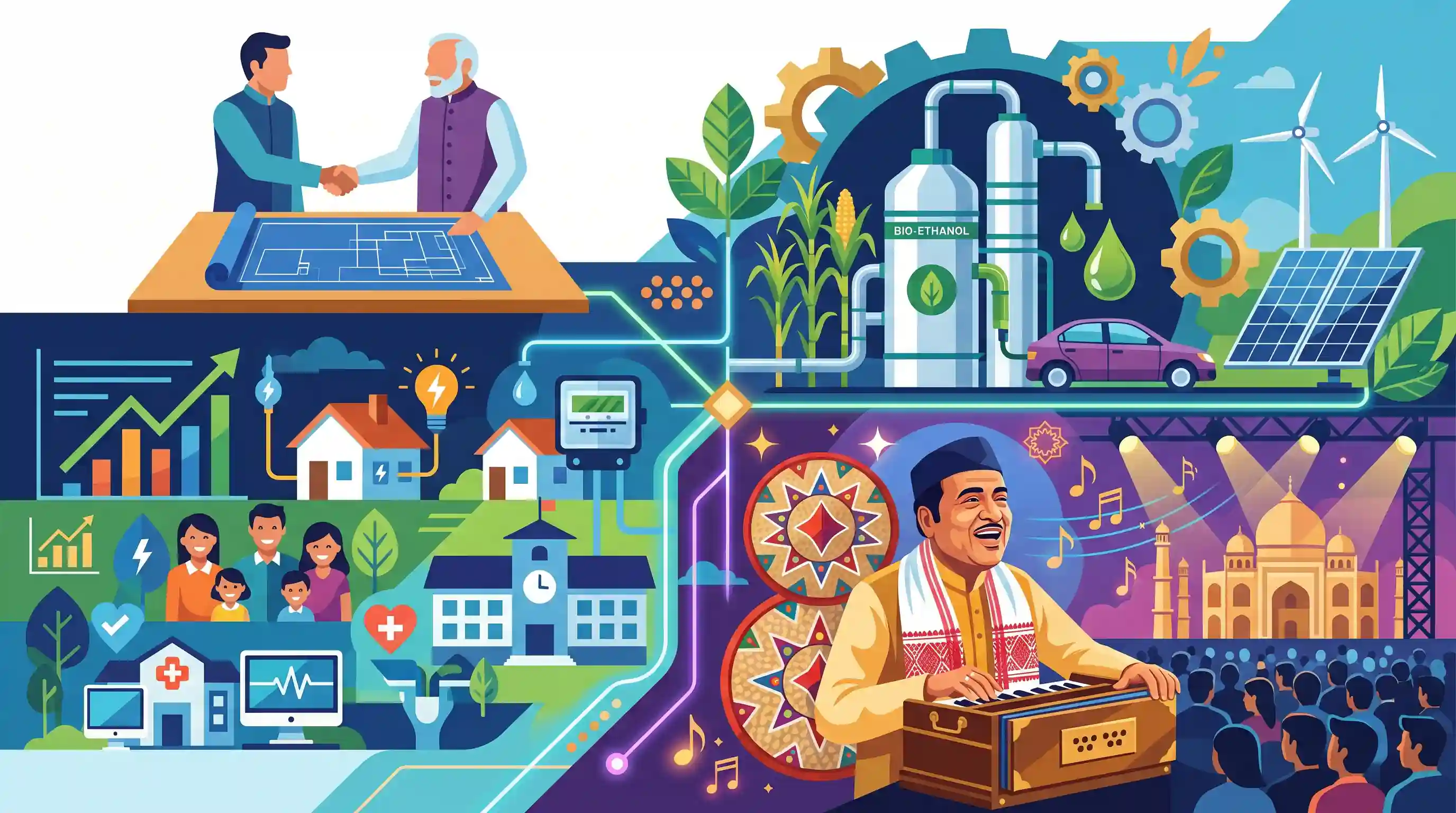
This article brings together diverse UPSC themes: governance (saturation of welfare schemes), environment and economy (commissioning of India's first bio-ethanol plant at Numaligarh for alternative fuels), and culture (celebrating Bharat Ratna Dr. Bhupen Hazarika).
Summary
Assam Chief Minister Himanta Biswa Sarma met Prime Minister Narendra Modi to provide updates on the successful implementation and near saturation of welfare schemes in the state, which have improved local socio-economic indicators. Additionally, Sarma invited the PM to inaugurate the birth centenary celebrations of Assamese cultural icon and Bharat Ratna Dr. Bhupen Hazarika in New Delhi. The Prime Minister is also expected to dedicate the nation's first bio-ethanol plant at the Numaligarh Refinery, marking a significant milestone in India's alternative energy and biofuel sector.
Key Points
- Assam Chief Minister Himanta Biswa Sarma briefed PM Narendra Modi on the near saturation of various welfare schemes in the state.
- The state reported significant improvements in its socio-economic indicators due to focused governance.
- PM Modi has been invited to inaugurate the year-long birth centenary celebrations of Bharat Ratna awardee Dr. Bhupen Hazarika on September 8 in New Delhi.
- The PM is also scheduled to dedicate the nation's first bio-ethanol plant at the Numaligarh Refinery in Golaghat, underscoring India's push towards biofuels and renewable energy.
Important Terms
Numaligarh Refinery Limited (NRL)

A major public sector oil refinery in Assam. It plays a critical role in Northeast India's energy security and industrial growth, recently expanding into biofuels and petrochemicals.
UPSC context
GS Paper 3: Infrastructure and Energy. Tests knowledge of strategic PSUs and regional development in the Northeast.
2G Bio-Ethanol
Ethanol produced from non-food biomass like bamboo or agricultural residue. It is more sustainable than 1G ethanol as it does not compete with food security.
UPSC context
GS Paper 3: Environment and Renewable Energy. Relevant for India’s Net Zero 2070 goals and biofuel policy.
Scheme Saturation
A policy goal to ensure 100% coverage of eligible beneficiaries under government welfare schemes, aimed at eliminating exclusion errors and ensuring last-mile delivery.
UPSC context
GS Paper 2: Governance and Social Justice. Tests understanding of scheme implementation, performance, and inclusive growth strategies.
Bharat Ratna
The highest civilian award of India, given for exceptional service of the highest order in any field of human endeavor.
UPSC context
GS Paper 1: Indian Culture. Important for recognizing national icons and their contributions to India’s heritage.
Ethanol Blending Programme (EBP)
A government initiative to mix ethanol with petrol to reduce dependence on crude oil imports, lower carbon emissions, and boost the agricultural economy.
UPSC context
GS Paper 3: Economic Development and Energy. Relevant for energy self-reliance and the Atmanirbhar Bharat initiative.
Dr. Bhupen Hazarika
A legendary Assamese musician, filmmaker, and Bharat Ratna awardee known as the "Bard of Brahmaputra." His work emphasized humanism, secularism, and national integration.
UPSC context
GS Paper 1: Art and Culture. Tests awareness of regional cultural icons and their role in national unity.
Prelims Trap
India's first 2G bio-ethanol plant at Numaligarh utilizes surplus food crops like sugarcane and maize to produce ethanol.
2G biofuels strictly utilize non-food lignocellulosic biomass. The Numaligarh plant uses locally abundant bamboo, whereas surplus sugarcane and maize are used for 1G biofuels.
Static Concepts Connected
What are the key differences between 1G, 2G, and 3G biofuels?
- 1G Biofuels: Produced directly from edible food crops with high sugar or starch content, such as sugarcane, maize, and corn.
- 2G Biofuels: Synthesized from non-food lignocellulosic biomass like agricultural crop waste, wood chips, and bamboo (as used in the Numaligarh plant).
- 3G Biofuels: Derived from specially engineered microalgae, offering high energy yields without competing for arable land or freshwater resources.
What are the key provisions of the amended National Policy on Biofuels (2018)?
- E20 Target: Advanced the target for 20% ethanol blending in petrol (E20) by five years, moving it from 2030 to the 2025-26 Ethanol Supply Year.
- Feedstock Expansion: Permits the use of surplus food grains (managed by FCI) and damaged grains unfit for human consumption for ethanol production to boost supply.
Cross-Topic Patterns
Bamboo economy driving 2G biofuels
Linking the National Bamboo Mission with 2G ethanol production at Numaligarh shows how non-timber forest produce can simultaneously fuel local Northeast economies and India's green energy transition.
Cultural icons bridging regional folk and mainstream
Dr. Bhupen Hazarika is highly testable as an Art & Culture personality who successfully integrated distinct Northeastern folk music traditions with pan-Indian mainstream cinema and national narratives.

Expect a multi-statement question combining 2G biofuel feedstocks (specifically bamboo) with the revised E20 blending targets for 2025-26.
Linked PYQs · 4
Linked PYQs · 4
- 2009PrelimsGS1
In the context of alternative sources of energy, ethanol as a viable bio-fuel can be obtained from
- 2025PrelimsGS1
Consider the following substances: I. Ethanol II. Nitroglycerine III. Urea Coal gasification technology can be used in the production of how many of them?
- 2022MainsGS3
Do you think India will meet 50 percent of its energy needs from renewable energy by 2030 ? Justify your answer. How will the shift of subsidies from fossil fuels to renewables help achieve the above objective ? Explain.
- 2021PrelimsGS1
Consider the following statements in respect of Bharat Ratna and Padma Awards : 1. Bharat Ratna and Padma Awards are titles under the Article 18(1) of the Constitution of India. 2. Padma Awards, which were instituted in the year 1954, were suspended only once. 3. The number of Bharat Ratna Awards is restricted to a maximum of five in a particular year. Which of the above statements are not correct?
