State polygamy prohibition legislation and sixth schedule exemptions
Source:The Hindu ↗
Why It Matters
The Assam Prohibition of Polygamy Bill, 2025 highlights the intersection between state interventions in personal laws and constitutional safeguards for tribal autonomy under the Sixth Schedule. It provides a contemporary case study for answering Mains questions regarding the implementation of the Uniform Civil Code (Article 44) versus religious and customary practices, as well as the governance dynamics of Schedule VI areas.
Summary
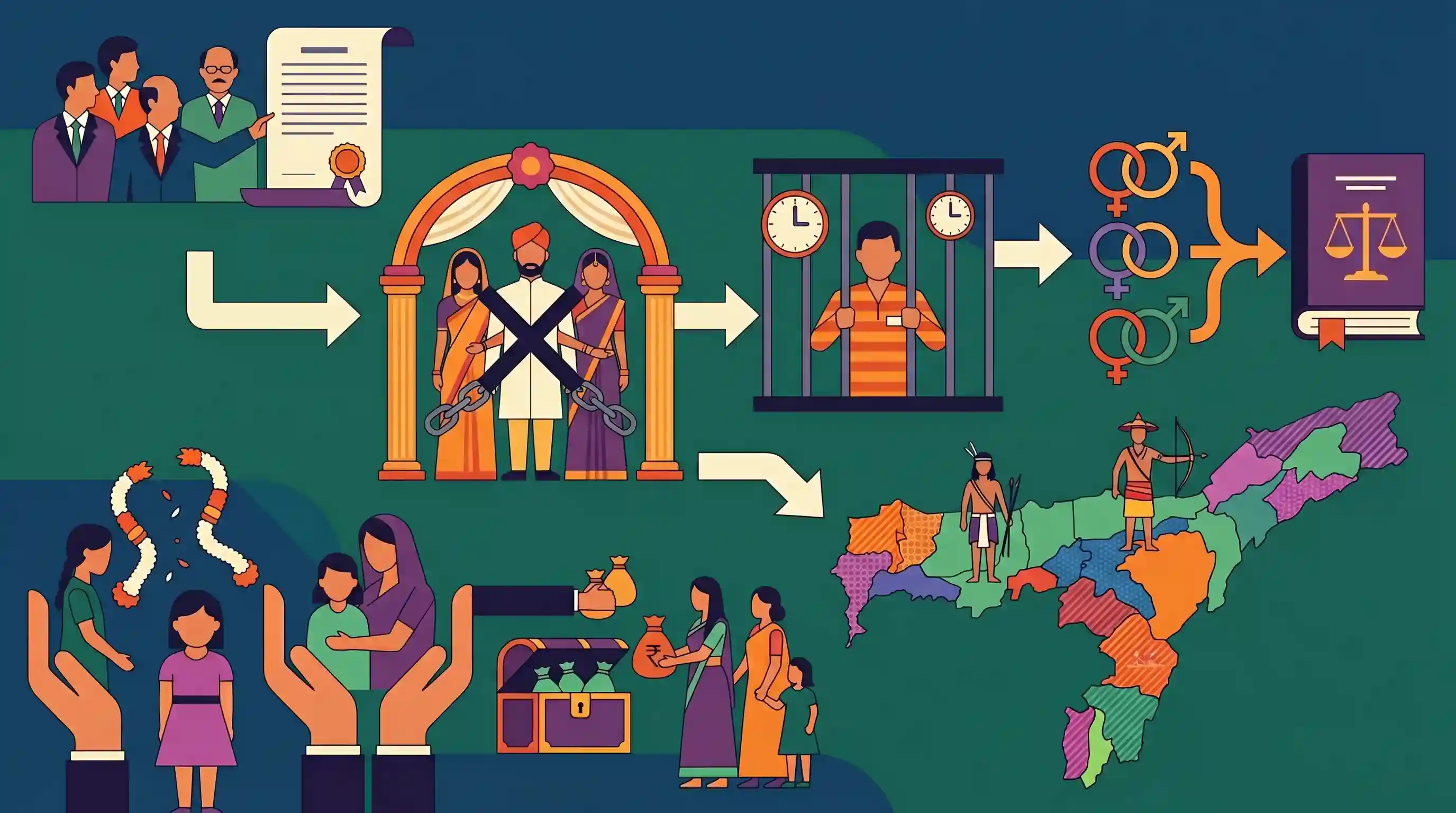
The Assam Cabinet has cleared the 'Assam Prohibition of Polygamy Bill, 2025', aimed at making polygamy a criminal offense punishable by up to seven years of rigorous imprisonment. In an effort to harmonize the ban with tribal autonomy, the Bill exempts the state's Sixth Schedule areas and certain districts with significant Scheduled Tribe (ST) populations. The legislation also features provisions declaring marriages involving minors null and void, along with a mandate to create a compensation fund for victims of polygamy, acting as a precursor to the implementation of the Uniform Civil Code (UCC) in the state.
Key Points
- The Assam Cabinet has approved the Assam Prohibition of Polygamy Bill, 2025, to impose a statewide ban on the practice.
- The legislation makes polygamy punishable by up to seven years of rigorous imprisonment and creates a dedicated compensation fund for victims.
- Areas under the Sixth Schedule of the Constitution (such as Karbi Anglong, Dima Hasao, and BTR) and select tribal areas outside it are explicitly exempted to protect customary laws.
- The proposed law establishes that any marriage involving a minor will be declared null and void.
Important Terms
Assam Prohibition of Polygamy Bill, 2025

Proposed legislation to criminalize polygamy in Assam, prescribing 7–10 years’ imprisonment. It exempts Sixth Schedule areas and specific tribal communities, acting as a precursor to a Uniform Civil Code.
UPSC context
GS Paper II: Government policies and interventions. Focuses on social legal reforms and their implementation challenges in diverse states.
Uniform Civil Code (UCC)
A proposed common set of laws governing personal matters like marriage, divorce, and inheritance for all citizens, intended to replace religion-specific personal laws to ensure legal uniformity.
UPSC context
GS Paper II: Indian Constitution and Polity. Relevant for Article 44 (DPSP) and the debate over secularism vs. religious freedom.
Sixth Schedule of the Constitution
Constitutional provisions under Articles 244(2) and 275(1) providing for autonomous administration in tribal areas of Assam, Meghalaya, Tripura, and Mizoram to safeguard indigenous rights and customs.
UPSC context
GS Paper II: Federalism and Governance. Tests knowledge of special provisions for tribal regions and local self-government.
Autonomous District Councils (ADCs)
Constitutional bodies formed under the Sixth Schedule with legislative, judicial, and executive powers to manage tribal areas, including the authority to govern customary laws like marriage.
UPSC context
GS Paper II: Local Governance and Tribal Affairs. Crucial for understanding decentralization and tribal autonomy in the Northeast.
Article 44
A Directive Principle of State Policy (DPSP) in the Indian Constitution that mandates the State to strive for a Uniform Civil Code for all citizens throughout India.
UPSC context
GS Paper II: Fundamental Rights and DPSPs. Central to constitutional debates on legal uniformity and minority rights.
Polygamy
The practice of having more than one spouse simultaneously. The state-level ban aims to criminalize this practice to promote gender justice and legal consistency across communities.
UPSC context
GS Paper I & II: Social Issues and Women Empowerment. Linked to personal laws and the protection of vulnerable sections.
Prelims Trap
The Assam Polygamy Bill applies uniformly to all regions within the state, superseding all tribal customary laws.
The Bill explicitly exempts Assam’s Sixth Schedule areas (Bodoland, Karbi Anglong, Dima Hasao) and select ST-dominated districts to protect tribal customary laws and autonomy.
Static Concepts Connected
What are the administrative features of the Sixth Schedule?
- AMTM States: Applies specifically to tribal areas in Assam, Meghalaya, Tripura, and Mizoram (AMTM) under Article 244(2).
- Autonomous Councils: Creates Autonomous District Councils (ADCs) possessing significant legislative, judicial, and executive powers.
- Customary Law Protection: ADCs have the constitutional power to make laws regarding marriage, divorce, inheritance, and social customs.
How is legislative competence over marriage defined in the Constitution?
- Concurrent Subject: 'Marriage and divorce' fall under Entry 5 of the Concurrent List in the Seventh Schedule.
- Shared Jurisdiction: Both Parliament and State Legislatures can draft laws regarding marriage, infants, minors, and personal laws.
- Article 254 (Repugnancy): If a state law on a concurrent subject contradicts a Central law, it requires Presidential assent to become operational.
Cross-Topic Patterns
UCC vs. Tribal Autonomy
The tension between Article 44 (UCC) and the Sixth Schedule is a prime Mains theme. Assam's exemption of tribal areas showcases a pragmatic, piecemeal approach to standardizing personal laws.
Concurrent List and Personal Laws
Assam's use of Entry 5 of the Concurrent List mirrors Uttarakhand's recent UCC passage, confirming a pattern of states leading personal law reforms rather than waiting for Central legislation.

Expect a 2026 Prelims question pairing Sixth Schedule exemptions in Assam (BTR, Karbi Anglong) with State powers under the Concurrent List.
Linked PYQs · 3
Linked PYQs · 3
- 2015MainsGS2
Discuss the possible factors that inhibit India from enacting for its citizens a uniform civil code as provided for in the Directive Principles of State Policy.
- 2015PrelimsGS1
The provisions in Fifth Schedule and Sixth Schedule in the Constitution of India are made in order to
- 2019PrelimsGS1
Under which Schedule of the Constitution of India can the transfer of tribal land to private parties for mining be declared null and void?
