Assam Arunachal Pradesh Border Dispute and Dhemaji Clashes
Source:Indian Express ↗
हे का महत्त्वाचे आहे
Inter-state border disputes in the North-East are complex issues that impact cooperative federalism, regional stability, and internal security. Understanding the historical context, the Gopinath Bordoloi committee, and modern resolution mechanisms like the Namsai Declaration and bilateral MoUs is highly relevant for both GS Paper II (Polity/Federalism) and GS Paper III (Internal Security).
सारांश
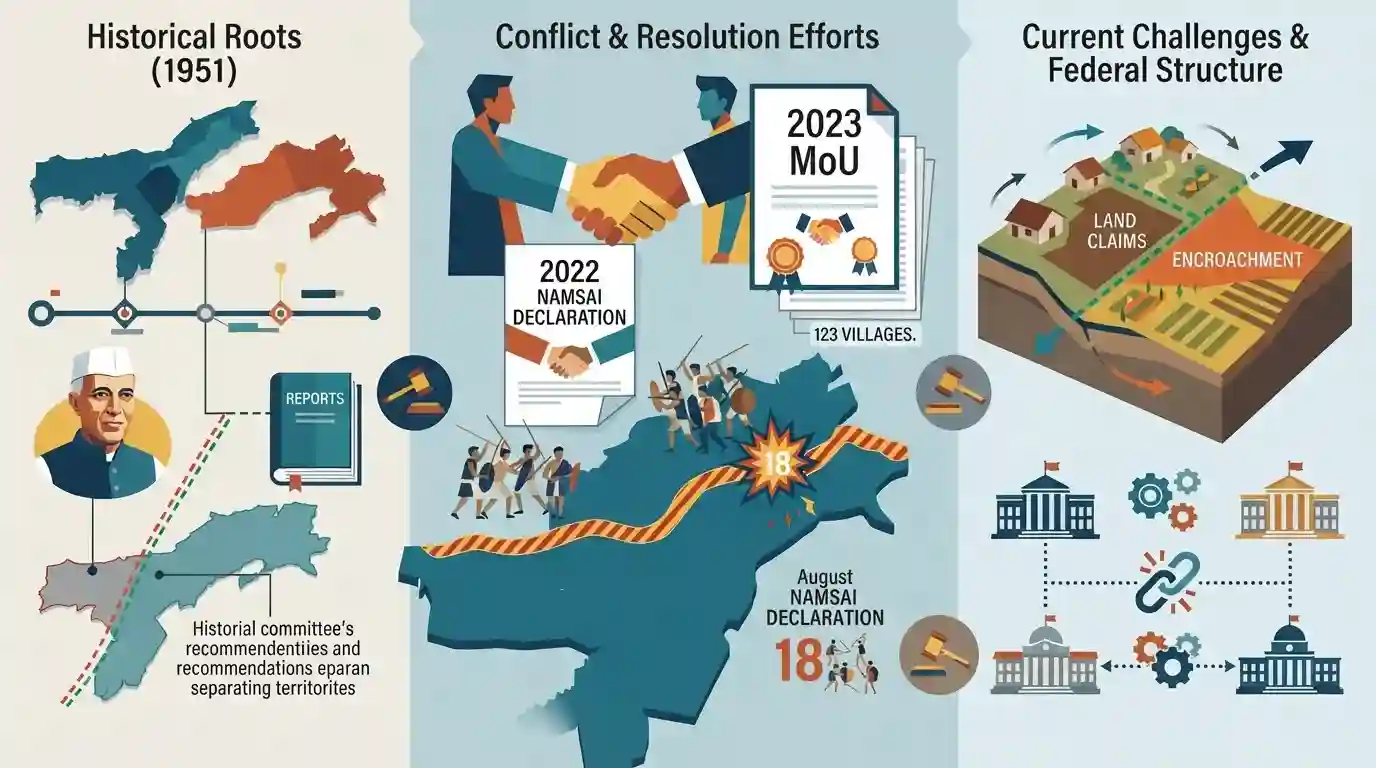
The article discusses the August 2026 inter-state border clash in Dhemaji district along the Assam-Arunachal Pradesh boundary, which injured 18 people. Despite the signing of a landmark Memorandum of Understanding (MoU) in 2023, localized conflicts over alleged encroachment and land ownership continue. The report traces the historical origins of the dispute from the 1951 Gopinath Bordoloi committee recommendations, outlines judicial and bilateral resolution attempts, and details the framework and progress of the 2023 MoU, which built upon the 2022 Namsai Declaration to address 123 disputed border villages.
मुख्य मुद्दे
- In August 2026, a localized clash at Mingmang Basti in Assam's Dhemaji district injured 18 residents, highlighting that border friction persists despite the 2023 landmark bilateral MoU.
- The root of the dispute lies in the 1951 Gopinath Bordoloi sub-committee recommendations, which transferred 3,648 sq km of plain areas (Balipara and Sadiya foothills) from NEFA (now Arunachal Pradesh) to Assam's Darrang and Lakhimpur districts.
- When Arunachal Pradesh became a Union Territory in 1972, it contested this transfer, claiming traditional forested tracts belonging to hill tribes had been unilaterally given to Assam.
- Past resolution efforts include a stalled 1979 tripartite committee, a 1989 Supreme Court suit filed by Assam, and a 2006 Supreme Court-appointed local boundary commission report in 2014.
- The 2023 Memorandum of Understanding (MoU) signed by the Chief Ministers of both states aimed to resolve the dispute over 123 border villages spanning 12 AP districts and 8 Assam districts.
- The 2022 Namsai Declaration had already resolved 37 villages in principle. The 2023 MoU resolved another 34 villages (totaling 71 resolved villages: 1 included in Assam, 10 remaining with Assam, and 60 included in Arunachal Pradesh).
- Under the MoU, 49 villages remained unresolved for regional committees to negotiate, and 3 villages in an IAF bombing zone in Dullong required central intervention. Both states agreed no new claims would be added.
महत्त्वाच्या संज्ञा
Namsai Declaration

A 2022 framework agreement between Assam and Arunachal Pradesh to resolve border disputes by forming regional committees and capping the conflict to 123 villages claimed in 2007, setting the groundwork for the 2023 MoU.
UPSC context
Crucial for GS Paper 2 (Inter-State Relations, Dispute Redressal Mechanisms). Shows cooperative federalism in resolving Northeast boundary disputes.
2023 Assam-Arunachal Pradesh MoU
A landmark political agreement signed by Assam and Arunachal Pradesh (brokered by the Home Ministry) to resolve boundary disputes over 123 border villages, finalizing the status of most and laying out timelines for the rest.
UPSC context
Important for GS 2 (Federal Structure) and GS 3 (Internal Security). Highlights the use of bilateral mechanisms over judicial suits.
North-East Frontier Agency (NEFA)
The colonial-era administrative division (formerly North-East Frontier Tracts) that was governed by Assam post-independence and later became the Union Territory, then State, of Arunachal Pradesh. The arbitrary transfer of its plains to Assam triggered modern disputes.
UPSC context
Vital for GS 1 (Post-Independence Consolidation) and GS 2 (State Reorganisation). Explains the historical root of Northeastern border conflicts.
Gopinath Bordoloi Committee (1951)
A 1951 committee whose recommendations led to the transfer of over 3,600 sq km of plain areas from NEFA (now Arunachal Pradesh) to Assam for administrative convenience, a move unilaterally rejected by Arunachal later.
UPSC context
Key for GS 1 (Post-Independence History) and GS 2 (Inter-State Borders). Illustrates early boundary demarcation errors driving current disputes.
पूर्वपरीक्षा सापळा
A final, binding settlement of inter-state boundary lines can only be executed via a judicial decree of the Supreme Court under Article 131.
Under Article 3, Parliament holds the sovereign, exclusive power to alter state boundaries. The Supreme Court under Article 131 can only adjudicate legal rights/claims; it cannot legislatively redraw borders.
संबंधित स्थिर संकल्पना
What are the constitutional mechanisms to resolve inter-state boundary disputes?
- Article 3: Empowers Parliament to alter state areas, boundaries, or names by a simple majority, without requiring a constitutional amendment under Article 368.
- Article 131: Grants the Supreme Court exclusive original jurisdiction to adjudicate legal disputes arising between two or more states or between the Union and states.
- Article 263: Allows the President to set up an Inter-State Council to investigate, discuss, and advise on disputes between states to foster cooperative federalism.
What was the Gopinath Bordoloi Sub-Committee and its constitutional legacy?
- Mandate: Appointed by the Constituent Assembly to recommend administrative safeguards for tribal and excluded areas in the Northeast.
- Sixth Schedule: Its 1947 recommendations formed the basis of the Sixth Schedule (Articles 244(2) and 275(1)), creating Autonomous District Councils (ADCs).
- Border Legacy: Its 1951 recommendations led to the transfer of prime plain areas from the North-East Frontier Agency (NEFA) to Assam, triggering long-term territorial disputes.
आंतर-विषय नमुने
Internal Security + Border Demarcation
Unresolved inter-state borders in the Northeast frequently intersect with ethnic insurgencies, transforming simple land disputes into critical internal security threats.
Asymmetric Federalism + Article 3
Parliament's unilateral power to alter state boundaries under Article 3 without binding state consent highlights the asymmetric, "quasi-federal" design of Indian federalism.

Article 3 parliamentary powers and Article 131 judicial limits are likely to be tested via a conceptual multi-statement question in 2026.
संबंधित PYQ · 3
संबंधित PYQ · 3
- 2025MainsGS3
What are the major challenges to internal security and peace process in the North-Eastern States? Map the various peace accords and agreements initiated by the government in the past decade.
- 2024PrelimsGS1
The North Eastern Council (NEC) was established by the North Eastern Council Act, 1971. Subsequent to the amendment of NEC Act in 2002, the Council comprises which of the following members? 1. Governor of the Constituent State 2. Chief Minister of the Constituent State 3. Three Members to be nominated by the President of India 4. The Home Minister of India Select the correct answer using the code given below:
- 2025PrelimsGS1
With reference to India, consider the following: I. The Inter-State Council II. The National Security Council III. Zonal Councils How many of the above were established as per the provisions of the Constitution of India?
