Junagadh Forest Department Rescues Trapped Asiatic Lion
Source:thehindu ↗
આ શા માટે મહત્વનું છે
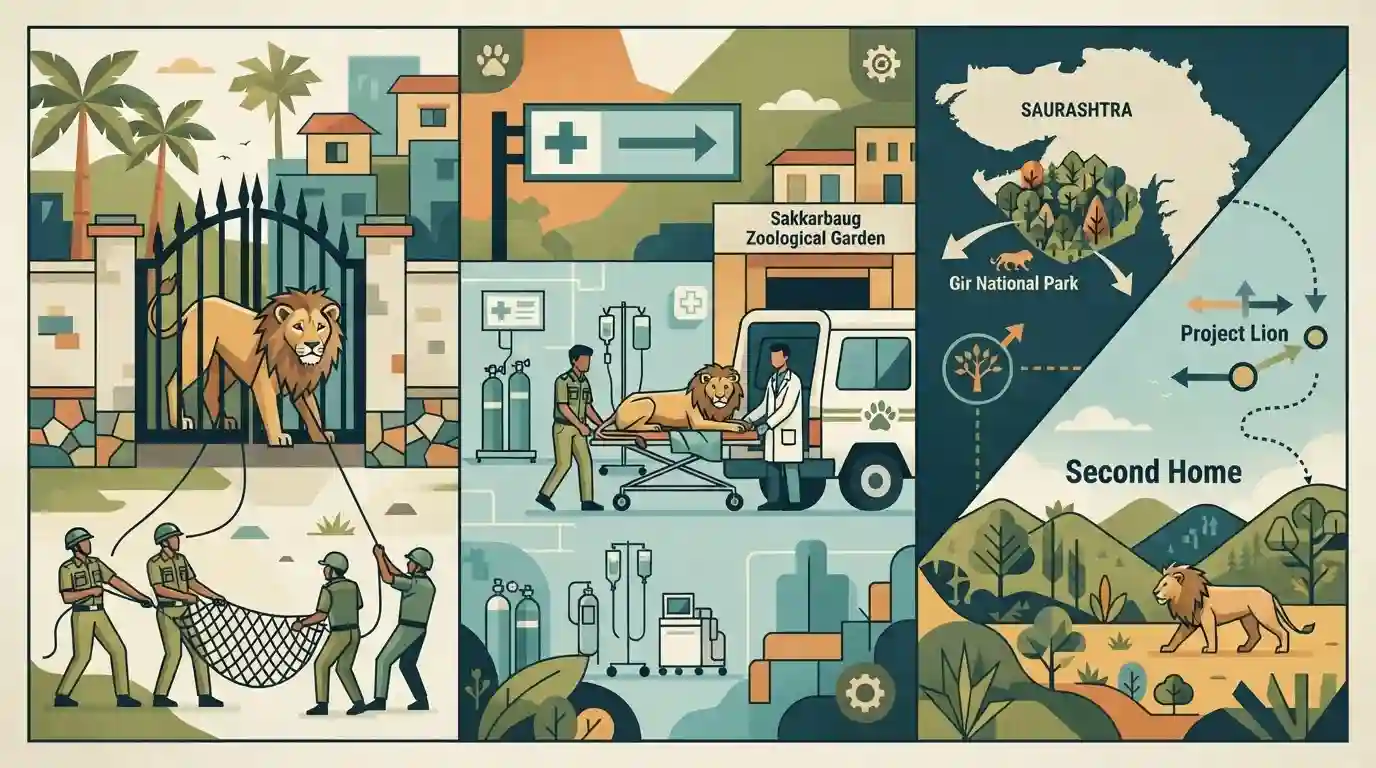
This incident sheds light on the frequent interactions between Asiatic lions and urban landscapes in Gujarat's Saurashtra region. It stresses the challenges of habitat fragmentation, urban sprawl, and infrastructure-induced hazards to wildlife. Furthermore, it reinforces the conservation argument for establishing a geographically distinct second home for Asiatic lions to safeguard the species from catastrophic localized events like epidemic outbreaks or extreme weather anomalies.
સારાંશ
A young Asiatic lion (1-2 years old) was rescued in a swift, coordinated operation by the Junagadh Forest Department and Sakkarbaug Zoological Garden after it got trapped and injured in a spiked iron gate in Junagadh, Gujarat. The big cat was shifted to the Sakkarbaug Zoological Garden for veterinary care. The incident highlights the growing human-wildlife interface in the Saurashtra region, the physical hazards urban settings pose to wildlife, and the ongoing ecological discussion about establishing a second home for the Asiatic lion under Project Lion.
મુખ્ય મુદ્દા
- A young Asiatic lion, aged one to two years, was successfully rescued after getting trapped in a spiked iron gate in the Grofed area of Junagadh city, Gujarat.
- The timely operation was jointly executed by the Junagadh Forest Department and the Sakkarbaug Zoological Garden, after which the injured lion was shifted to the zoo for veterinary treatment.
- The incident brings back focus to the increasing human-wildlife interface and the hazards urban infrastructure poses to wide-ranging carnivores.
- The event highlights the debate around the necessity of a second home for the Asiatic lion population, which is currently concentrated primarily in the Gir landscape, making them vulnerable to localized disasters.
- Additionally, recent findings noted in the context indicate that extreme heat, rather than infectious disease, was responsible for the deaths of eight lion cubs in the Gir forest.
મહત્વપૂર્ણ શબ્દો
Asiatic Lion

A majestic big cat subspecies whose only wild population exists in the Greater Gir landscape of Gujarat, India; protected under Schedule I of the Wildlife (Protection) Act, 1972.
UPSC context
GS Paper III (Ecology & Biodiversity); tests species-in-news, distribution, legal protections, and ecological significance.
Project Lion
A comprehensive conservation initiative launched by India in 2020 to safeguard Asiatic lions in the Greater Gir landscape using habitat restoration, advanced monitoring, and disease management.
UPSC context
GS Paper III (Environment); relevant for central conservation projects, biodiversity policies, and species recovery programs.
Human-Wildlife Conflict
Adverse interactions between humans and wild animals resulting in crop damage, livestock loss, injury, or death, aggravated by habitat fragmentation and expanding wildlife populations.
UPSC context
GS Paper III (Biodiversity & Conservation); critical for questions on coexistence frameworks, ecological corridors, and mitigation.
Barda Wildlife Sanctuary
A coastal sanctuary in Gujarat being developed as a second home and satellite habitat for Asiatic lions to reduce single-habitat extinction risks under Project Lion.
UPSC context
GS Paper III (Protected Areas); covers wildlife translocation, ecosystem rehabilitation, and regional conservation geography.
Sakkarbaug Zoological Garden
Established in 1863 in Junagadh, Gujarat, it is India's oldest zoo and the primary coordinating facility for the captive breeding program of the Asiatic lion.
UPSC context
GS Paper III (Environment & Ecology); tests ex-situ conservation, breeding programs, and genetic pool management.
Junagadh Forest Department
The regional division of the state forest department responsible for managing sanctuaries, protecting wildlife, and resolving local human-wildlife encounters within the Saurashtra region.
UPSC context
GS Paper III (Environment/Disaster Management); tests field execution of wildlife rescue operations and administration.
પ્રિલિમ્સ ટ્રેપ
The Asiatic Lion is distinguished from the African Lion by its larger, more majestic mane and the lack of a belly skin fold.
It is actually the opposite: Asiatic lions have shorter manes (leaving their ears visible) and possess a unique, prominent longitudinal fold of skin along their belly.
સંલગ્ન સ્થિર ખ્યાલો
What are the ecological characteristics and protection status of the Asiatic Lion?
- Physical Features: Physically distinguished by a prominent, longitudinal belly fold of skin and a shorter mane compared to African lions.
- Legal Status: Classified as Endangered on the IUCN Red List, and listed under Schedule I of India's Wildlife (Protection) Act, 1972.
- Distribution: Exclusively restricted to the Gir landscape of Gujarat, though dispersal outside core zones into human-dominated areas is rapidly increasing.
What is Project Lion and the 'Second Home' conservation debate?
- Project Mandate: Launched in 2020 to secure lion habitats, mitigate human-wildlife conflict, and establish satellite populations to avoid catastrophic single-point extinction risks.
- Barda Sanctuary: Identified as an internal second home (Satellite Population 8) within Gujarat to accommodate dispersing lions safely outside the main Gir complex.
- The Kuno Debate: The Supreme Court of India in 2013 directed translocation to Kuno National Park (MP) to prevent disease-driven extinction, which remains a key inter-state point of debate.
આંતર-વિષય પેટર્ન
Linear Infrastructure + Wildlife Corridors
Urban sprawl and spiked barriers in Saurashtra intersect with dispersing carnivores, echoing GS-3 concerns on eco-bridges and eco-sensitive zone (ESZ) regulations around protected areas.
Ex-Situ Breeding + Genetic Safeguards
Legacy centers like Sakkarbaug Zoo bridging ex-situ conservation with in-situ reintroduction highlights scientific management of low-gene pools under Wildlife Protection Act mandates.

Multi-statement questions in 2026 may test physical differences of Asiatic vs. African lions alongside the geography of Barda Sanctuary.
સંલગ્ન PYQ · 2
સંલગ્ન PYQ · 2
- 2026GPSC_PRELIMSGS1
The 'Great Indian Bustard (GIB)' (Ghorad) is frequently seen in the news in the context of wildlife conservation efforts in western India. Consider the following statements regarding this species: 1. Currently, the highest surviving wild population of the Great Indian Bustard in India is located in the semi-arid grasslands of Gujarat. 2. It is a long-distance migratory bird that travels from Central Asia to the Indian subcontinent to escape harsh winters. Which of the above statement(s) is/are correct?
- 2022GPSC_PRELIMSGS1
Which garden of Gujarat has the trees and plants of rare species?
