Asiatic Lion Population Growth in Gujarat Census
Source:Indian Express ↗
Why It Matters
The Asiatic lion is an endangered flagship species and a frequent topic in UPSC exams. Its conservation success story must be studied alongside the ecological challenges of a single isolated population, the necessity of genetic diversity, and legal frameworks concerning wild animals migrating outside protected forest reserves.
Summary
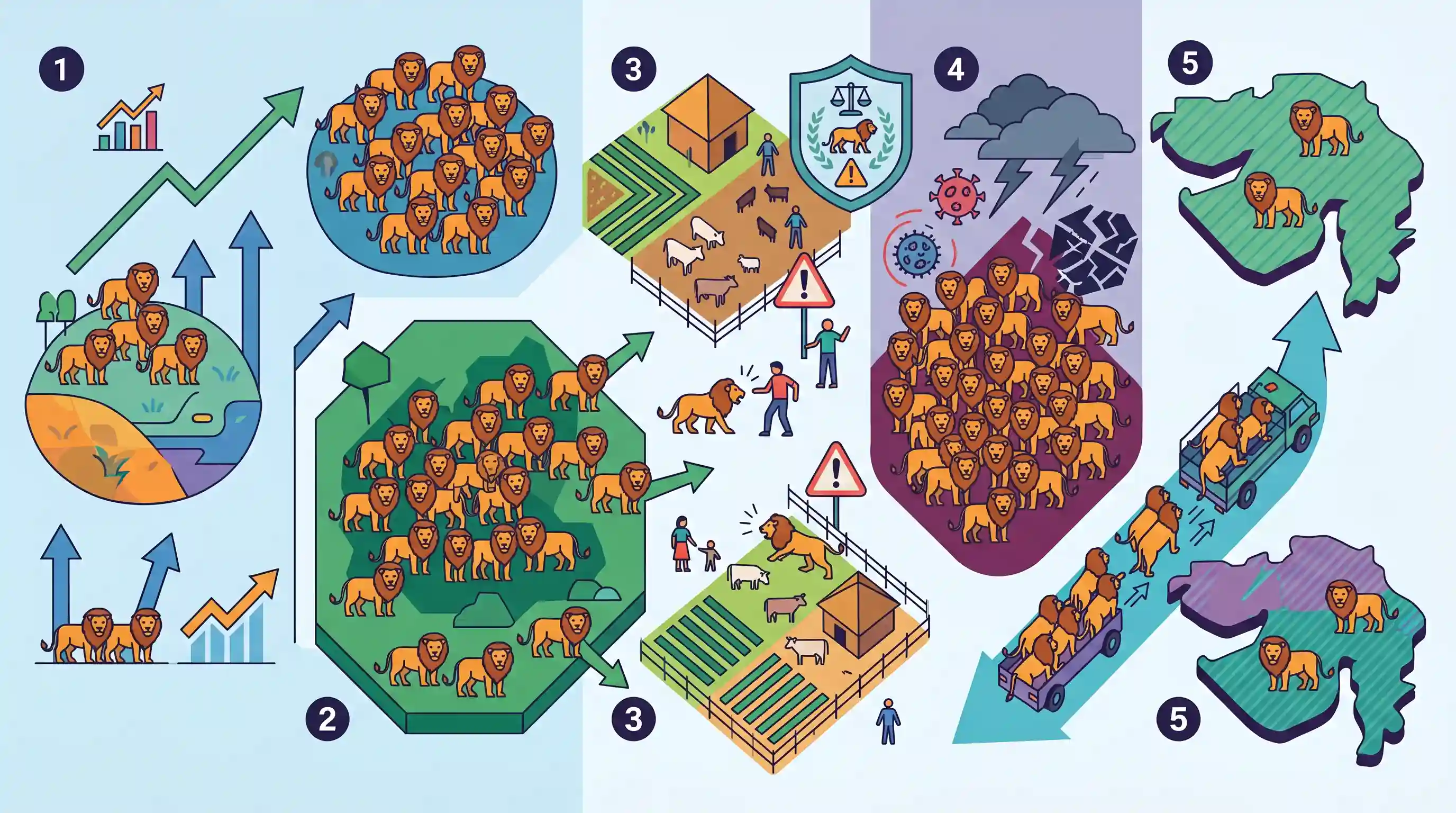
The population of Asiatic lions in Gujarat has seen a significant increase, rising from 674 in 2020 to 891, according to the latest census details shared by Chief Minister Bhupendra Patel. This 32% growth over five years underscores the success of ongoing conservation efforts in the Saurashtra region, including Project Lion. However, the burgeoning population also brings to the forefront challenges related to the carrying capacity of the Gir National Park. As lions increasingly move outside protected areas, issues of human-wildlife conflict and the legal protection of wildlife outside sanctuaries become pertinent. Furthermore, the concentration of the entire species in a single state reiterates the ecological risk of disease outbreaks, keeping the unfulfilled proposal to translocate some lions to Kuno National Park highly relevant for conservationists.
Key Points
- The Asiatic lion population in Gujarat has grown to 891, an increase from 674 recorded in the 2020 census, marking a roughly 32% rise over five years.
- Gujarat Chief Minister Bhupendra Patel announced the latest census figures, highlighting the success of state-led conservation initiatives in the region.
- Asiatic lions (Panthera leo persica) are found exclusively in the Gir forest and the broader Saurashtra region of Gujarat, making them vulnerable as a single geographically isolated population.
- The sustained population growth has forced lions to expand their territory outside protected boundaries, raising critical questions about carrying capacity and human-wildlife conflict management.
- The expanding population renews the debate on the long-pending Supreme Court directive to translocate a pride of Asiatic lions to Kuno National Park in Madhya Pradesh to safeguard against epidemics like the Canine Distemper Virus.
Important Terms
Asiatic Lion

The only wild population of this lion subspecies (Panthera leo leo) lives in Gujarat. Notable for its longitudinal belly fold and Schedule I status under the Wildlife (Protection) Act.
UPSC context
GS Paper III: Biodiversity. Tests knowledge of endemic species, conservation status, and physiological differences from African counterparts.
Project Lion
Launched in 2020, this initiative focuses on landscape-based conservation of lions, habitat restoration, and making India a global hub for big cat disease diagnostics.
UPSC context
GS Paper III: Conservation. Tests understanding of specific government schemes and their multi-pronged ecological and community objectives.
Wildlife (Protection) Act, 1972
India's primary wildlife law. The 2022 amendment rationalized schedules into four categories and strengthened CITES compliance; Asiatic lions receive the highest level of protection under Schedule I.
UPSC context
GS Paper II/III: Governance & Environment. Fundamental for questions on environmental legislation and species' legal protection levels.
Barda Wildlife Sanctuary
A sanctuary in Gujarat's Porbandar district recently developed as a 'second home' for Asiatic lions to help manage the growing population outside the Gir forest.
UPSC context
GS Paper III: Environment. Relevant for mapping and regional conservation strategies (e.g., Greater Gir Concept).
Kuno National Park
A protected area in Madhya Pradesh proposed by the Supreme Court (2013) as a translocation site for lions; currently the primary site for Project Cheetah.
UPSC context
GS Paper III: Conservation. Tests knowledge of translocation controversies, inter-state environmental issues, and predator-prey dynamics.
Human-Wildlife Conflict
Negative interactions between people and animals. With 44% of lions now living in non-forested areas, this is a major challenge for Gujarat's 'Greater Gir' landscape.
UPSC context
GS Paper III: Environment & Social Issues. Tests ability to analyze the impact of successful conservation on local communities.
Prelims Trap
Asiatic lions are Critically Endangered and are naturally found in multiple states across Western India.
They are 'Endangered' (not Critically Endangered) on the IUCN Red List and are exclusively endemic ONLY to Gujarat, despite pending Kuno translocation plans.
Static Concepts Connected
What is the conservation status of the Asiatic Lion?
- IUCN Red List: Classified as Endangered. Though the population is growing, the species remains vulnerable due to its single isolated habitat in Gujarat.
- WPA 1972: Protected under Schedule I of the Act, granting the highest degree of legal protection against poaching and hunting.
- CITES: Listed in Appendix I, completely prohibiting international commercial trade of the species or its body parts.
Why is Kuno National Park suitable for lion translocation?
- Ideal Habitat: Features dry deciduous forests and savanna-like open grasslands, making it an ideal ecosystem for cursorial predators like lions and cheetahs.
- Prey Base: Sustains a robust, well-established population of chital, sambar, nilgai, and wild boar to support large apex predators.
- Historical Range: Geographically falls directly within the historical central-Indian range of Asiatic Lions before they were hunted down and restricted to Gujarat.
Cross-Topic Patterns
Genetic bottlenecks and viral outbreaks
The threat of Canine Distemper Virus (CDV) wiping out the Asiatic Lion connects to genetic bottleneck themes, mirroring the declining resilience seen in translocated Cheetahs and the Great Indian Bustard.
Federalism vs. Conservation mandates
The delay in implementing the 2013 Supreme Court directive to move lions to Madhya Pradesh highlights friction between state pride (Gujarat) and national ecological priorities, a classic federalism debate.

Expect a multi-statement Prelims question in 2026 contrasting Asiatic Lions and Cheetahs regarding habitat, IUCN status, and viral risks.
Linked PYQs · 3
Linked PYQs · 3
- 2017PrelimsGS1
Recently there was a proposal to translocate some of the lions from their natural habitat in Gujarat to which one of the following sites?
- 2017PrelimsGS1
In India, if a species of tortoise is declared protected under Schedule I of the Wildlife (Protection) Act, 1972, what does it imply?
- 2022PrelimsGS1
With reference to Indian laws about wildlife protection, consider the following statements : 1. Wild animals are the sole property of the government. 2. When a wild animal is declared protected, such animal is entitled for equal protection whether it is found in protected areas or outside. 3. Apprehension of a protected wild animal becoming a danger to human life is sufficient ground for its capture or killing. Which of the statements given above is/are correct?
