Asian Equities Fall Amid Escalating Middle East Geopolitical Tension
Source:The Hindu ↗
Why It Matters
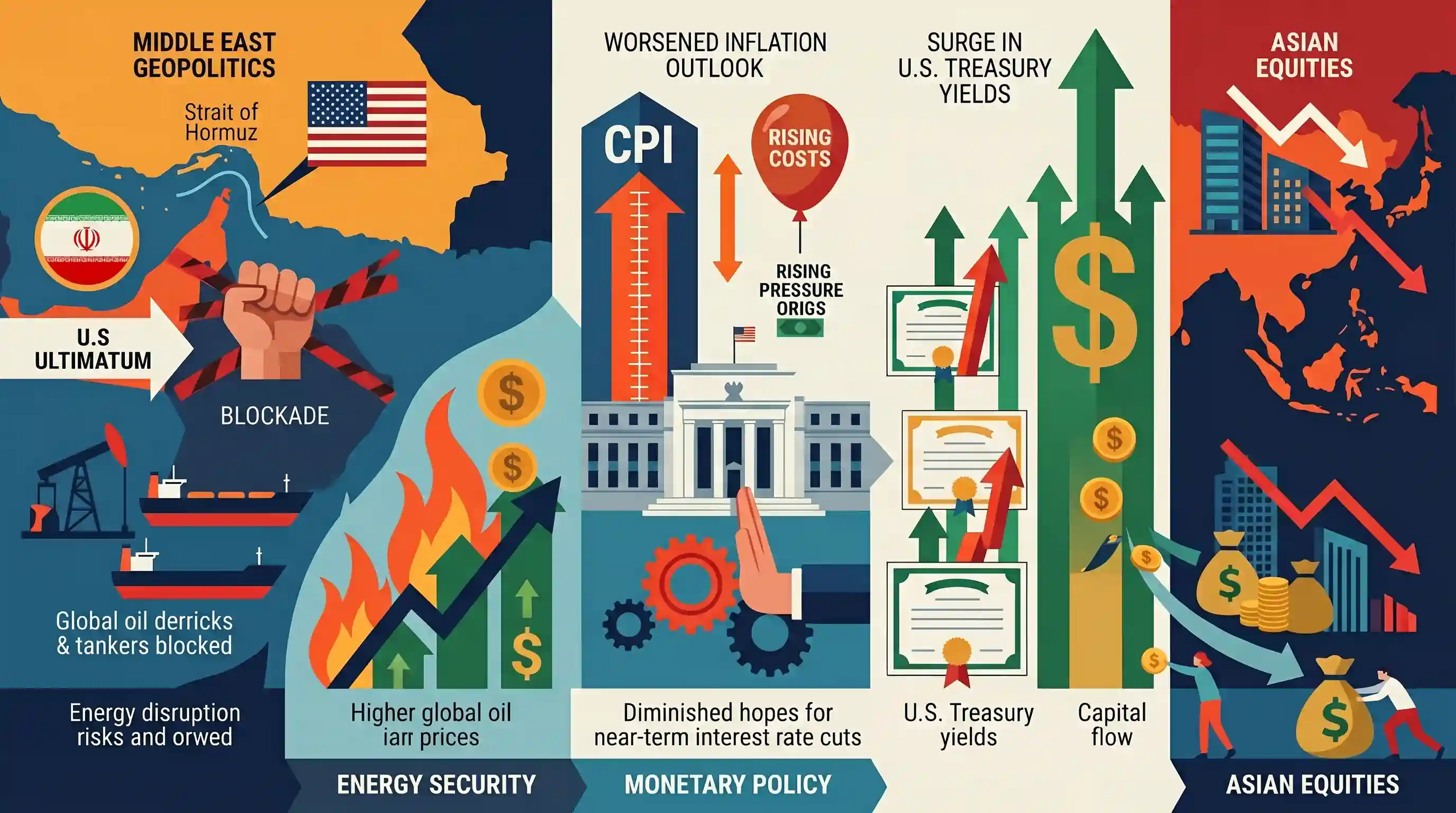
The event illustrates the profound interconnectedness of geopolitics, energy security, and global financial markets. Disruptions in key maritime chokepoints like the Strait of Hormuz directly impact global inflation through higher oil prices. This, in turn, dictates the monetary policy of major central banks like the U.S. Federal Reserve, directly influencing capital flows, exchange rates, and macroeconomic stability in emerging economies like India.
Summary
Asian equities declined amid escalating geopolitical tensions in the Middle East, specifically threats concerning the closure of the Strait of Hormuz by Iran following a U.S. ultimatum. The heightened risk of energy disruption drove global oil prices higher. Consequently, the inflation outlook worsened, diminishing hopes for near-term interest rate cuts by the U.S. Federal Reserve. This led to a surge in U.S. Treasury yields and a stronger U.S. dollar, adversely impacting Asian markets and driving capital away from regional equities.
Key Points
- Geopolitical tensions escalated as U.S. President Donald Trump issued an ultimatum to Iran regarding the Strait of Hormuz, threatening its power plants.
- Iran responded with threats of retaliatory strikes on U.S. and Israeli energy and infrastructure assets, raising the risk of significant conflict.
- Fears of disruption at the Strait of Hormuz, a critical chokepoint for global oil trade, drove benchmark crude prices higher.
- Elevated oil prices worsened inflation fears, dampening market expectations for near-term interest rate cuts by the U.S. Federal Reserve.
- The anticipated delay in monetary easing caused U.S. Treasury yields to spike and strengthened the U.S. dollar, triggering a decline in Asian equities and weakening currencies like the Japanese yen.
Important Terms
Federal Reserve (Fed)

The central bank of the United States that manages monetary policy, sets interest rates, and regulates the financial system to ensure economic stability and moderate long-term interest rates.
UPSC context
GS Paper 3 (Economy); tests knowledge of global monetary spillovers, exchange rate volatility, and their impact on India's foreign portfolio investments (FPI).
Strait of Hormuz
A strategic maritime chokepoint between Iran and Oman connecting the Persian Gulf to the Gulf of Oman, carrying approximately 20% of the world's daily oil supply.
UPSC context
GS Paper 2 (IR) & GS Paper 3 (Energy Security); critical for mapping questions and analyzing India's energy vulnerability and West Asian diplomacy.
U.S. Treasury Yields
The interest rate the U.S. government pays to borrow money through debt securities; rising yields often trigger capital outflows from emerging markets as investors seek safer returns.
UPSC context
GS Paper 3 (Economy); essential for understanding the 'Taper Tantrum' effect, rupee depreciation, and the narrowing interest rate differential between the U.S. and India.
Imported Inflation
A rise in domestic prices caused by an increase in the cost of essential imported goods, particularly crude oil, which raises transportation and production costs across the economy.
UPSC context
GS Paper 3 (Economy); tests understanding of inflation dynamics beyond domestic factors and the sensitivity of India's Consumer Price Index (CPI) to global shocks.
OPEC (Organization of the Petroleum Exporting Countries)
An intergovernmental organization of oil-exporting nations that coordinates petroleum policies to stabilize markets; its production decisions directly influence global oil prices and India's trade balance.
UPSC context
GS Paper 2 & 3; relevant for discussing global energy governance and India's strategic petroleum reserves and energy diversification efforts.
Capital Flight
The rapid movement of financial assets out of a country due to unfavorable economic conditions, geopolitical risks, or higher interest rates in developed economies.
UPSC context
GS Paper 3 (Economy); relates to Balance of Payments (BoP) crises and the volatility of Foreign Portfolio Investment (FPI) in Indian equity markets.
Prelims Trap
A delay in US Fed rate cuts increases foreign portfolio investments (FPI) into Asian emerging markets.
Delayed rate cuts keep US Treasury yields high. This triggers capital flight (FPI outflows) from emerging markets as investors shift to safer US assets.
Static Concepts Connected
What are the key geographical features of the Strait of Hormuz?
- Connecting bodies: It serves as a critical maritime link connecting the Persian Gulf to the Gulf of Oman and the Arabian Sea.
- Bordering nations: Bounded by Iran to the north and Oman's Musandam Peninsula and the UAE to the south.
- Strategic choke point: It is a crucial transit route for approximately one-fifth of global oil consumption, making it a highly sensitive geopolitical chokepoint.
How do global crude oil price shocks impact India's macroeconomic stability?
- Imported Inflation: Expensive oil increases domestic freight and production costs, which directly drives up wholesale and retail inflation (CPI).
- Widening CAD: Since India imports over 85% of its crude oil requirements, elevated global prices inflate the import bill and widen the Current Account Deficit.
- Rupee Depreciation: A widening CAD combined with capital flight increases demand for US dollars, forcing the Indian Rupee to depreciate.
Cross-Topic Patterns
Strong Dollar & ECB Currency Risk
A strengthening US dollar caused by tight Fed rates increases the debt-servicing cost for domestic firms holding unhedged External Commercial Borrowings (ECBs), as more rupees are needed for repayment.
Chokepoints and Energy Security
Vulnerabilities at the Strait of Hormuz frequently test alongside India's strategy to expand its Strategic Petroleum Reserves (SPRs) and its broader push for renewable energy to mitigate import dependence.

Expect a 2026 prelims question linking US Fed policy, capital flight, Rupee depreciation, and its direct impact on India's ECB burden.
Linked PYQs · 4
Linked PYQs · 4
- 2024PrelimsGS1
Consider the following statements : Statement-I : Sumed pipeline is a strategic route for Persian Gulf oil and natural gas shipments to Europe. Statement-II : Sumed pipeline connects the Red Sea with the Mediterranean Sea. Which one of the following is correct in respect of the above statements?
- 2022PrelimsGS1
Consider the following statements: 1. Tight monetary policy of US Federal Reserve could lead to capital flight. 2. Capital flight may increase the interest cost of firms with existing External Commercial Borrowings (ECBs). 3. Devaluation of domestic currency decreases the currency risk associated with ECBs. Which of the statements given above are correct?
- 2021PrelimsGS1
Consider the following statements : The effect of devaluation of a currency is that it necessarily 1. improves the competitiveness of the domestic exports in the foreign markets 2. increases the foreign value of domestic currency 3. improves the trade balance Which of the above statements is/are correct?
- 2018MainsGS3
How would the recent phenomena of protectionism and currency manipulations in world trade affect macroeconomic stability of India?
