Gujarat gets approval for desert themed night safari and zoo
Source:india-gazette ↗
Why It Matters
The initiative demonstrates the alignment of sustainable regional economic development (ecotourism) with modern ex-situ biodiversity conservation. It exemplifies the practical application of green technologies and natural habitat simulation for both indigenous and exotic arid-region wildlife.
Summary
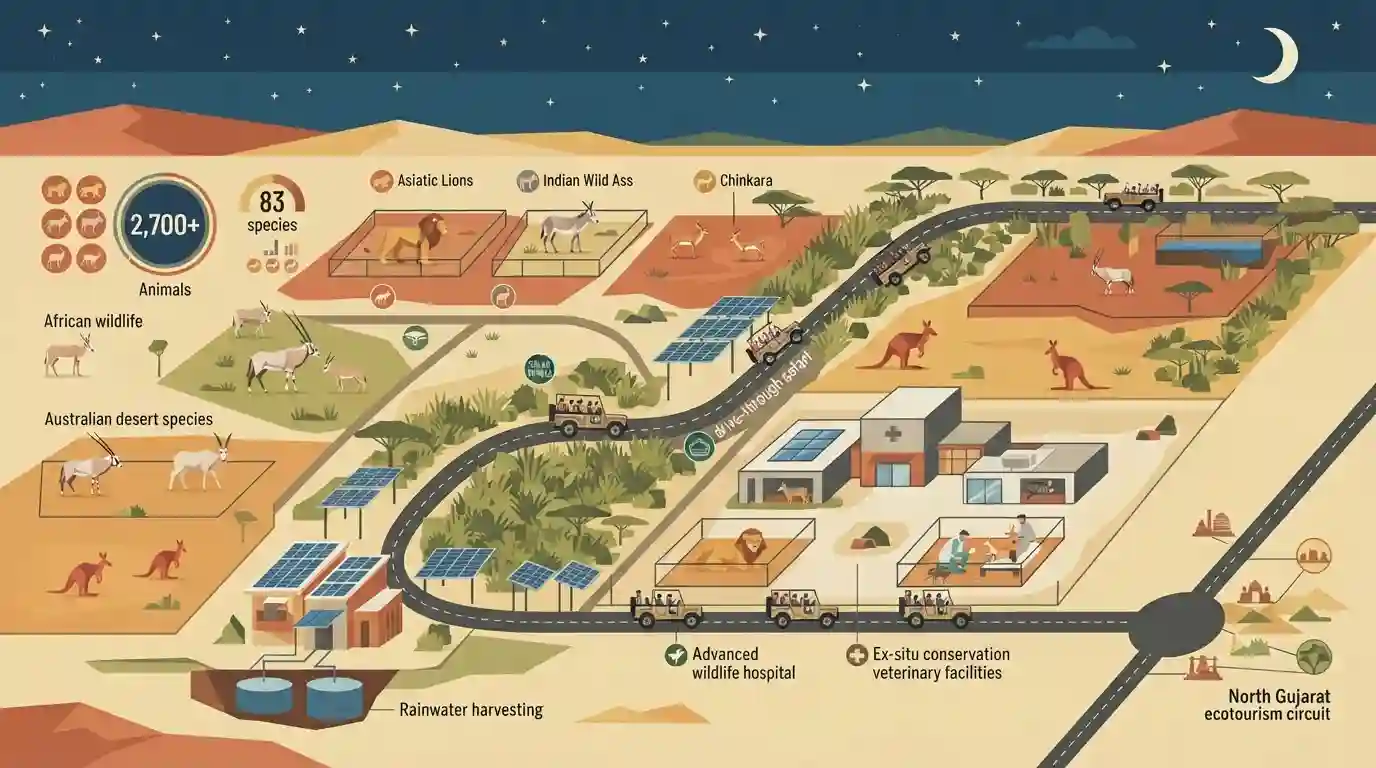
The Central Zoo Authority has approved the development of Asia's first desert-themed drive-through night safari and zoological park in Deesa, Banaskantha district, Gujarat. Spanning 103 hectares with a budget of Rs 542.14 crore, the facility will exhibit over 2,700 animals from 83 species. It will showcase native fauna such as the Asiatic lion, Indian wild ass, and chinkara alongside exotic desert animals from Africa and Australia. Promoting sustainability, the project incorporates solar power, rainwater harvesting, and native plant buffers. Furthermore, it will function as a vital ex-situ conservation center equipped with an advanced wildlife hospital, enhancing the North Gujarat ecotourism circuit.
Key Points
- The Central Zoo Authority has approved Asia's first desert-themed drive-through night safari and zoological park.
- The facility will be built on 103 hectares of land in Deesa, Banaskantha district, Gujarat, at an estimated cost of Rs 542.14 crore.
- It will house approximately 2,700 animals representing 83 species, including native Indian fauna (Asiatic lion, Indian wild ass, chinkara, blackbuck) and exotic desert species from Africa and Australia.
- The park will heavily integrate green technologies, featuring rainwater harvesting, solar energy, a sewage treatment plant, solid waste management, and native botanical buffer zones.
- Designed to serve as a major ecotourism hub on the North Gujarat circuit, it will also include an advanced wildlife hospital, rescue center, and quarantine facilities for conservation.
Important Terms
Central Zoo Authority

A statutory body established in 1992 under the Wildlife (Protection) Act, 1972. It oversees, regulates, and provides technical assistance to zoos across India to ensure international standards in animal care and wildlife conservation.
UPSC context
Vital for GS Paper 3 (Environment). GPSC tests its statutory backing (WPA 1972) and its mandate to approve and regulate zoological parks.
Ex-situ conservation
The protection and breeding of endangered species outside their natural habitats. Common examples include zoological parks, botanical gardens, and seed banks, which provide a controlled environment for survival and genetic diversity.
UPSC context
Crucial for GS Paper 3 (Biodiversity). Exams frequently ask candidates to distinguish between in-situ (national parks) and ex-situ conservation methods.
Indian wild ass
A subspecies of the onager native to South Asia, known locally as Ghudkhur. It is primarily found in Gujarat's Little Rann of Kutch and is currently listed as Vulnerable by the IUCN.
UPSC context
Important for Gujarat Geography and Environment. GPSC heavily tests its IUCN status and its endemic habitat in the Little Rann of Kutch.
Deesa Night Safari
Asia's first desert-themed drive-through night safari, located in Deesa, Banaskantha district. The 103-hectare project promotes ecotourism, ex-situ conservation, and exhibits native fauna alongside African and Australian desert animals.
UPSC context
Highly relevant for GPSC Current Affairs and State Tourism. Tests awareness of state-led sustainable ecotourism initiatives and regional geography.
Prelims Trap
"The newly approved Deesa safari is an in-situ conservation reserve for the Indian Wild Ass."
Safaris and zoos are ex-situ (off-site) conservation methods. Aspirants often confuse large safari parks with wildlife sanctuaries or national parks, which are in-situ (on-site).
Static Concepts Connected
What is the statutory backing and mandate of the Central Zoo Authority (CZA)?
- Statutory Origin: Established in 1992 under an amendment to the Wildlife (Protection) Act, 1972 to oversee the functioning of zoos across India.
- Key Mandate: Evaluates zoo standards, coordinates captive breeding of endangered species, regulates animal transfers, and oversees ex-situ conservation efforts.
- Leadership: It is a statutory body chaired by the Union Minister of Environment, Forest and Climate Change.
What are the unique characteristics of the Indian Wild Ass (Khur)?
- Endemic Habitat: Its wild range is uniquely restricted to the arid salt flats and scrublands of the Little Rann of Kutch in Gujarat.
- Conservation Status: Listed as Near Threatened by the IUCN and heavily protected under Schedule I of the Wildlife (Protection) Act, 1972.
Cross-Topic Patterns
Ecotourism and Border Tourism Synergy
The Banaskantha safari expands the North Gujarat circuit, linking closely with the Nadabet Indo-Pak border tourism initiative and Ambaji, showcasing a strategic push for regional economic diversification through tourism.
Gujarat's Arid Biodiversity Endemism
Exhibiting the Indian Wild Ass and Asiatic Lion together draws attention to Gujarat's distinct arid and semi-arid ecosystems, frequently tested in geography and ecology mapping questions regarding endemism.

Expect a multi-statement question combining CZA's statutory backing (WPA 1972), ex-situ conservation, and Indian Wild Ass habitat.
Linked PYQs · 2
Linked PYQs · 2
- 2026GPSC_PRELIMSGS1
The 'Great Indian Bustard (GIB)' (Ghorad) is frequently seen in the news in the context of wildlife conservation efforts in western India. Consider the following statements regarding this species: 1. Currently, the highest surviving wild population of the Great Indian Bustard in India is located in the semi-arid grasslands of Gujarat. 2. It is a long-distance migratory bird that travels from Central Asia to the Indian subcontinent to escape harsh winters. Which of the above statement(s) is/are correct?
- 2024GPSC_PRELIMSGS1
Which of the following are legal provisions for the implementation of the Fundamental Duties? 1. The Protection of Civil Rights Act. 2. The Unlawful Activities (Prevention) Act. 3. The Representation of Peoples Act. 4. The Wildlife (Protection) Act Select the correct answer code:
