Techno-legal framework for AI crime and accountability in India
Source:Indian Express ↗
Why It Matters
The article bridges technology, internal security, and ethics, directly addressing the evolving challenges of AI in cybercrime. It provides valuable perspectives for answers on the modernization of law enforcement (like the CBI), AI regulation, and India's developmental strategy towards 2047.
Summary
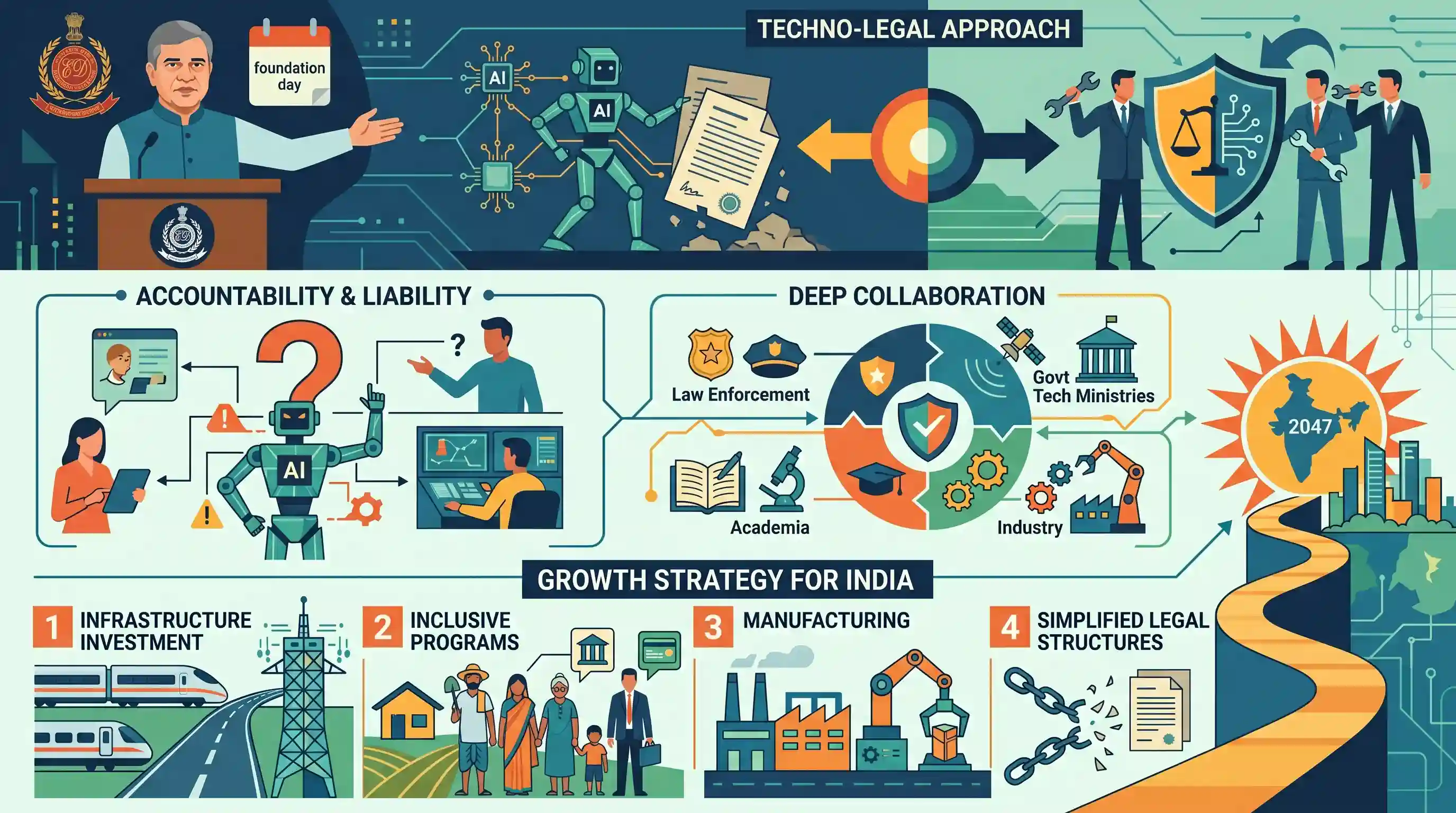
Union Minister Ashwini Vaishnaw, speaking at the CBI Foundation Day, stressed the need for a "techno-legal approach" to tackle the complexities of new-age crimes involving Artificial Intelligence. He raised pertinent ethical questions about accountability and liability when AI agents commit offenses. To effectively manage these challenges, he advocated for deep collaboration between law enforcement, government tech ministries, academia, and industry. Additionally, he mapped out India's broader growth strategy focusing on infrastructure investment, inclusive programs, manufacturing, and simplified legal structures, aiming towards Viksit Bharat by 2047.
Key Points
- Union IT Minister Ashwini Vaishnaw emphasized the necessity of a "techno-legal approach" to combat emerging AI-driven crimes, stating that legal frameworks alone are insufficient.
- He highlighted ethical and legal dilemmas regarding accountability, questioning who bears liability (the AI creator or the AI agent) when an AI entity commits an offense.
- Called for a synergistic collaboration among investigating agencies, government departments (MeitY, DoT, DST), academia, and the industry to upgrade investigative and forensic capabilities.
- Outlined a four-pillar growth strategy for Viksit Bharat 2047: public investment in physical/social/digital infrastructure, inclusive growth programs, focus on manufacturing/innovation, and simplification of legal compliance.
Important Terms
Viksit Bharat-2047

A long-term strategic vision to transform India into a developed nation by 2047, targeting a $30–40 trillion economy through inclusive growth, social progress, and modern governance.
UPSC context
Relevant for GS Paper III (Economy/Planning); tests understanding of strategic national objectives and inclusive development.
Central Bureau of Investigation (CBI)
India's premier investigating agency, established to probe corruption, economic offenses, and serious crimes. It derives its legal powers from the Delhi Special Police Establishment Act, 1946.
UPSC context
Relevant for GS Paper II (Statutory/Regulatory Bodies); tests knowledge of institutional frameworks for internal security and federal jurisdictional issues.
Ministry of Electronics and Information Technology (MeitY)
The nodal ministry responsible for IT policy, electronics manufacturing, digital governance, and cybersecurity. It spearheads the Digital India program and oversees AI-related regulatory frameworks.
UPSC context
Relevant for GS Paper II (Governance) and GS III (Science & Tech); tests understanding of digital policy and technology governance.
Department of Telecommunications (DoT)
A department under the Ministry of Communications responsible for formulating policies and licensing for telecom services, essential for India's digital infrastructure and spectrum management.
UPSC context
Relevant for GS Paper III (Infrastructure/Science & Tech); tests knowledge of the physical and regulatory backbone of connectivity.
Department of Science and Technology (DST)
The nodal agency for organizing and promoting science and technology activities in India, responsible for formulating S&T policies and supporting research and innovation.
UPSC context
Relevant for GS Paper III (Science & Technology); tests awareness of institutional support for scientific research and technological self-reliance.
Prelims Trap
The CBI is a statutory body established under the Delhi Special Police Establishment (DSPE) Act, 1946.
The CBI is not a statutory body. It was set up by a 1963 executive resolution of the Ministry of Home Affairs, though it derives its police powers from the DSPE Act.
Static Concepts Connected
What is the legal basis and mandate of the CBI?
- Not statutory: Established by a 1963 executive resolution; it merely derives investigative powers from the DSPE Act, 1946.
- Nodal Ministry: Functions under the Ministry of Personnel, Public Grievances and Pensions, not the Ministry of Home Affairs.
- Core mandate: Investigates anti-corruption cases, economic offenses, and serious multi-state organized crimes.
What is the 'Safe Harbour' protection under the IT Act?
- Section 79: Grants intermediaries immunity from legal liability for third-party data or information hosted on their platforms.
- Conditional immunity: Protection requires strict adherence to government-prescribed due diligence and prompt action on legal takedown notices.
- The AI gap: Autonomous AI agents generate content rather than merely hosting it, complicating the traditional intermediary defense.
Cross-Topic Patterns
AI Ethics + Internal Security
The 'attribution problem' of AI crimes fuses GS-4 (moral accountability of creators) with GS-3 (cybersecurity and multi-agency cooperation), making techno-legal frameworks a cross-disciplinary Mains theme.
DPI + Viksit Bharat 2047
Public investment in multimodal infrastructure combines digital public goods with physical manufacturing to drive the macroeconomic, inclusive growth goals of Viksit Bharat 2047.

Expect a GS-3 Mains question on the 'attribution problem' in AI crimes, assessing how investigative agencies must adopt techno-legal tools.
Linked PYQs · 5
Linked PYQs · 5
- 2023MainsGS3
Introduce the concept of Artificial Intelligence (AI). How does Al help clinical diagnosis? Do you perceive any threat to privacy of the individual in the use of Al in healthcare?
- 2020MainsGS3
Discuss different types of cyber crimes and measures required to be taken to fight the menace.
- 2023MainsGS3
What are the internal security challenges being faced by India? Give out the role of Central Intelligence and Investigative Agencies tasked to counter such threats.
- 2024MainsGS4
The application of Artificial Intelligence as a dependable source of input for administrative rational decision-making is a debatable issue. Critically examine the statement from the ethical point of view.
- 2021MainsGS3
“Investment in infrastructure is essential for more rapid and inclusive economic growth.” Discuss in the light of India's experience.
