Semiconductor ecosystem growth driven by skilled talent pipeline
Source:Indian Express ↗
Why It Matters
Semiconductors are a critical foundation for modern technology, economy, and national security. For UPSC aspirants, the focus on the 'talent pipeline' and ecosystem expansion directly relates to GS Paper 3 topics like indigenization of technology, the India Semiconductor Mission (ISM) (asked in Mains 2025), and the role of the PLI scheme in transforming the manufacturing sector.
Summary
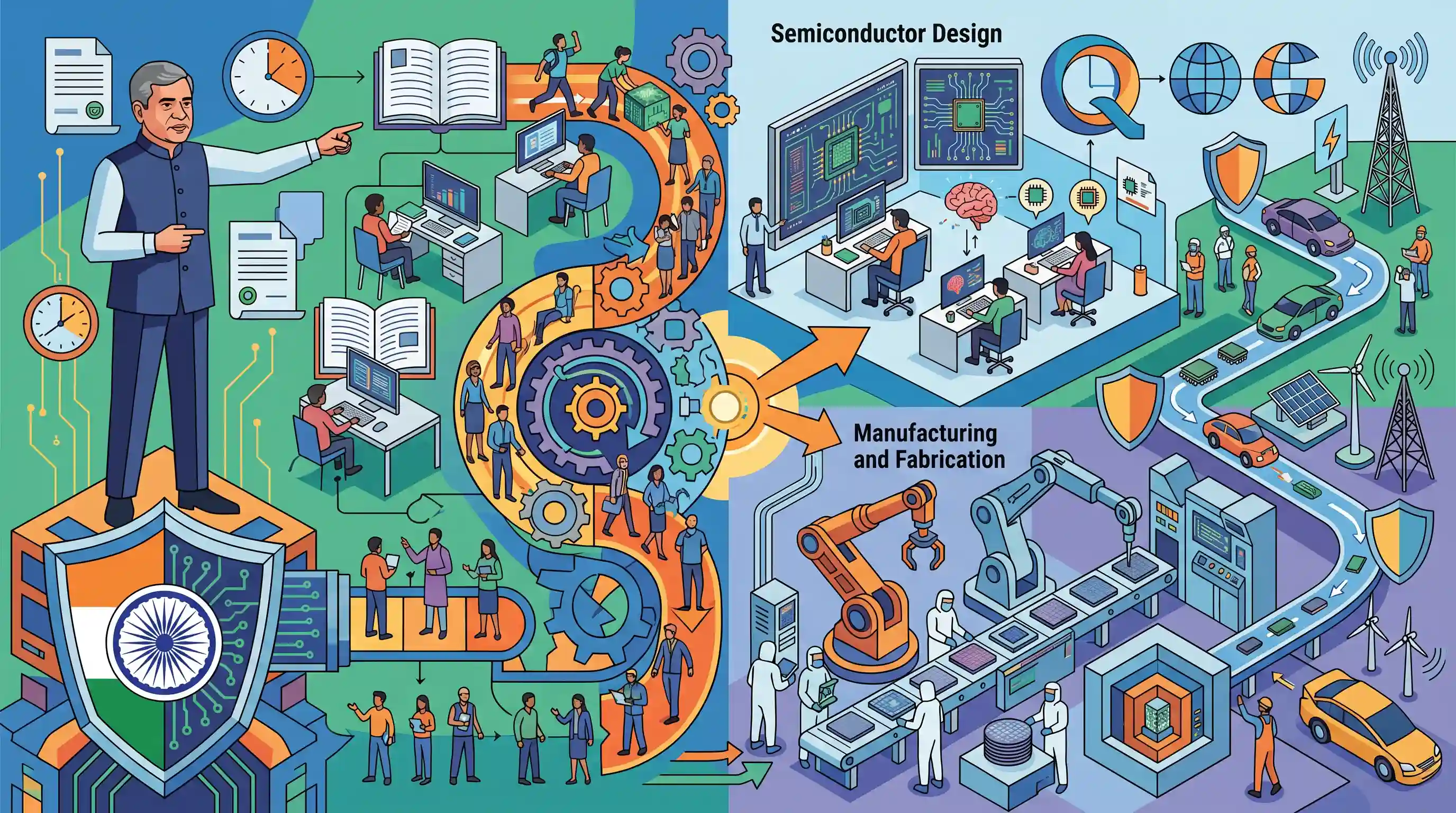
Union Minister Ashwini Vaishnaw recently stated that India's semiconductor ecosystem is undergoing rapid expansion, with a strong talent pipeline acting as the core driver of growth. The involvement of global tech giants like Qualcomm underscores India's strategic push to become a pivotal player in semiconductor design and manufacturing. The development of specialized human resources aligns with broader government initiatives, such as the India Semiconductor Mission (ISM), aiming to secure critical electronics supply chains and foster high-tech job creation.
Key Points
- Union Minister Ashwini Vaishnaw highlighted the rapid expansion of India's semiconductor ecosystem, signaling a shift toward indigenous technological capacity.
- A robust 'talent pipeline' was emphasized as the primary driver of future growth, aiming to position India as a global hub for semiconductor design and engineering.
- The active involvement of major global semiconductor companies like Qualcomm indicates growing confidence in India's capacity for high-tech research, development, and manufacturing.
- Nurturing skilled professionals in the semiconductor space is critical for addressing global supply chain vulnerabilities and generating high-quality domestic employment.
Important Terms
India Semiconductor Mission (ISM)

A specialized nodal agency under MeitY launched in 2021 to build a sustainable semiconductor and display ecosystem in India through fiscal support and strategic planning.
UPSC context
GS Paper 3: Science & Technology and Economy; tests knowledge of indigenization, strategic autonomy, and high-tech industrial policy.
Semicon India Programme
A ₹76,000-crore comprehensive government initiative designed to provide financial incentives and support for semiconductor design, fabrication, display manufacturing, and assembly units.
UPSC context
GS Paper 3: Economy and S&T; essential for understanding India’s push to integrate into global electronics value chains.
Production Linked Incentive (PLI) Scheme
A performance-based incentive program offering financial rewards (typically 4-6%) to companies based on incremental sales of products manufactured in India to boost domestic production.
UPSC context
GS Paper 3: Indian Economy; critical for topics on 'Make in India,' manufacturing sector growth, and reducing import dependency.
Ministry of Electronics and Information Technology (MeitY)
The nodal Union Ministry responsible for formulating IT policy, electronics manufacturing, and digital infrastructure, acting as the executive body for the India Semiconductor Mission.
UPSC context
GS Paper 2: Governance; examines the role of ministries in policy execution and managing India’s digital sovereignty.
Qualcomm
A global semiconductor giant that collaborates with the Indian government on high-end chip design, 6G research, and end-to-end semiconductor value chain development.
UPSC context
GS Paper 3: Science & Technology; represents the role of global partnerships and FDI in fostering an indigenous high-tech talent pipeline.
Prelims Trap
India is currently a major global hub for semiconductor wafer fabrication.
India holds ~20% of the global semiconductor *design* workforce, but relies entirely on imports for commercial wafer *fabrication*, which is highly capital-intensive.
Static Concepts Connected
What is the institutional setup and scope of the India Semiconductor Mission (ISM)?
- Institutional Setup: It functions as an independent business division under the Digital India Corporation (a Section 8 company under MeitY), not as a statutory body.
- Design Linked Incentive: Implemented by C-DAC, this scheme offers financial reimbursement to domestic startups and MSMEs for designing Integrated Circuits (ICs) and Systems on Chips (SoCs).
- Chips to Startup: Aims to train 85,000 highly qualified engineers over five years in Very Large-Scale Integration (VLSI) and embedded systems design.
Which critical minerals are essential for semiconductor manufacturing?
- Key Minerals: While Silicon is the foundation, trace elements like Gallium, Germanium, and Arsenic are critical dopants or compound materials for advanced, high-frequency chips.
- Supply Chain Security: Processing of these elements is geographically concentrated. To mitigate supply shocks, India formally joined the 14-member, US-led Minerals Security Partnership (MSP).
Cross-Topic Patterns
Semiconductors + Critical Minerals Geopolitics
Chip manufacturing ties directly to IR and trade, notably China's export curbs on Gallium and Germanium. India's defensive strategy relies on Quad tech-sharing and the US-led Minerals Security Partnership (MSP).
High-Tech Employment & Demographics
The push for a semiconductor 'talent pipeline' (e.g., C2S programme) reflects a policy shift from low-end IT services to high-value IP creation, vital for India to avoid the middle-income trap.

Expect a 2026 prelims multi-statement question mixing ISM schemes (DLI, C2S) with India's role in the Minerals Security Partnership (MSP).
Linked PYQs · 3
Linked PYQs · 3
- 2025MainsGS3
India aims to become a semiconductor manufacturing hub. What are the challenges faced by the semiconductor industry in India? Mention the salient features of the India Semiconductor Mission.
- 2025MainsGS3
Discuss the rationale of the Production Linked Incentive (PLI) scheme. What are its achievements? In what way can the functioning and outcomes of the scheme be improved?
- 2025PrelimsGS1
Consider the following statements : I. India has joined the Minerals Security Partnership as a member. II. India is a resource-rich country in all the 30 critical minerals that it has identified. III. The Parliament in 2023 has amended the Mines and Minerals (Development and Regulation) Act, 1957 empowering the Central Government to exclusively auction mining lease and composite license for certain critical minerals. Which of the statements given above are correct?
