India US Agricultural Trade and Tariff Rate Quota Mechanism
Source:Indian Express ↗
Why It Matters
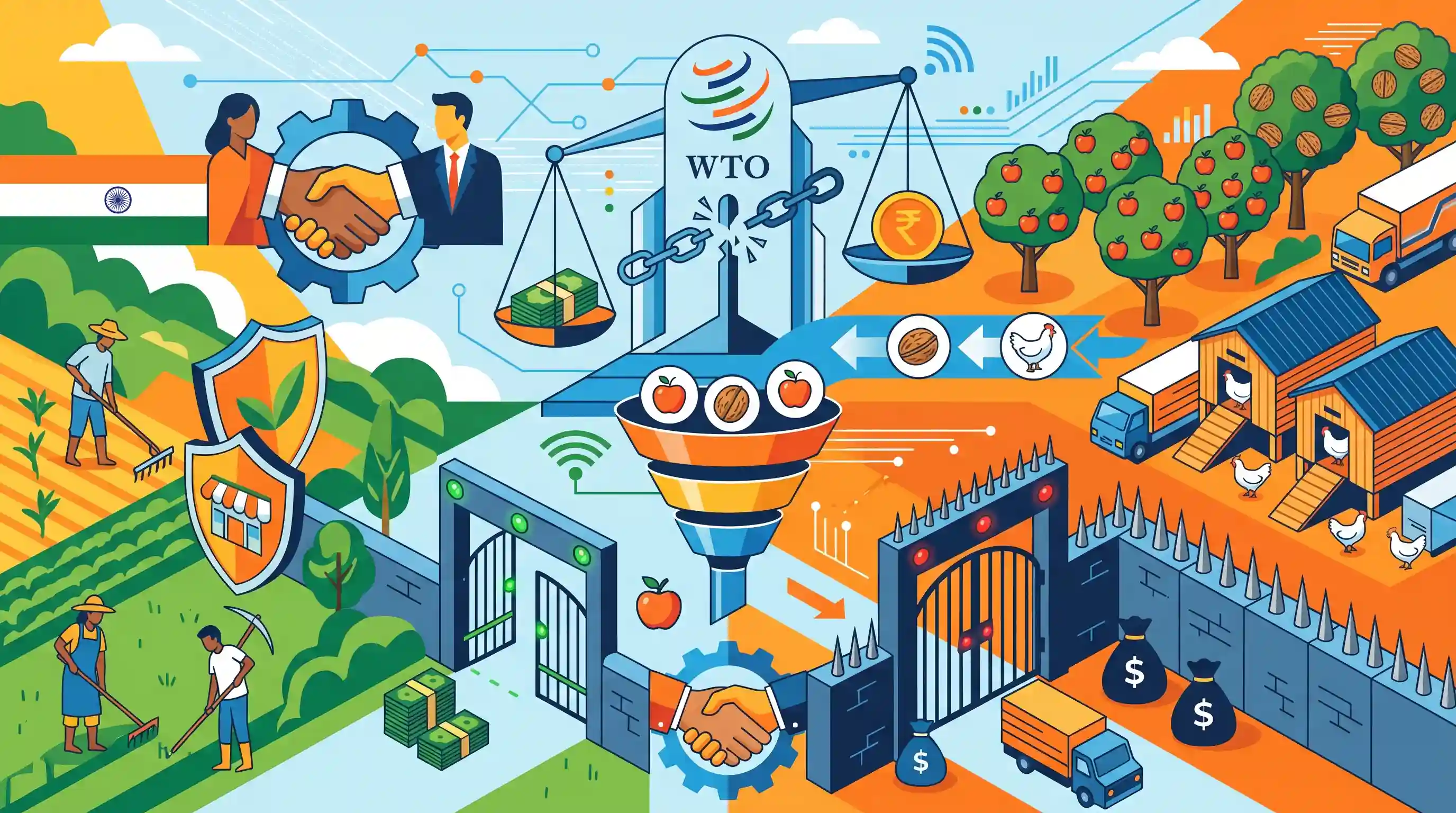
It illustrates a practical mechanism (TRQs) used in trade diplomacy to resolve the classic conflict between globalization (expanding international trade partnerships) and protectionism (safeguarding vulnerable domestic agricultural markets), which is a recurring theme in GS3.
Summary
In the context of the evolving India-US bilateral trade relationship, Ashok Gulati discusses how both nations are navigating the complexities of agricultural trade. To resolve outstanding WTO disputes and strengthen strategic partnerships, India has agreed to open its agricultural sector to US products like apples, walnuts, and poultry. However, this is being done cautiously through the use of Tariff Rate Quotas (TRQs). TRQs allow limited quantities of imports at reduced tariffs, striking a balance between liberalizing trade with a key geopolitical partner and protecting domestic farmers from a sudden influx of subsidized foreign produce.
Key Points
- India and the US are cautiously opening their agricultural trade by leveraging Tariff Rate Quotas (TRQs) rather than opting for blanket free trade.
- The TRQ mechanism allows a predetermined quantity of an agricultural commodity to be imported at a lower tariff, protecting local markets from a glut while opening avenues for trade.
- This cautious approach is necessary to safeguard domestic Indian farmers from heavily subsidized agricultural imports from the US, such as apples, walnuts, and poultry.
- The resolution of historical WTO trade disputes between India and the US has paved the way for these bilateral trade compromises, prioritizing strategic ties while respecting domestic political realities in agriculture.
Important Terms
Tariff Rate Quotas (TRQs)

A trade policy tool where a lower tariff applies to a specific quantity of imports, while a higher duty applies to any volume exceeding that limit.
UPSC context
GS Paper III (Economy/Agri). Tests understanding of instruments used to balance trade liberalization with the protection of domestic producers.
Agreement on Agriculture (AoA)
A WTO treaty aimed at reforming global agricultural trade by reducing trade-distorting subsidies and barriers across three pillars: market access, domestic support, and export competition.
UPSC context
GS Paper III (Subsidies/MSP). Essential for understanding India’s food security concerns and global trade negotiations.
World Trade Organization (WTO)
The global intergovernmental organization that regulates international trade, facilitates the negotiation of trade agreements, and provides a legal framework for resolving trade disputes.
UPSC context
GS Paper II (International Institutions). A core topic for global governance, trade disputes, and multilateralism.
Sanitary and Phytosanitary (SPS) Measures
Regulations designed to protect human, animal, or plant health from pests and diseases, which must be based on scientific evidence to prevent unfair trade barriers.
UPSC context
GS Paper III (Agri/Trade). Relevant for non-tariff barriers, specifically in India-US agricultural disputes like poultry.
Market Access
The conditions, including tariff and non-tariff measures, under which a country permits the entry of foreign goods into its domestic market.
UPSC context
GS Paper III (Economy). Fundamental concept in trade deals, testing understanding of trade openness vs. protectionism.
Prelims Trap
A Tariff Rate Quota imposes an absolute limit on the total volume of an agricultural commodity that can be imported.
TRQs do not legally cap total imports. They only apply a lower tariff to a specific volume; anything above that faces a much higher tariff. It is a two-tiered tariff, not an absolute ban.
Static Concepts Connected
What are the WTO Agreement on Agriculture (AoA) subsidy boxes and limits?
- Amber Box: Trade-distorting subsidies like MSP and fertilizer support that directly influence production and are subject to reduction commitments.
- De minimis limit: The ceiling for Amber Box subsidies, capped at 10% of total agricultural production value for developing nations (like India) and 5% for developed nations.
- Peace Clause: An interim shield protecting developing nations from WTO disputes if their public stockholding (food security programs) breaches the 10% subsidy limit.
How does a Tariff Rate Quota (TRQ) function in international trade?
- Two-tiered tariff: A specific predetermined volume of imports enters at a lower, concessional tariff, while any imports exceeding that quota face a significantly higher safeguard tariff.
- WTO tariffication: Introduced to replace opaque non-tariff barriers (like absolute quotas) with transparent tariff equivalents, adhering to the WTO mandate to liberalize trade cautiously.
Cross-Topic Patterns
Indo-US Trade vs Strategic Convergence
India leverages minor agricultural trade concessions (like apples and poultry via TRQs) to cement critical defense and technology partnerships, demonstrating how bilateral trade compromises serve broader geopolitical goals.
Domestic MSP vs WTO Commitments
India's domestic farmer protests demanding legalized MSP clash directly with US complaints at the WTO regarding India's breach of the 10% de minimis agricultural subsidy limit under the AoA.

Expect a 2026 Prelims question contrasting TRQs with Quantitative Restrictions, linked to WTO AoA de minimis limits and 1986-88 baselines.
Linked PYQs · 3
Linked PYQs · 3
- 2023MainsGS3
What are the direct and indirect subsidies provided to farm sector in India? Discuss the issues raised by the World Trade Organization (WTO) in relation to agricultural subsidies.
- 2016MainsGS2
The broader aims and objectives of WTO are to manage and promote international trade in the era of globalization. But the Doha round of negotiations seem doomed due to differences between the developed and the developing countries." Discuss in the Indian perspective.
- 2015PrelimsGS1
The terms 'Agreement on Agriculture', 'Agreement on the Application of Sanitary and Phytosanitary Measures' and 'Peace Clause' appear in the news frequently in the context of the affairs of the
